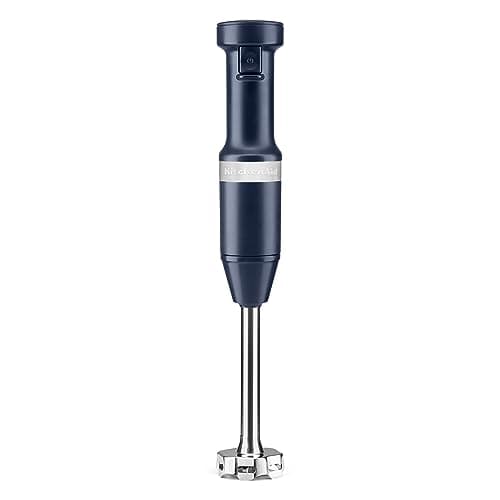
The KitchenAid Variable-Speed Corded Hand Blender (KHBV53) solves a problem the specification sheets of this category rarely mention: depth. Most stick blenders are built around a saucepan. Put one in a tall stockpot of soup and you either tilt the pot — with three liters of scalding liquid in it — or you plunge your hand toward the surface. An 8-inch removable arm reaches the bottom of a full pot with your hand well clear, and that is the entire reason to buy this one.
Reach is a safety feature, not a convenience
The hazard in blending soup is not the blade; it is the volume of hot liquid and how close your hand is to it. A short shaft forces a compromise: either you tip the pot toward you, or you work with the motor body only a couple of inches above the surface, where a burst of steam or a splash lands on your wrist. The extra reach removes that compromise entirely. Our hot-liquid guide makes the same point at length: most of the risk in this job is geometry.
The removable pan guard is the second thoughtful piece. It is a plastic ring around the bell that stops the metal skirt scraping a non-stick surface. If you blend in a coated pan — and most people do — that is the difference between the pan surviving and not.
180 watts, in context. That is a published continuous figure, and at 3 minutes a day, 365 days a year it costs about $0.57 a year to run at 17.45¢ per kWh. Electricity is never the reason to choose between these machines. The figure matters as a capability ceiling: it is comfortably enough for soup, and it is genuinely modest against the 600 watts of the All-Clad when the job is a stiff puree.
Where the modest motor shows
On thin and medium soups — tomato, squash, lentil, potato and leek — you will not notice it. On genuinely thick loads it is the limit of the machine: stiff hummus, a dense bean puree, anything where the mixture stops flowing back around the bell. The blender does not fail so much as stop making progress, because the food is not circulating.
The fix for that is technique before hardware: add liquid, work in a narrower vessel so the mixture has to pass the blade, and move the head in small lifts rather than holding it still. But if thick purees are your regular job, the honest recommendation is the All-Clad Stainless Steel Immersion Blender from our main ranking, or a food processor, which is the right tool for a paste that will not flow.
How it compares
Against Braun MultiQuick 7 (MQ7035X), our overall pick: the Braun’s splash-control bell and trigger-pressure speed control are more pleasant to use, and it bundles a whisk and a chopper bowl. The KitchenAid answers with reach and a more solid metal body. Against MuellerLiving Ultra-Stick 500W Immersion Blender: the Mueller has more published watts and more attachments for much less money, and gives up build quality and arm length. Against the Breville Control Grip: similar philosophy — both are designed around handling rather than raw power.
KitchenAid also builds this design without the cord: the Go KHBRV71 keeps the removable arm, the variable-speed trigger and the pan guard, drops the arm to 7 inches, and runs on a removable 12V MAX battery that ships in the box. It is our pick on the cordless immersion blender page, which is the place to go if the cord over the burner is the thing that bothers you about this one.
The buying summary: deep pots and non-stick pans, this one. Thick purees, buy more motor. Everything else, read the full ranking.
How we picked
Tools we claim to have lab-tested: 0
Every site in this category tells you they ran twenty machines through a lab. We have not, and we say so. Here is what we do instead: read the manufacturer's manual and spec sheet, record the published bowl capacity, motor rating, blade and disc counts and materials, cross-check the warranty against the manufacturer's own warranty document, and cite all of it so you can check the work. Prices come live from Amazon's API and disappear rather than go stale.
The scores above are judgments from that documented research — not test results. The full rubric, including what disqualifies a product, is published in full.