HUB 06 · Guides
Granite vs Marble Mortar and Pestle
This is a question about rock, and rock has published properties. One of these stones is harder than kitchen steel and the other is softer than it — which settles most of the argument before you get to price.
We earn a commission if you buy through our links. It does not change the price you pay, and it does not decide our picks — our selection criteria are published in full. How this works.
Buy granite. It is harder, heavier and chemically inert, and for everything people actually use a mortar for — whole spices, curry paste, pesto, garlic and salt — it is the better stone by a clear margin. The Kota Japan Large Black Granite Mortar & Pestle is the one we would buy. Marble is a reasonable second choice in exactly one situation: you want a small, cheap, good-looking mortar for soft dry spices and nothing else, in which case the Fox Run Marble Mortar and Pestle Set (4 in) is a 4-inch, 1.9 lb bowl that lives in a drawer.
The hardness problem, in numbers
Marble is metamorphosed limestone, which means it is essentially calcite— calcium carbonate, CaCO3. Calcite sits at 3 on the Mohs hardness scale. For comparison, the same scale puts ordinary steel at 4 to 4.5 and quartz at 7. Granite is a rock rather than a single mineral — it is a mixture, mostly quartz and feldspar, each with its own hardness — which is why mineralogists are careful about assigning it a single number; some sources put it at 6 to 7.
Read those figures back and the practical conclusion arrives on its own. A marble mortar is made of a mineral softer than a kitchen knife. A granite mortar is made largely of minerals harder than one. When you press a peppercorn against a bowl wall with a few pounds of force, the question of which gives way first is not rhetorical.
In use this shows up as three things. Marble wears: the inside of a hard-used marble mortar slowly smooths, and a smooth mortar stops grinding. Marble chips: a sharp blow on an edge takes a flake out of calcite far more readily than out of quartz. And marble sheds more of itself into what you are grinding, for longer, which is the part people notice first.
The acid problem, which matters more than the hardness
Calcium carbonate reacts with acid. That is not a kitchen-blog claim, it is the defining chemical property of the material — it is why vinegar fizzes on limestone and why acid-based cleaners are not used on marble worktops.
A mortar is a tool you put lemon juice, lime, tomatillo, tamarind and vinegar into. In a granite bowl none of that matters. In a marble bowl, repeated contact with acidic ingredients etches the surface — dulling the finish and, over time, smoothing exactly the roughness that makes the tool work. If you want to make guacamole with lime or a tomatillo salsa, marble is the wrong bowl, and this is a better reason to avoid it than hardness is.
Side by side
| Factor | Granite | Marble |
|---|---|---|
| What it is | Igneous rock, mostly quartz and feldspar | Metamorphosed limestone — calcite, CaCO3 |
| Mohs hardness | Assigned 6–7 by some sources | Calcite is 3 — below ordinary steel at 4–4.5 |
| Reacts with acid | No | Yes — etches with citrus, vinegar, tomatillo |
| Hard spices, peppercorns, dry chilli | Yes | Workable, with less force and more patience |
| Fibrous pastes (lemongrass, galangal) | Yes | Not really — needs pounding force marble resents |
| Typical weight in this category | About 4–8 lb in the sets we rank | Under 2 lb in the set we rank |
| Stays still on the counter | Yes, and that is half the point of stone | Light ones shift when you lean in |
| Stores in a drawer | No | Yes, at 4 inches |
| Price | Low to moderate | Lowest here |
Check the stone claim, because one of these listings cannot keep it straight. Fox Run Marble Mortar and Pestle Set (4 in)calls itself marble in its title and granite in two of its own bullet points. We have left that on its card rather than quietly picking the answer we preferred, because it is exactly the kind of thing a buyer should know: when a maker contradicts itself about the material, the material is not a claim you can rely on. It still earns a place for a different reason — it states an unpolished, rough interior, which is the one specification that actually predicts whether a mortar grinds.
What actually decides it: unpolished, not granite
Here is the part that gets lost in granite-versus-marble arguments. A rough marble mortar will out-grind a polished granite one every time. Polish is the failure mode in this category, not stone choice: a glossy interior gives ingredients nothing to catch on, so they slide and nothing breaks down. Stone type is the second question. The first is whether the interior is unpolished, and whether the pestle tip is too — Cole & Mason Granite Mortar & Pestle (5 in) is the only listing we have found that states both, which is why it is our pick for spices despite holding only about a cup.
So the order of operations when buying is: unpolished first, granite second, weight third, published dimensions fourth. Our mortar and pestle roundup ranks five sets in exactly that order, and whichever stone you end up with, season it with rice before the first thing you make.
And the third option nobody asks about
Volcanic lava rock— the traditional Mexican molcajete — is a genuine third material and it is better than both of these at one specific job. It is far more porous than either granite or marble, so it grips soft, wet ingredients instead of letting them slide, which is why guacamole and roasted salsa are its home ground. The trade-off is in its own listing: it must be cured before use, it is the slowest of the three to stop shedding, and an open porous bowl is the wrong shape for a teaspoon of coriander seed. If your mortar is for dips rather than spices, that is the one to look at.
What to avoid in all cases: ceramic, glass and wood. Ceramic and glass are hard but smooth, so they slide rather than grind, and glass can crack under a real blow. Wood is porous in the wrong way — it takes up oil and flavour permanently, so the cumin you ground in March turns up in the pesto in July. If you are weighing a mortar against a machine instead, that comparison is mortar and pestle vs food processor.
The hardware
The hardware this guide is about
The products this guide refers to, with prices pulled live from Amazon and dated on every card. Full rankings live in the roundups linked above.
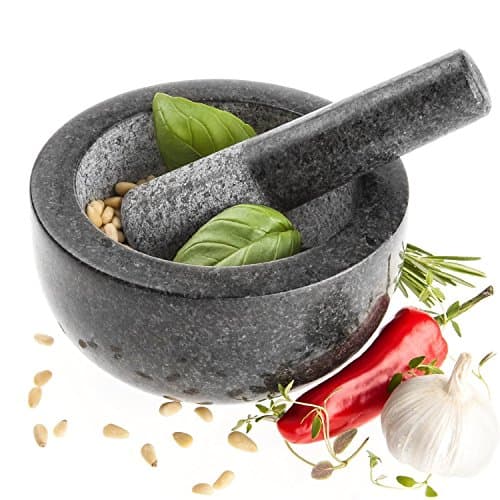
Most kitchens
Kota Japan Large Black Granite Mortar & Pestle
The set that publishes the number nobody else does: the interior bowl size, in unpolished granite, so you know what actually fits before it arrives.
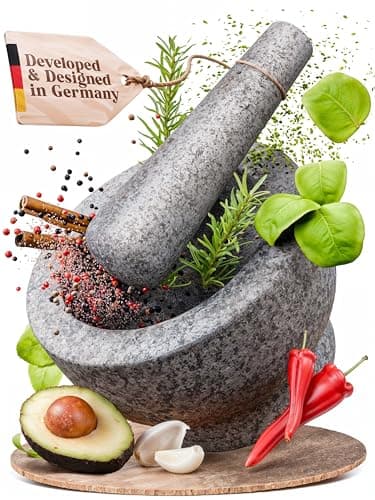
A first granite mortar
ChefSofi Granite Mortar and Pestle Set (2 cups)
The same unpolished granite and the same 2-cup bowl as our top pick, for a little less — bought on the stone rather than on the spec sheet.
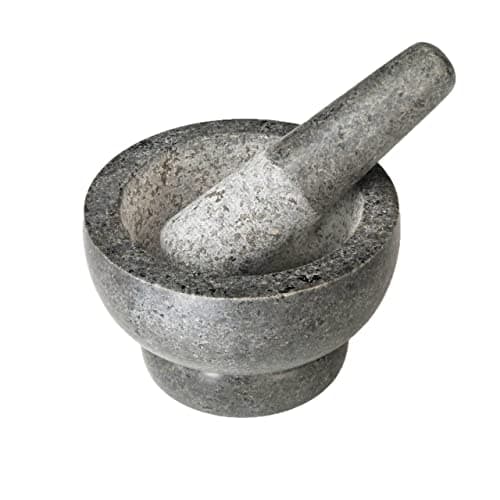
Spices and small batches
Cole & Mason Granite Mortar & Pestle (5 in)
The only listing here that says the pestle tip is unpolished as well as the bowl — which is the half of the equation most makers leave out.
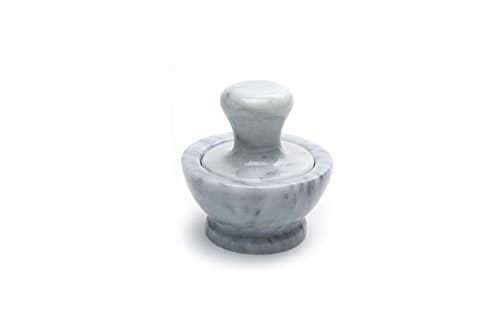
Dry spices, smallest budget
Fox Run Marble Mortar and Pestle Set (4 in)
The cheap, small one that still gets the important part right: a rough, unpolished interior, in a 4-inch bowl that lives in a drawer.
#ad · As an Amazon Associate we earn from qualifying purchases.
Questions
Frequently asked
Is granite or marble better for a mortar and pestle?
Will a marble mortar get damaged by lemon or vinegar?
Does a heavier mortar grind better?
Can you tell granite from marble by looking?
What about a polished granite mortar?
Keep reading
Related
Receipts
Sources
We do not run a testing lab and we do not pretend to. Specifications come from the manufacturer's own published documents and from published standards; prices come from the live Amazon API. Where a figure is not published, the page says “not published” rather than guessing. Read the full method.