Skip to content
TheBench

HUB 04 · Immersion Blenders

The Best Immersion Blenders Under $50

Fifty dollars is the line where published watts and bundled attachments stop moving in the same direction as brand and build. Four sticks that puree a pot of soup properly, and a plain account of what each one gives up to land under the line.

By Stephen V.Updated How we pick
#ad

We earn a commission if you buy through our links. It does not change the price you pay, and it does not decide our picks — our selection criteria are published in full. How this works.

The short answer

Quick picks

#ProductBest forScorePrice
01
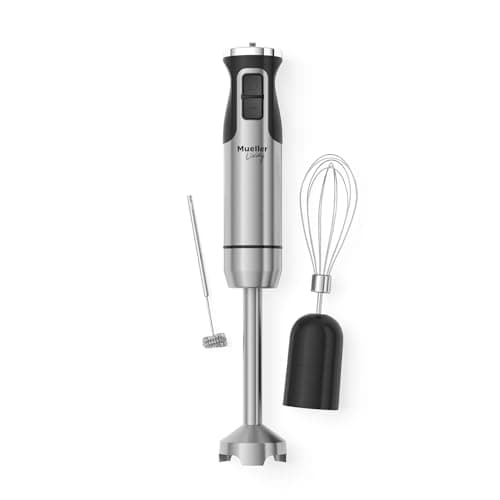
Mueller MuellerLiving Ultra-Stick 500W Immersion Blender
MuellerLiving Ultra-Stick 500W Immersion Blender

The budget champion: a 500-watt, nine-speed stick with whisk and chopper for the price of a basic model.

Best cheap immersion
8.3
$31.99Amazon
02
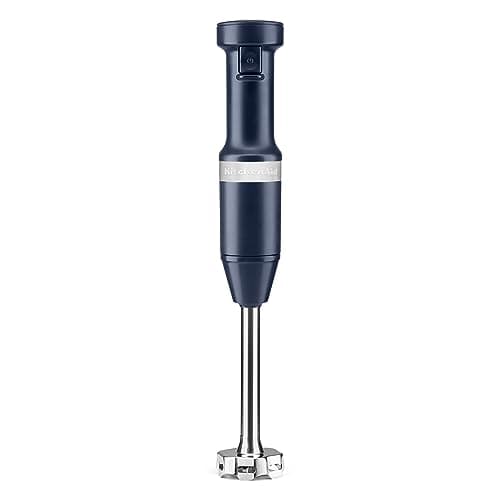
KitchenAid KitchenAid Variable-Speed Corded Hand Blender (KHBV53)
KitchenAid Variable-Speed Corded Hand Blender (KHBV53)

The reach specialist: an 8-inch blending arm that gets to the bottom of a tall stockpot, in solid KitchenAid metal.

Deep pots
8.1
$49.99Amazon
03
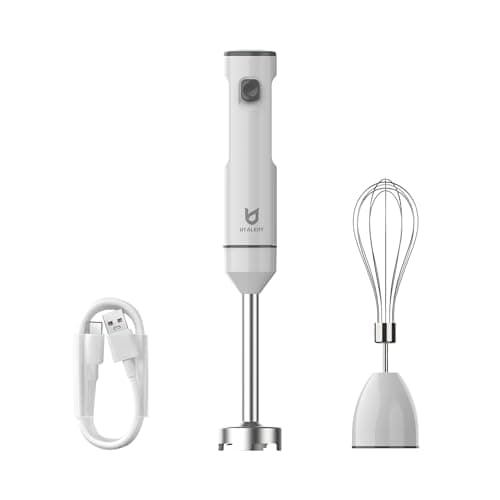
UTALENT UTALENT Cordless Hand Blender with Whisk (TL6001)
UTALENT Cordless Hand Blender with Whisk (TL6001)

The budget cordless that publishes more about itself than the big brands: a runtime claim with its basis, a charge time, a weight, and the one limit the others leave out — it will not run while it charges.

Best value
8.2
$42.49Amazon
04
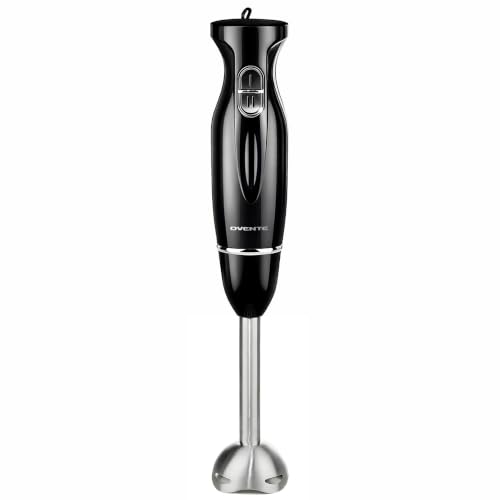
OVENTE OVENTE Electric Corded Hand Blender (HS560B)
OVENTE Electric Corded Hand Blender (HS560B)

The floor of the category: a 300-watt, two-speed corded stick that purees a pot of soup and does nothing else.

Cheapest working stick
6.3
$14.99Amazon

#ad · Prices pulled live from the Amazon Product API, last checked November 23, 2026. Where we have no verified live price we show none — we would rather leave a gap than print a number that has gone stale. Scores are our own, compiled from published specs; they are not test results.

Under $50 the decision is not brand against generic. It is whether you want published watts and a full attachment set or metal, reach and a name, because at this price those two things come from different machines. The MuellerLiving Ultra-Stick 500W Immersion Blender is the first of them: 500 published watts, nine speeds plus turbo, and both a whisk and a chopper in the box. The KitchenAid Variable-Speed Corded Hand Blender (KHBV53) is the second, and the only major brand that still lands inside the band. If the cord is the thing you want gone, the UTALENT Cordless Hand Blender with Whisk (TL6001)is the cordless pick that fits, and the budget pick — the cheapest stick here that still publishes a motor figure — is the OVENTE Electric Corded Hand Blender (HS560B).

Every price in the table above is read live from Amazon with the date it was last checked. We never print a number we cannot verify, so a blank price means “check” rather than a stale figure. The $50 line is our editorial band, not a claim about today’s price — read the live figure before you buy, because sticks at this end of the market cross it in both directions, and two of them had crossed it when this page was written.

What actually changed at the $50 line

This is the useful part, and it is specific. Our under-$100 ranking puts two mid-band machines in the middle of its order: the Cuisinart Smart Stick and the Toogel cordless. Both were live above$50 when we checked for this page. So the sub-$50 band is not the bottom four of that list. It contains one generic 500-watt stick, one major-brand corded model, one cordless model and the floor of the category — four machines that answer four different questions rather than four versions of the same answer.

The second change is more interesting: cordless now fits. When we wrote the cordless roundupthe whole category sat above this band. One of those machines is now inside it, which makes “do I want to lose the cord?” a question a sub-$50 buyer can genuinely ask for the first time.

How we drew the line at $50

  • Currently purchasable, at a real price. Every pick was checked for availability and a live Amazon price before it was written up. A stick that is nominally cheap and permanently out of stock is not a cheap stick.
  • A published wattage, or it does not rank. All four of these makers state a motor figure in their own listing, which is why all four carry a running-cost number further down this page. Cordless machines that publish nothing at all are covered on the cordless page, where the absence is the story; in a price band, an unpublished motor is a disqualification.
  • A real speed control. Two speeds is the floor. A single on/off button turns a soup to water before you have finished thinking about it, and nothing on this page has one.
  • Limits the maker will put in writing.The most useful thing a cheap machine can publish is what it will not do. The UTALENT states that it cannot run while it charges — a sentence most cordless listings leave out — and we rate that higher than a bigger number on the box.
  • No pick on this page claims a bell. The splash-control guard that keeps soup off your ceiling is a feature of the machines in the main roundup. Pretending otherwise at this price would be the easiest way to mislead you, so it is stated here instead.

The watts trap at this price

The 500-watt generic on this page publishes nearly three times the motor figure of the major-brand pick, which states 180 watts. That is a real difference and it is also a genuinely misleading one, because wattage is an input, not an output. It tells you what the motor draws, not how much of that reaches the blade, how the blade is shaped, or how deep the shaft reaches. A well-geared 180-watt stick with a long arm will puree a pot of soup more neatly than a loud 500-watt one that cannot reach the bottom of the pot.

What the number does tell you honestly is running cost, because that arithmetic only needs the draw. At the national average rate this site uses, the 500-watt pick costs about $1.65 a year, the 180-watt KitchenAid about $0.59, and the 300-watt floor model about $0.99— on the same assumption of light daily use. Those are rounding errors against the purchase price, which is the real answer to “is a powerful stick blender expensive to run?”. It is not. Buy on control and reach.

Which one, for which kitchen

Buy the MuellerLiving Ultra-Stick 500W Immersion Blenderif you want the most machine for the least money and you would rather have the attachments than the badge. Nine speeds plus turbo is more granular control than anything else here, and the whisk and chopper in the box genuinely displace two other gadgets — the chopper cup handles herbs, nuts and a single onion, which is the job most people buy a food chopper for. The honest cost is the build: it is plastic-heavy next to the metal-bodied sticks, and its longevity is less proven than a Braun or a KitchenAid.

Buy the KitchenAid Variable-Speed Corded Hand Blender (KHBV53) if your pots are deep or you want metal in your hand. Its 8-inch removable blending arm is the longest reach on this page, matched only by the cordless pick, and the removable pan guard is there to keep the blade off a non-stick surface. It is the machine we already recommend for deep pots in the soup ranking. The cost is the motor: 180 watts is the lowest published figure here, so stiff purees and nut butters are out of scope — see the emulsifying page for where that ceiling starts to bite.

Buy the UTALENT Cordless Hand Blender with Whisk (TL6001)if the cord over a hot burner is what you want gone. It is the only cordless machine inside this band, it states the basis of its runtime claim — 60 bowls of soup, measured as 15 batches of 12-ounce tomato basil soup — which is more than the big cordless brands publish, and it has the same 8-inch detachable arm as the KitchenAid. Two things to know before you buy: it ships with a whisk but no beaker, and it cannot run while it is charging, which the maker states plainly and we repeat because a dead battery mid-soup has no workaround.

Buy the OVENTE Electric Corded Hand Blender (HS560B)— the budget pick — if you want the cheapest thing on this page that still does the one job properly. Three hundred published watts, two mixing speeds, stainless blades, corded. What you are buying is the wand: the listing names no whisk, no chopper cup and no beaker, so if any of those matter to you, the 500-watt pick above is the better buy for not much more. It is the right answer for a second kitchen, a rental, or a cook who purees soup four times a year.

Hot soup and a stick blender need one rule.Keep the blade fully submerged before you pull the trigger and do not lift it while it is spinning. A stick blender in a pot of near-boiling liquid is the most common way people get hurt with one of these, and it is entirely avoidable — the hot-liquid safety guide is five minutes well spent, whichever of these you buy.

What you give up against the $100 band

Three things, in the order you will notice them. First, the splash-control bell: a shaped guard at the blade end that keeps soup in the pot and the blade off your pan. Nothing under $50 has one. Second, a pressure-sensitive trigger— speed that glides with finger pressure instead of stepping through a dial, which matters more than it sounds when you are trying not to aerate a puree. Third, a metal body on a strong motor at the same time: under $50 you can have one or the other, and the two mid-band machines that used to bridge that gap have both moved out of the band.

What you are notgiving up is the everyday job. A blade spinning in a pot is a blade spinning in a pot: a cheap stick purees a lentil soup as smoothly as an expensive one, because the soup does the work of not resisting. The expensive machine wins on control, on mess, and on the tenth year of daily use — which is exactly the list above. If you expect to use it daily, read the under-$100 band before you decide.

Corded or cordless, under $50

With one cordless model in the band, this is now a real question rather than a theoretical one. Cordless wins on the two things people complain about with stick blenders: the cord draping across a hot burner, and the socket that is never where the stove is. It loses on three. A battery machine publishes no wattage, so you cannot compare its motor with a corded one on any number at all. It has a runtime, which means it can run out mid-job and — in this case explicitly — cannot be plugged in and used while it recharges. And the battery is the part that ages: a corded stick is as strong in year five as in week one.

Our reading is simple. If you puree one pot at a time, cordless is a genuine convenience win at this price. If you batch-cook, or if the machine will be shared and nobody will remember to charge it, buy corded and spend the difference on the attachments that earn their space. For the full cord-free field, including the models above this band, see the cordless roundup.

What a sub-$50 stick will not replace

An immersion blender is a puree tool. It is excellent at soup, smoothies, sauces, mayonnaise and baby food, and it is the wrong tool for anything you want to come out in pieces or in even slices. It will not slice a potato, shred a block of cheese, make a pastry dough or grind meat, and no amount of watts changes that — the geometry is wrong. If that is the job, a processor in the same price band is the better buy: the food processors under $50 page ranks the one machine in that band with a real feed chute and a slicing disc, and immersion blender against food processor works through the division of labor properly. If you are weighing a stick blender against buying nothing at all, our alternatives to an immersion blender page ranks the tools that take over most of its work.
In detail

The picks, in full

01
Mueller MuellerLiving Ultra-Stick 500W Immersion Blender

Best cheap immersion

MuellerLiving Ultra-Stick 500W Immersion Blender

500 W at a budget priceWhisk + chopper
8.3/10

The budget champion: a 500-watt, nine-speed stick with whisk and chopper for the price of a basic model.

Power
8.5
Reach & build
7.2
Attachments
8.5
Ease of clean
8
Value
9.2

What it gets right

  • A lot of watts and a full attachment set for very little money
  • Nine speeds give real control at this price
  • Whisk and chopper included

What it doesn't

  • Build is plastic-heavy compared with the metal-bodied sticks
  • Longevity is less proven than Braun or KitchenAid

What it costs to run

About $1.65 a year in electricity, at 3 minutes a day, 365 days a year and 18.04¢ per kWh.

500 W, printed in the product title and listing. The full arithmetic is published.

Skip this if…

…You want a blender that lasts a decade of daily use — a metal-bodied Braun or KitchenAid is the safer long-term buy.

$31.99on Amazon

$39.9920% off

Price last checked November 23, 2026. Prices move constantly — Amazon's at checkout is the one that counts.

#ad · we may earn a commission from this link to MuellerLiving Ultra-Stick 500W Immersion Blender

02
KitchenAid KitchenAid Variable-Speed Corded Hand Blender (KHBV53)

Deep pots

KitchenAid Variable-Speed Corded Hand Blender (KHBV53)

Long 8-inch arm
8.1/10

The reach specialist: an 8-inch blending arm that gets to the bottom of a tall stockpot, in solid KitchenAid metal.

Power
7.5
Reach & build
9
Attachments
7.5
Ease of clean
8.5
Value
8

What it gets right

  • The long arm reaches the bottom of tall pots without tilting them
  • Solid metal build feels premium and durable
  • Removable pan guard protects non-stick surfaces

What it doesn't

  • 180 watts is on the lower side for very thick purees
  • Fewer bundled attachments than the Braun

What it costs to run

About $0.59 a year in electricity, at 3 minutes a day, 365 days a year and 18.04¢ per kWh.

180 W, the figure KitchenAid lists for the KHBV53 and shown on the listing. The full arithmetic is published.

Skip this if…

…You blend thick, heavy mixtures like nut butters or stiff hummus — this modest motor is happier with soups than dense loads.

$49.99on Amazon

$69.9929% off

Price last checked November 23, 2026. Prices move constantly — Amazon's at checkout is the one that counts.

#ad · we may earn a commission from this link to KitchenAid Variable-Speed Corded Hand Blender (KHBV53)

03
UTALENT UTALENT Cordless Hand Blender with Whisk (TL6001)

Best value

UTALENT Cordless Hand Blender with Whisk (TL6001)

Runtime basis stated8-inch armNo beaker in the box
8.2/10

The budget cordless that publishes more about itself than the big brands: a runtime claim with its basis, a charge time, a weight, and the one limit the others leave out — it will not run while it charges.

Battery & runtime
8.2
Power & control
8
Attachments
7.4
Ease of clean
8.4
Value
9.2

What it gets right

  • States the basis of its 60-bowl runtime claim — the bowl size, the batch count and the soup — which most cordless listings, including the big brands, do not
  • The longest arm on the page at 8 inches, matching the corded KitchenAid that is our deep-pot pick
  • Publishes its weight (1.4 lb with the arm) and fits an unlock button against accidental starts

What it doesn't

  • The battery is not described as removable, so when it fades the tool goes with it
  • No beaker in the box; the same TL6001 sold as a kit adds a 600 ml vessel and a 500 ml chopper for a little more
  • 3.5 hours to a full charge, and it cannot run on the cable while it charges

What it costs to run

UTALENT publishes no usable wattage for this machine, so we do not show a running-cost figure for it. Here is the method we would have used.

Skip this if…

…You want a battery you can swap or replace — this one is built in, and the KitchenAid Go is the pick if the blender should outlive its first battery.

$42.49on Amazon

$49.9915% off

Price last checked November 23, 2026. Prices move constantly — Amazon's at checkout is the one that counts.

#ad · we may earn a commission from this link to UTALENT Cordless Hand Blender with Whisk (TL6001)

04
OVENTE OVENTE Electric Corded Hand Blender (HS560B)

Cheapest working stick

OVENTE Electric Corded Hand Blender (HS560B)

Published 300 WNo attachments named in the listing
6.3/10

The floor of the category: a 300-watt, two-speed corded stick that purees a pot of soup and does nothing else.

Power
6
Reach & build
5.8
Attachments
3.5
Ease of clean
7.5
Value
8.8

What it gets right

  • The cheapest stick on the page that still publishes a wattage
  • Two speeds rather than a single on/off button, which matters for soup
  • Light enough to hold over a pot one-handed

What it doesn't

  • The listing names no whisk, chopper or beaker — you are buying the wand only
  • 300 W is the lowest published motor here, so dense or fibrous jobs are slow
  • Plastic housing and no published shaft length

What it costs to run

About $0.99 a year in electricity, at 3 minutes a day, 365 days a year and 18.04¢ per kWh.

300 W, printed in the product title and listing. The full arithmetic is published.

Skip this if…

…You want a whisk or a chopper bowl in the box — the MuellerLiving ships both for roughly twice the money.

$14.99on Amazon

Price last checked November 23, 2026. Prices move constantly — Amazon's at checkout is the one that counts.

#ad · we may earn a commission from this link to OVENTE Electric Corded Hand Blender (HS560B)

How we picked

Tools we claim to have lab-tested: 0

Every site in this category tells you they ran twenty machines through a lab. We have not, and we say so. Here is what we do instead: read the manufacturer's manual and spec sheet, record the published bowl capacity, motor rating, blade and disc counts and materials, cross-check the warranty against the manufacturer's own warranty document, and cite all of it so you can check the work. Prices come live from Amazon's API and disappear rather than go stale.

The scores above are judgments from that documented research — not test results. The full rubric, including what disqualifies a product, is published in full.

Questions

Frequently asked

Is a $50 immersion blender worth buying?
For pureeing soup, blending smoothies, whisking cream and making mayonnaise, yes. All four picks here publish a motor figure and have at least two speeds, which is the floor for real control. What you give up against a premium stick is the splash-control bell, the pressure-sensitive trigger and a metal body on a strong motor — not the ability to do the everyday jobs.
How many watts does an immersion blender need?
Fewer than the marketing implies. The major-brand pick on this page states 180 watts and is our deep-pot recommendation; the 500-watt generic is stronger on paper and noisier in practice. Wattage is what the motor draws, not what reaches the blade, so treat it as one input among shaft length, blade shape and speed control rather than as a score. For thick nut butters and stiff purees, none of these four is the right machine.
Can you get a cordless immersion blender under $50?
One, at the time of writing: the UTALENT Cordless Hand Blender with Whisk (TL6001), which is the only cord-free machine we found inside the band with a live price. It states its runtime basis, charges over USB-C in about three and a half hours, and cannot be operated while charging. Every other cordless model we track sits above $50 — they are ranked on the cordless page.
What is the difference between a cheap and an expensive immersion blender?
Control and containment, not blending ability. Expensive sticks add a bell-shaped splash guard, a trigger that varies speed with finger pressure, a stiffer metal body and usually a longer warranty. Cheap sticks blend the same pot of soup. The gap shows up in mess, in fine control over texture, and in how the machine feels after several years of use.
Does a cheap immersion blender come with a whisk and chopper?
Some do and some are the wand alone, and it is the single most important thing to check at this price. The MuellerLiving Ultra-Stick 500W Immersion Blender includes both a whisk and a chopper; the UTALENT Cordless Hand Blender with Whisk (TL6001) includes a whisk but no beaker; the OVENTE Electric Corded Hand Blender (HS560B) listing names no attachments at all. Our attachments guide covers which ones are worth the cupboard space.
Should I buy an immersion blender or a food processor under $50?
They are different tools. A stick blender purees in the pot and makes smooth things smooth; a processor chops, slices and shreds and makes food into pieces. If your cooking is soup, sauce and smoothies, buy the stick. If it is vegetable prep, buy the processor — the food processors under $50 page covers that band, and only one machine in it has a real slicing disc.

Keep reading

Receipts

Sources

We do not run a testing lab and we do not pretend to. Specifications come from the manufacturer's own published documents and from published standards; prices come from the live Amazon API. Where a figure is not published, the page says “not published” rather than guessing. Read the full method.