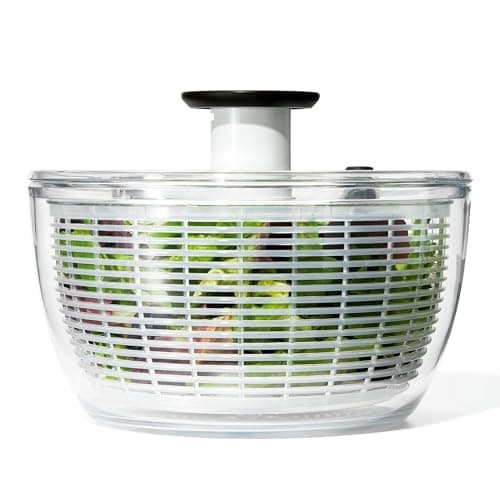
A salad spinner is a simple machine with one job, which means the design details decide everything. The OXO Good Grips Salad Spinner (Large) is built around three of them: a pump you press with one hand, a brake button that stops the basket on demand, and a non-slip ring under the bowl so the whole thing does not travel across the counter while you do it. Those three together are why this is the spinner that gets used on a Tuesday rather than the one that lives at the back of a cupboard.
Wet greens are the reason salads fail. Dressing is oil-based and water repels it, so a wet leaf sheds its dressing into a puddle at the bottom of the bowl instead of holding a coating. Wet greens also wilt faster in the fridge, because the surface water accelerates breakdown. Drying is not a finishing touch — it is the step that makes the other steps work.
The pump is the design
OXO’s stated mechanism is a one-hand pump with a brake button. That phrasing is doing more work than it looks like. Pull-cord spinners need one hand on the lid and one hand steadying the bowl, and crank spinners need the same — which means a spinner is a two-hand appliance at the exact moment your other hand wants to be doing something else. A pump you press straight down lets the bowl stay put under its own weight plus the force you are applying, so one hand genuinely does the job.
The brake button is the other half of it. Without a brake, a loaded basket free-spins for a long time after you stop driving it, and you either wait or you grab it. With one, you press, it stops, you lift the lid. Both the OXO and its main rival the Zyliss have a brake; cheap spinners frequently do not, and it is the first thing to check on anything not on that list.
The bowl earns its cupboard space
The single best thing about this particular spinner has nothing to do with spinning: OXO states the outer bowl doubles as a serving bowl. A salad spinner is a bulky object that does one job for thirty seconds. One that is also a bowl you would put on a table does two jobs, and the cupboard arithmetic changes completely.
The basket is similarly dual-purpose. It is a colander with handles: rinse the greens in it, lift it out, drop it back in, spin. That means washing and drying happen in one vessel rather than three, which is the difference between a thirty-second job and a sink full of things to dry afterwards.
Three jobs people do not buy it for
Herbs. Parsley and cilantro hold water in their crevices more stubbornly than lettuce does, and wet herbs turn to slime in the fridge within a day. Spin them dry and they keep for the better part of a week wrapped loosely in a paper towel. This is arguably a better use of the tool than lettuce, and it pairs with a herb chopper for the next step.
Berries and grapes. Rinsed berries that go into the fridge wet mold quickly. A gentle spin — short bursts, not a sustained one — takes the surface water off without bruising them. Raspberries are the exception; they are too fragile for any spinner.
Shredded vegetables. Grated potato for rosti, shredded cabbage for slaw, grated zucchini for fritters — all of them cook or dress far better with the water spun out first. If you shred with a box grater or a food processor disc, the spinner is the natural next step, and it is faster than squeezing handfuls in a towel.
Washing it, which is the part people get wrong
The basket and bowl are straightforward. The lid is not, because the pump assembly sits inside it and water gets into places it does not easily leave. Two rules cover most of the problems people have with this tool.
Rinse the lid immediately and store it separately. Do not reassemble a damp spinner and put it in the cupboard. Trapped moisture in a pump housing is how a spinner starts to smell, and it is entirely avoidable: leave the three pieces apart until they are dry.
Do not force the lid open to clean inside it. The pump mechanism is the part most likely to wear over years of use, and it is not designed to be dismantled by the owner. A rinse under a running tap and a shake is the intended maintenance.
If you are buying for a household that will put everything in the dishwasher without thinking, check the care instructions on the listing for the specific size and model you are ordering before you do it — OXO sells this spinner in more than one size, and a pump assembly is exactly the sort of part where a top rack and a bottom rack are not the same thing.
What it does not do well
It is bulky, and that is not a fixable complaint. A spinner has to be bigger than the salad it dries, and a large one takes a real shelf. The serving-bowl double-duty takes the edge off but does not remove the problem. In a small kitchen this is a genuine reason not to buy one, which is the argument our small-kitchen prep tools page makes at length.
The pump is the wear point. Every mechanism has one, and on a pump spinner it is the pump: it is the only moving part under load, and it is the part you cannot service. This is not a prediction of failure, it is where to expect one eventually.
It will not dry greens completely. No spinner will. A spinner removes surface water, and the last of it comes off in the bowl or on the plate. If you want genuinely dry leaves for a dressing that clings hard, spin and then lay them on a towel for a minute.
Overfilling defeats it. A packed basket has nowhere for the water to go and nowhere for the leaves to move, so the outer leaves stay wet and the inner ones get bruised. Two smaller spins beat one big one, every time.
The honest case against buying one
A clean kitchen towel dries greens for free. Pile the leaves on half of it, fold the other half over, and either pat them or gather the corners and swing it outside. It works, it costs nothing, it stores flat, and for one or two servings it is faster end to end than fetching, filling, spinning and washing a spinner.
A spinner wins on volume and on consistency. For a whole head of lettuce, a bunch of herbs or a slaw’s worth of shredded cabbage, the towel method becomes genuinely tedious and you will skip it — which is how wet salad happens. If you eat salad once a week, buy the towel. If you eat it most days, or you buy herbs by the bunch, the spinner pays for itself in leaves you do not throw away.
How it compares to the pull-cord alternative
The main competition is a pull-cord spinner, and the trade is straightforward. A cord gives you a faster spin-up for less effort per pull, because you are using a longer stroke. A pump gives you one-hand operation and a shorter, more controllable action, and there is no cord to retract, fray or jam. Neither is clearly better; they fail in different places.
The OXO Good Grips Salad Spinner (Large) is the one we rank first in the salad spinner roundup because the one-hand pump and the serving-bowl base are the two features most likely to change whether the tool actually gets used. The roundup lays out where the pull-cord design wins and what the alternatives publish.
Where this fits in a prep kit
A spinner is a washing-and-drying tool, which puts it at the front of the prep chain rather than in the middle of it. It pairs naturally with a grater or a mandoline for shredded vegetables, with a herb chopper for the bunch of parsley you just dried, and with a decent board for everything that follows. It replaces nothing else in the kitchen, which is both its weakness — it is a single-purpose object — and the reason it is hard to improve on.
Should you buy this one?
Buy it if you eat salad regularly, buy herbs by the bunch, or shred vegetables for slaw and fritters; if you want one hand free while you work; and if a bowl you can serve from earns its place in your cupboard.
Skip it if your kitchen has no spare shelf, or if you make one small salad a week — a clean towel does that job for nothing and stores flat.
Consider the alternative if you want the fastest possible spin-up for the least effort. A pull-cord spinner gives you a longer stroke per pull; you give up one-hand operation to get it.
What to check before you order
OXO sells this spinner in more than one size. Pick the one that matches the amount of salad you actually make: a large spinner half-full works fine, but a small one overfilled does not work at all. Check the care instructions on the listing for the exact size you are ordering rather than assuming the pump lid is treated like the bowl.
What we are not claiming
We have not tested this spinner. Every mechanism description, feature and care note above is drawn from OXO’s own published wording on the listing the buy button points at, cited below. The reasoning about wet leaves, dressing and spoilage is ordinary kitchen science you can verify in any cooking reference, not a trial we ran, and no drying percentage is claimed anywhere on this page because OXO publishes none. The price is pulled live from Amazon with the date attached.