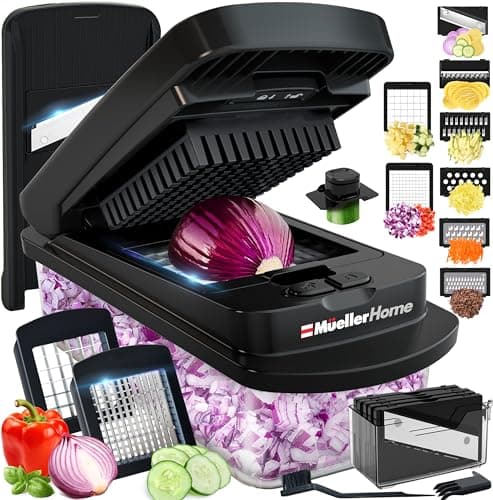
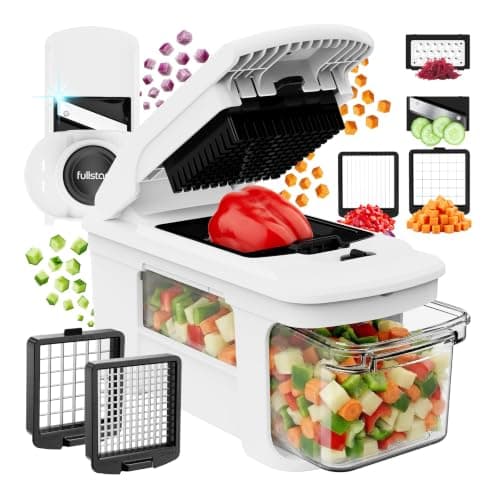
For vegetables specifically, the Fullstar Pro XL Vegetable Chopper & Mandolineis the pick, and the reason is the cut. Most vegetable prep wants uniform pieces — mirepoix for a stew, peppers for a stir-fry, onion and tomato for pico de gallo — and a push-dicer presses food through a fixed grid so every piece comes out the same size. A spinning blade cannot do that. It minces, which is a different and often less useful cut for vegetables.
Two tools, one name
“Vegetable chopper” is sold on both sides of a real split. The push-dicers — the Fullstar Pro XL Vegetable Chopper & Mandoline and the Mueller Pro-Series 10-in-1 Vegetable Chopper— are hinged frames holding a blade grid: lay the food down, press the lid, and cubes fall into a catch container. No motor, no cord, and the cut is genuinely even.
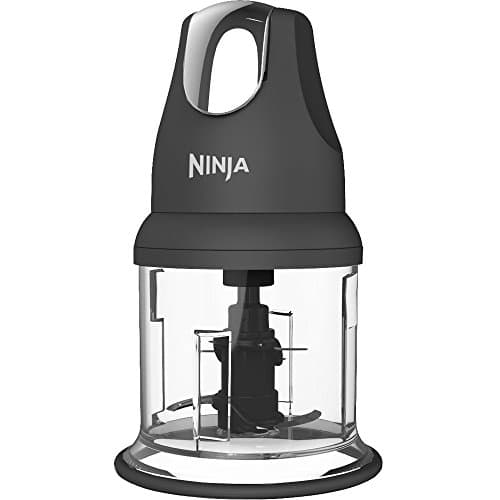
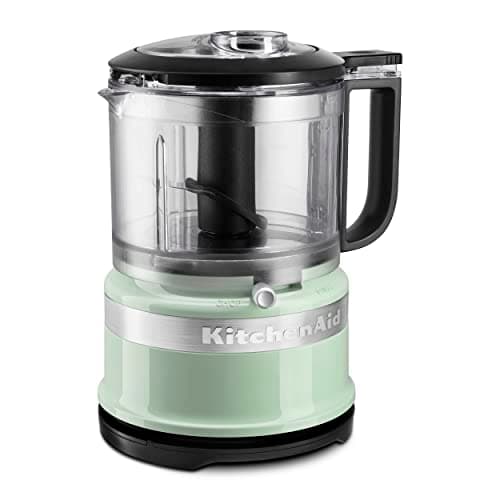
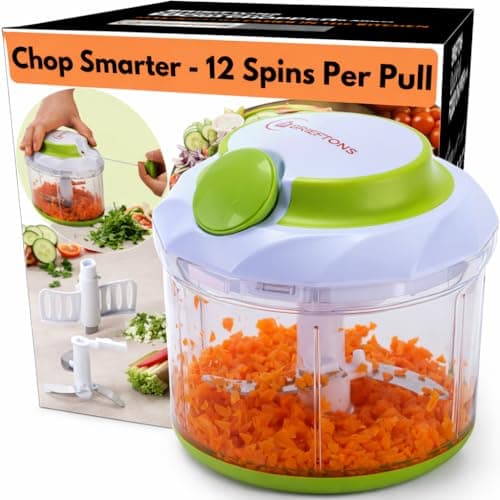
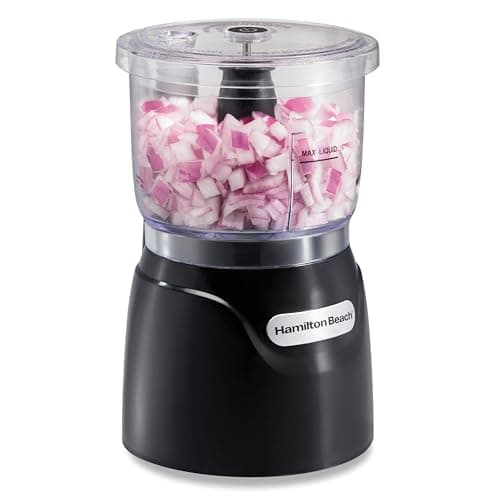
The electric bowls — the Ninja Express Chop (NJ110GR), the KitchenAid 3.5-Cup Food Chopper (KFC3516) and the Hamilton Beach 3-Cup Electric Vegetable Chopper— spin stacked blades to mince. That is the right tool for onion and garlic destined for a sauce, for herbs, for a coarse salsa where texture is not the point. It is the wrong tool for anything you want to look neat on the plate, because you cannot stop a spinning blade at “cube”. The Brieftons QuickPull Manual Food Chopper (4-Cup) sits between the two: a pull-cord drive that minces like an electric with no outlet and no noise.
The one-line rule. Cubes for a dish where the pieces are visible? Buy a push-dicer. A mince that disappears into a sauce, salsa or dressing? Buy an electric bowl. If you want both, buying one of each still costs less than a small food processor.
The hard-vegetable problem
This is the honest limitation of push-dicers, and it is the one most listings do not mention. Soft and medium vegetables — onion, tomato, mushroom, courgette, bell pepper — drop through the grid with a light press. Raw carrot, sweet potato, celeriac and winter squash take a genuinely firm, two-handed shove, and if your wrists or grip are not up to that, the tool will frustrate you every time you reach for it.
There are two honest answers. Either pre-cook or par-boil hard roots before dicing, which works but adds a step. Or accept a mince and buy an electric chopper, where the motor does the work — the Ninja Express Chop (NJ110GR) handles a raw carrot without complaint, it just will not give you a cube. There is no cheap tool that dices raw sweet potato effortlessly; a food processor with a dicing kit is the only thing that does, and that is a different budget.
Which vegetable chopper to buy
Buy the Fullstar Pro XL Vegetable Chopper & Mandolinefor the best all-round dice: a well-judged set of blades, a catch container that doubles as storage, and a finger guard in the box — and if you are torn between it and the Mueller, that is settled in Fullstar vs Mueller. Take the Mueller Pro-Series 10-in-1 Vegetable Chopperinstead if you want maximum range — eight interchangeable blades that add julienne and grate on top of dicing — at the cost of more small parts to store and keep track of.
For electric, the Ninja Express Chop (NJ110GR) is the fastest, simplest and easiest to wash. The KitchenAid 3.5-Cup Food Chopper (KFC3516) is the nicely-made alternative, with two speeds and a drizzle basin for dressings, if the finish matters to you. The Hamilton Beach 3-Cup Electric Vegetable Chopperis the cheapest bowl here that still holds three cups — best kept to soft and medium foods. And the Brieftons QuickPull Manual Food Chopper (4-Cup) is the one to buy for an RV, a boat, a dorm or a campsite, where a pull cord beats an outlet you do not have.
Two adjacent questions this page does not settle. If you are weighing one of these against a slicer rather than against another chopper, mandoline vs vegetable chopper lays out why they are not substitutes — one makes a flat slice and these make a cube or a mince. And if your cooking is mostly Indian, the best chopper for Indian cooking ranks the same field on the three jobs a masala base actually needs.