HUB 06 · Guides
How to Dice Vegetables
Dicing is three cuts in a fixed order, and the first one is the one everybody skips. Here is the method, the sizes recipes mean, and the short list of machines that genuinely dice rather than mince.
We earn a commission if you buy through our links. It does not change the price you pay, and it does not decide our picks — our selection criteria are published in full. How this works.
Dicing is three cuts in one order: make a flat side, cut planks, cut the planks into batons, then cut across the batons into cubes.That is the whole technique, it applies to almost every vegetable, and the step people skip — making a flat side first — is the one that makes the other three fast and safe. If you want a machine to do it, the list is short, because a spinning blade cannot produce a cube.
The method, in order
- Make a flat side. Cut a thin slice off one face and turn the vegetable onto it. A round vegetable rolls; a vegetable with a flat side does not. Everything after this is easier and nothing after this works properly without it. On an onion, halving it through the root does the same job.
- Cut planks.With the flat face down, slice down through the vegetable at the thickness you want your final cube to be. Quarter-inch cube means quarter-inch planks. This is where the size of the dice is decided — not at the end.
- Cut batons. Stack two or three planks, square them up, and cut lengthwise at the same thickness. You now have square-section sticks. (Stop here and you have julienne, which is a different cut we cover in how to julienne vegetables.)
- Cut across. Gather the batons, line up the ends, and cut across them at the same thickness again. Cubes.
The reason this produces an even dice is that the same measurement is used three times. If your planks, batons and cross-cuts are all a quarter of an inch, the result is a quarter-inch cube whether or not your knife skills are good. Evenness is a consequence of the method, not of talent.
What the sizes in recipes mean
These are conventional kitchen names rather than a published standard, and the approximate sizes below are what you will usually be expected to produce:
| Recipe says | Roughly | Used for |
|---|---|---|
| Brunoise / fine dice | About 1/8 in | Garnish, mirepoix for a delicate sauce, anything that should disappear |
| Small dice | About 1/4 in | Soffritto, salsa, stuffing, most “diced onion” instructions |
| Medium dice | About 1/2 in | Hash, roasted vegetables, chunky soups |
| Large dice | About 3/4 in | Stews, sheet-pan roasts, anything with a long cook |
When a recipe does not specify, the useful rule is to match the dice to the cooking time. A small dice in a two-hour braise dissolves; a large dice in a ten-minute stir-fry stays raw in the middle. That is the actual reason evenness matters, and it is why a mince of mixed sizes cooks unevenly even when it tastes fine.
How to dice faster
Stack and square. The whole speed gain is in cutting two or three planks at once rather than one. Square the stack against the board edge first so the ends line up.
Use a big board and a sharp knife.A board that is too small is why people work slowly — you spend the time clearing cut vegetables out of your own way. The OXO Good Grips Plastic Utility Cutting Board is a 10.4 by 14.8 inch non-slip board with a drip catcher, which is the right size for this; our cutting board roundup covers the materials.
Do not chase the last piece. The final inch of any vegetable is where people cut themselves, for the same reason as a box grater. Save the ends for stock.
Onions are a special case— halve through the root, peel, make radial cuts toward the root, then cut across. The root holds the layers together so nothing slides. If the problem is your eyes rather than your technique, that is a separate page.
Why your food processor will not dice, whatever the box says. A processor and a bladed chopper work by hitting food repeatedly with a fast spinning blade. Each piece gets struck a random number of times, so the output is a minceof mixed sizes with liquid released — never a cube. There is no pulse count that fixes this; it is the mechanism. Searching for a “dicing machine” or asking how to dice in a Ninja food processor usually ends here, and it is better to know before you buy. The full explanation is on our dicer roundup, and electric vs manual choppers sets the two mechanisms against each other directly.
The three things in our catalog that actually dice
Push-down dicers.You lay food on a grid of blades and press the lid, and the food passes through once — so every piece is cut exactly as many times as the grid has edges. That is why the output is even cubes and why the size is set by which grid you fitted. The Fullstar Pro XL Vegetable Chopper & Mandoline publishes interchangeable dicing and slicing grids and a catch container that doubles as storage; the Mueller Pro-Series 10-in-1 Vegetable Chopperpublishes eight interchangeable stainless blades and a 1.2 L container. Both ask for real hand force on carrot and sweet potato, which is stated on their cards rather than hidden — if grip strength is a concern, see prep tools for weak grip.
A food processor with a dedicated dicing kit. This is the exception to the rule above, and it is rare. The KitchenAid 13-Cup Food Processor (KFP1318)ships one — a separate grid assembly that food is pushed through, rather than a blade that spins past it. It works, and its own card is honest about the cost: the kit is fiddly to assemble and clean, so plan on rinsing several parts. If you want one machine that both dices and slices, that is the route.
A knife. Still the best dicer in any kitchen, still free, and the only one that handles a vegetable too big or too soft for a grid. The method at the top of this page is all of it.
The hardware
The hardware this guide is about
The products this guide refers to, with prices pulled live from Amazon and dated on every card. Full rankings live in the roundups linked above.
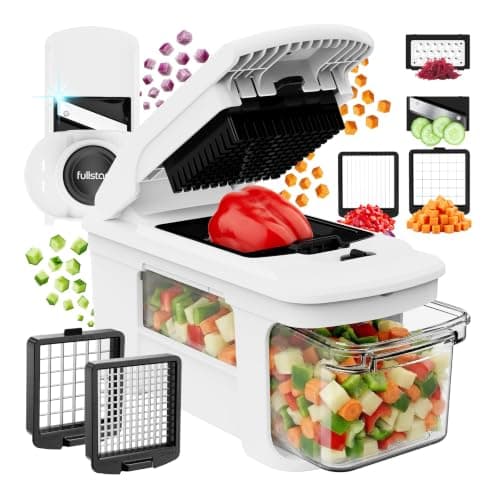
Even manual dicing
Fullstar Pro XL Vegetable Chopper & Mandoline
The best-selling push-down dicer: press the lid and vegetables fall through a grid into neat, even cubes.
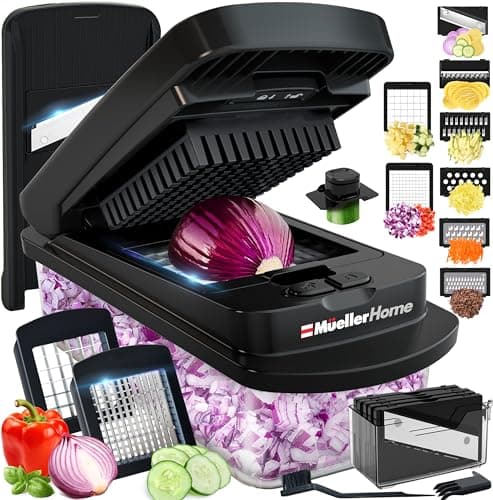
Most blade options
Mueller Pro-Series 10-in-1 Vegetable Chopper
A push-dicer with the widest blade set here — eight inserts covering dice, slice, grate and spiralize.
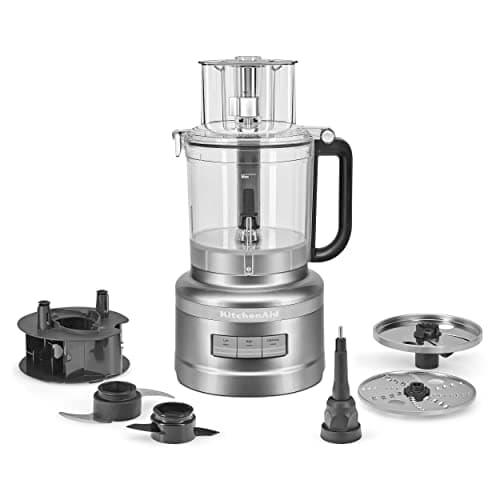
Dicing and prep variety
KitchenAid 13-Cup Food Processor (KFP1318)
A 13-cup KitchenAid with a 3-in-1 feed tube and an included dicing kit — the widest job range in the roundup.

Everyday prep
OXO Good Grips Plastic Utility Cutting Board
The everyday board: big, non-porous, dishwasher safe, with non-slip feet and a drip catcher that actually catches drips.
#ad · As an Amazon Associate we earn from qualifying purchases.
Questions
Frequently asked
How do you dice vegetables quickly?
How do you dice vegetables in a food processor?
What is the difference between dicing and chopping?
What size dice should I use?
Is a vegetable dicer worth buying?
Keep reading
Related
- The best vegetable dicersThe tools that make an actual cube.
- Electric vs manual food chopperMince or cube, decided by mechanism.
- Chopping onions without cryingIf the problem is your eyes.
- How to julienne vegetablesStop one cut earlier.
- The best cutting boardsThe surface all of this happens on.
- The best food choppers and dicersThe whole category, ranked.