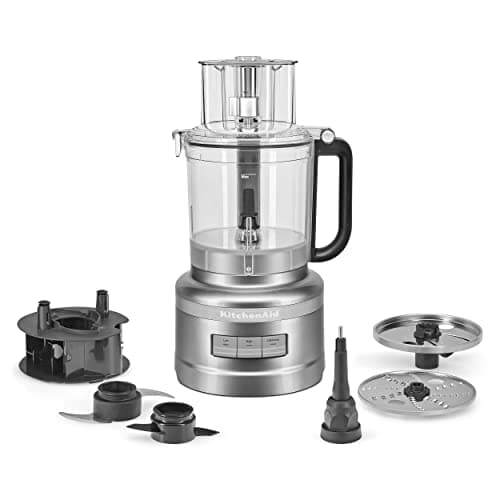
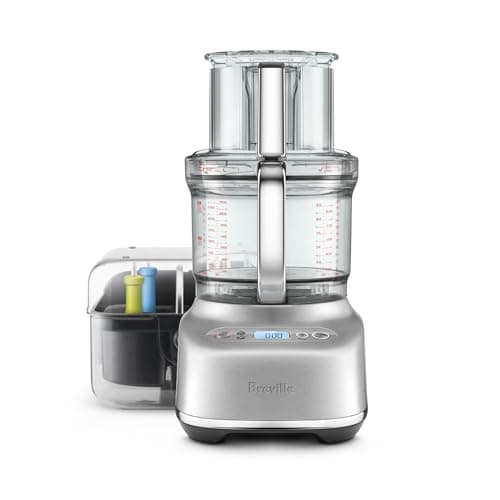
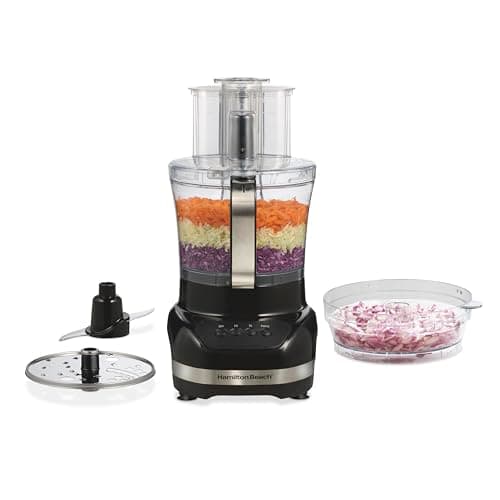
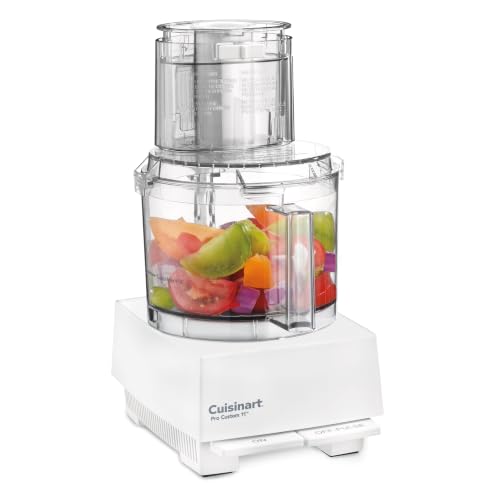
The straight swap is the Cuisinart Pro Custom 11-Cup Food Processor (DLC-8SY): two more cups of bowl, an extra-large feed tube with two pushers, a dough blade named in the box, and the shortest parts list in this group. If what you wanted from the Ninja was a wider range of CUTS rather than more power, it is the KitchenAid 13-Cup Food Processor (KFP1318), which dices. If you want to beat the Ninja outright and price is not the constraint, it is the Breville Sous Chef 16 (BFP810). And the budget pick — the cheapest machine here that still does full-size work — is the Hamilton Beach Big Mouth Duo Plus 12-Cup. Live prices for all four are in the table above with the date each was last checked.
What Ninja is actually known for
Worth being precise about, because which substitute suits you depends entirely on which of these you are giving up. Across the Professional Plus BN601 listing Ninja publishes three things that its competitors at the same money generally do not:
- A 1,000-peak-watt motor. That is a big number for the price, and in practice the machine does push through dough.
- Auto-iQ preset programs.A one-press timed pulse pattern for chopping, slicing, pureeing and mixing. Nothing else on this page has an equivalent, and that is not us being generous — it is the single feature none of the four alternatives below can match.
- A dough blade AND an adjustable slicing/shredding disc in the box. A complete kit rather than a bowl and one plate. People forget the adjustable disc is in there, and it matters when you compare: two of the four alternatives below have a fixed slicing thickness.
What the brand does not lead on is equally documented. The bowl is 9 cups, smaller than the 11 to 16-cup machines it is usually shopped against. There is no dicing kit. And “peak” watts is not a comparable unit— it is a momentary maximum, the continuous figure is lower and Ninja does not publish it, so a 1,000-peak-watt Ninja and a 625-watt Cuisinart are not 375 watts apart in any meaningful sense. That single unit mismatch is the reason most Ninja comparisons on the internet are wrong, and it is why our spec rows print the basis for every wattage we show.
Four alternatives, and the strength each one matches
The straight swap: Cuisinart Pro Custom 11-Cup Food Processor (DLC-8SY).Eleven cups against Ninja’s nine, a 625-watt motor that Cuisinart states plainly rather than as a peak, and — the part that matters if dough was the reason you were looking at a Ninja at all — a chopping/mixing/dough blade named in the accessory list. The extra-large feed tube takes whole fruit and vegetables with a small and a large pusher. What you lose is real: there are no preset programs, and the slicing disc is a fixed 4 mm rather than adjustable, so thickness means buying another disc. This is the pick for someone who wants more bowl, fewer parts and a number they can actually compare.
Add the cuts Ninja cannot make: KitchenAid 13-Cup Food Processor (KFP1318).Thirteen cups, a 3-in-1 feed tube, an external ExactSlice lever that changes slicing thickness without opening the bowl, and an included dicing kit — which is the one job the Ninja’s own accessory list does not cover. If you went looking for an alternative because you wanted even cubes for a mirepoix or a salsa, this is the answer and the rest of the page is noise. The honest costs: the dicing kit is fiddly to assemble and clean, and KitchenAid headlines no wattage at all, so you cannot compare it on power even badly. It is also our top pick in the under-$200 band.
Beat it outright: Breville Sous Chef 16 (BFP810).Sixteen cups, a 1,450-watt motor, and an adjustable slicing dial with 24 positions covering 0.3 to 8.0 mm — a millimeter range Breville prints in its own instruction book rather than describing in adjectives. This is unambiguously the more capable machine and it costs several times what a Ninja does. Buy it only if capability was the point; if you reach for a processor a few times a month you will not use the dial enough to justify it.
Undercut it on price: Hamilton Beach Big Mouth Duo Plus 12-Cup.The budget pick. Twelve cups plus a 4-cup chopper bowl that nests inside it, a published 500-watt motor, a Big Mouth chute listed to take whole tomatoes and potatoes, and a price well under the Ninja’s. You give up the dough blade entirely — there is none in the box and no adjustable slicing thickness either, just one reversible disc and an S-blade — and the plastic is plainer. For chopping, slicing and shredding, which is most of what most households do, that is enough.
If the real problem is the price of the whole category. The floor of the market is lower than most people think, and the trade-offs are specific rather than vague: see food processors under $50, where exactly one machine still has a feed chute and a disc. For the brand question set out the other way round, our alternatives to a Cuisinart food processor starts from the default brand instead.
What you give up leaving Ninja
Two things, and neither shows up on a spec sheet. The first is the preset programs. A timed pulse pattern you trigger with one press is genuinely useful if you do not want to stand there judging an onion, and no Cuisinart, KitchenAid, Breville or Hamilton Beach machine in this catalog offers one. If you have used Auto-iQ and liked it, you will miss it, and we would rather say that than pretend the substitutes are strictly better.
The second is power per dollar. Whatever you think of the peak-watt unit, the Ninja is an unusually cheap way into a motor that does not visibly struggle, and it ships a dough blade with a motor rated to use it, which is rare at its place in the market. Swapping to an 11-cup Cuisinart buys you bowl and simplicity; it does not buy you more motor. Our Ninja against Cuisinart and KitchenAid against Ninja head-to-heads work both trades through on published figures alone, which is the right place to go if you have narrowed it to two machines rather than four.
Which question are you actually asking?
The machine’s own published specification points at three limits, and this page is ordered to match them. Some readers want a bigger bowl— that is the Cuisinart. Some want a cut the Ninja does not do, almost always dicing — that is the KitchenAid. Some want to spend less— that is the Hamilton Beach. The fourth pick exists for the smaller group who want the Ninja’s capability ceiling raised rather than its price lowered. If you are in none of those groups, the honest advice is that the Ninja is a good machine and you do not need to replace it.