HUB 06 · Guides
Mandoline vs Box Grater
They sit next to each other in every kitchen shop and do genuinely different things. One cuts flat planes, the other tears strands — and the safety gap between them is wider than the price gap.
We earn a commission if you buy through our links. It does not change the price you pay, and it does not decide our picks — our selection criteria are published in full. How this works.
A mandoline makes slices. A box grater makes shreds.If the finished dish needs flat, even planes — gratin, scalloped potatoes, a cucumber salad, chips — that is a mandoline. If it needs strands — melted cheese, carrot for a cake, potato for hash browns — that is a grater. The overlap between them is much smaller than their shelf placement suggests, and for most kitchens the grater is the one to buy first.
Two different cuts, mechanically
A mandoline has one long blade set into a flat deck, with an adjustable gap in front of it. You slide food across; whatever passes through the gap is severed as a continuous slice. Change the gap and you change the thickness — from translucent to a quarter-inch on the adjustable models. That single blade is what makes a mandoline uniquely good at precision and uniquely dangerous.
A box grater has perforated panels, each hole a small raised cutting edge. You rub food across it and each hole takes a strand. There is no adjustment and no continuous cut — you get whatever that panel’s hole size produces. The blades are small, fixed and shallow, which is precisely why grater injuries are grazed knuckles rather than the deep lacerations mandolines cause.
The safety difference is not marginal. A mandoline is the single most common source of serious kitchen lacerations, which is why we publish a full mandoline safety guide and recommend a cut-resistant glove with every one we rank. A box grater will take skin off a knuckle. That is a real injury and a genuinely different order of one.
Head to head
| Mandoline | Box grater | |
|---|---|---|
| Cut | Flat slices; julienne with a blade change | Shreds, grates and zest |
| Thickness | Adjustable, often paper-thin to 6 mm+ | Fixed per panel |
| Best at | Gratin, chips, cucumber, radish, slaw | Cheese, carrot, potato for hash, citrus zest |
| Hard cheese | No | Yes — the fine panel is made for it |
| Risk | High — deep lacerations | Moderate — grazed knuckles |
| Storage | Bulky; blades need guarding | Compact, often nests |
| Typical price | Higher | Lower |
Where they genuinely overlap
Two places. Cabbagecan be shredded by either: a mandoline gives longer, more even strands (and is the traditional choice — see the best mandoline for cabbage), while the coarse panel of a grater gives shorter, more ragged ones that are perfectly good in a slaw. Potatoessplit by dish: sliced for gratin is mandoline work, shredded for hash browns or rösti is grater work.
Beyond those, they rarely substitute. A mandoline cannot grate parmesan — hard cheese crumbles rather than slicing. A grater cannot produce the even discs a gratin needs.
Which to buy first
For most kitchens, the grater. The OXO Good Grips Box Grater covers cheese, vegetables and zest, costs little, stores easily and will not seriously hurt you. It is the higher-frequency tool in nearly every household, and it is the safer place to start. Our box grater roundup ranks the field.
Buy the mandoline when you have a specific reason: you make gratins or chips, you want restaurant-even slices, or you slice in enough volume that a knife is the bottleneck. The OXO Good Grips Chef's Mandoline Slicer 2.0 is our pick for a first one because its hand guard is the best designed of those we rank; the Benriner Super Slicer (Japanese Mandoline) is the professional choice and correspondingly less forgiving.
The third option most people should consider
A food processorwith slicing and shredding discs does both jobs, at volume, with the blade fully enclosed. It is the answer if you already own one or if you are doing enough work to justify the assembly and washing — mandoline vs food processor sets out that trade. And for hard cheese specifically, a rotary grater beats both: finer, fluffier, and with your fingers nowhere near a blade.
There is a fourth tool worth naming here, because the table above quietly hides it. The “zest” a box grater does on its finest panel is the one job it is clumsiest at, and it is the whole purpose of a handheld rasp or zester— citrus rind without the bitter pith, whole nutmeg, garlic paste, parmesan fine enough to melt on contact. It costs very little and it does not compete with either tool on this page.
The hardware
The hardware this guide is about
The products this guide refers to, with prices pulled live from Amazon and dated on every card. Full rankings live in the roundups linked above.
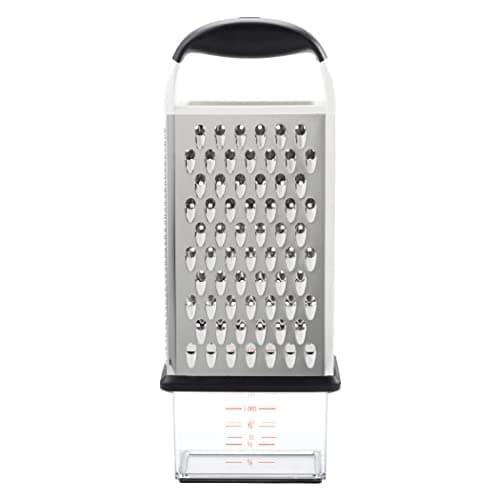
Everyday grating
OXO Good Grips Box Grater
The box grater that gets it right: four sharp sides, a soft non-slip base and a container that catches and measures.
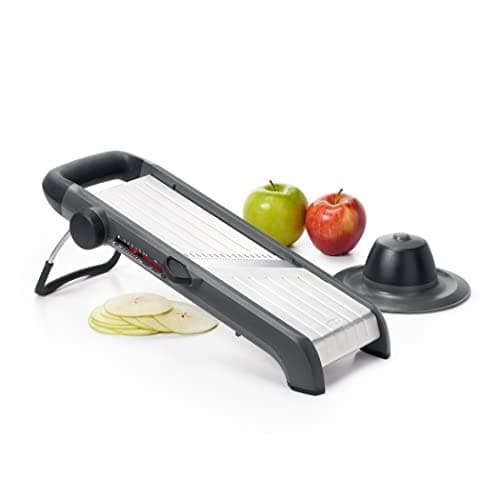
Most home cooks
OXO Good Grips Chef's Mandoline Slicer 2.0
The mandoline to buy: a solid, foldable slicer with a runway of thickness settings and a genuinely usable hand guard.
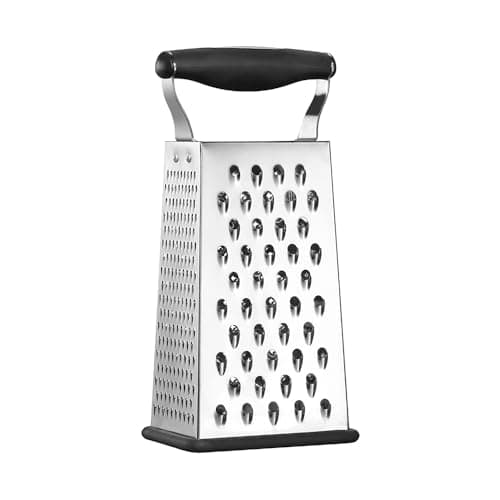
Budget grating
Cuisinart Box Grater (CTG-00-BG)
The budget box grater: a simple, sharp stainless four-sided grater with no container to store or wash.
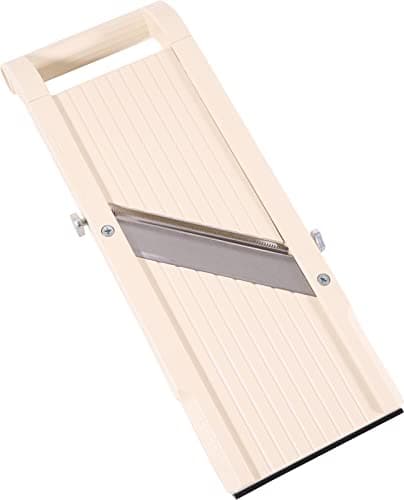
Sharpest slices
Benriner Super Slicer (Japanese Mandoline)
The professional's mandoline: a wide Japanese slicer whose razor-sharp blades chefs quietly rely on.
#ad · As an Amazon Associate we earn from qualifying purchases.
Questions
Frequently asked
What is the difference between a mandoline and a box grater?
Can a mandoline grate cheese?
Do I need both a mandoline and a box grater?
Which is better for coleslaw, a mandoline or a grater?
Keep reading