HUB 06 · Guides
Cuisinart vs Breville Food Processor
One is the machine that has been the default for decades. The other adds 730 watts, two cups and a slicing dial for a lot more money. Here is exactly what the difference buys.
We earn a commission if you buy through our links. It does not change the price you pay, and it does not decide our picks — our selection criteria are published in full. How this works.
This is the clearest either/or in the full-size food processor market, because the two machines are honest about being different things. The Cuisinart 14-Cup Food Processor (DFP-14BCNY) is a 14-cup bowl, a 720-watt motor and three parts to wash. The Breville Sous Chef 16 (BFP810)is 16 cups, 1,450 watts and a slicing dial covering 0.3–8.0 mm. The question is not which is better built; it is whether you will use what the Breville adds.
The specs, side by side
| Cuisinart 14-Cup Food Processor (DFP-14BCNY) | Breville Sous Chef 16 (BFP810) | |
|---|---|---|
| Work bowl | 14 cups | 16 cups |
| Published motor | 720 W | 1,450 W |
| Slicing | One fixed stainless disc | Adjustable dial, 0.3–8.0 mm |
| Parts to wash | Three | More — the dial and disc set |
| Est. cost / year | $2.29 | $4.62 |
What 1,450 watts actually changes
Two jobs, and only two: stiff dough and nut butter. Both are sustained loads where the motor works continuously against real resistance for minutes rather than seconds, and both are where a 720-watt machine is audibly working while a 1,450-watt one is not.
For everything else — chopping onions, slicing cucumber, shredding cheese, pureeing a soup, making pastry — the extra watts change nothing you can see. The Cuisinart’s 720 W is comfortably enough, which is exactly why it has been the default full-size processor for so long. Our dough and nut butterroundups are the two pages where the Breville’s advantage is real.
What the slicing dial changes
More than the wattage does, for most people. A fixed disc gives you one thickness; Breville publishes a dial spanning 0.3–8.0 mm that you turn without swapping discs. If you slice often — gratins, crisps, roasting trays, salads — that is a genuine daily difference, and it removes a drawer of discs.
If you slice occasionally and always at roughly the same thickness, it is a feature you will set once. Our slicing roundup goes into what decides that job, and the honest summary is that the dial matters to a minority of buyers and matters a lot to them.
Fewer parts is a real feature, not a consolation prize.The DFP-14 has three washable parts. Every study of why appliances stop getting used comes back to friction, and a machine you can wash in ninety seconds gets used on a Tuesday. Breville’s capability comes with more to store, more to align and more to dry — see the cleaning guide for what that involves.
The case for the Cuisinart
It costs substantially less, it does every everyday job as well, it has the shortest parts list in the category, and it has been in production long enough that parts, bowls and lids are genuinely available — which matters more than buyers expect, because a cracked bowl is how most processors die. Its own honest limitation is the flip side of the big bowl: dicing a single shallot in 14 cups is wasteful and messy, and a mini processor or a chopper is the better tool for small jobs.
The case for the Breville
You cook a lot, and the machine is out on the counter rather than in a cupboard. You make bread or pizza dough regularly, or nut butter. You slice at varied thicknesses often enough to want a dial. And you would rather have the extra two cups than the smaller footprint. If two or more of those are true, the Breville is not extravagant, it is the right tool. If none are, you are paying for headroom you will never reach.
What neither one solves
Both are full-size machines, and both are bad at small jobs. Half an onion in a 14- or 16-cup bowl is a chore to wash for a result a cheap chopper would have given you in seconds. Neither brand fixes that with a nested mini bowl, so if a lot of your prep is small, plan on a second, cheaper tool rather than expecting either machine to scale down — the chopper hub is where that decision lives.
Both also take real counter or cupboard space, and the Breville takes more of it. A processor that lives in a low cupboard gets used far less than one that lives out, which is a genuine argument for buying the machine that fits your kitchen rather than the machine with the better spec sheet. Our size guidetreats footprint as a real spec for exactly that reason.
The decision rule
Buy the Cuisinart unless you make dough or nut butter regularly, or slice at varied thicknesses regularly. Those are the only three things the Breville does that the Cuisinart does not do well.
Buy the Breville if any of those three is a weekly part of how you cook. The money is not buying a better onion; it is buying headroom and control on the specific jobs that punish a smaller motor and a fixed disc.
If you are choosing between brands more broadly, we have the same comparison for Cuisinart against KitchenAid and Ninja against Cuisinart, and the cost guide sets out what each price band buys.
And if it is the Breville you keep coming back to, our full Sous Chef 16 review goes through the micro-adjustable slicing dial and the 16-cup bowl on their own terms, without a rival in the frame.
The hardware
The hardware this guide is about
The products this guide refers to, with prices pulled live from Amazon and dated on every card. Full rankings live in the roundups linked above.
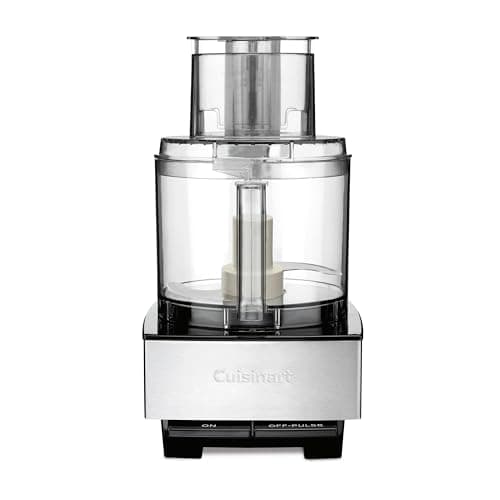
Most full-size kitchens
Cuisinart 14-Cup Food Processor (DFP-14BCNY)
The default full-size processor for a reason: a big, simple, 720-watt workhorse with the shortest parts list to go wrong.
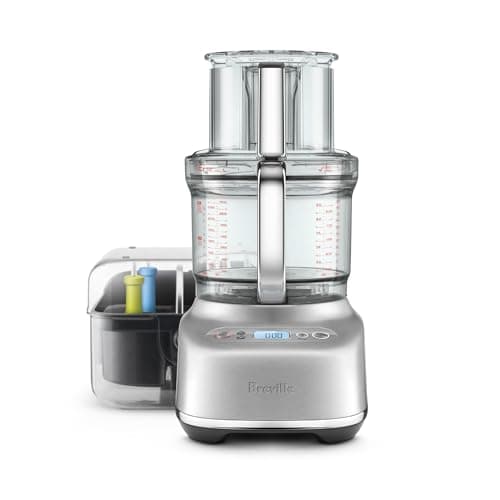
Serious, frequent cooks
Breville Sous Chef 16 (BFP810)
The one to buy if you actually use a processor daily: an adjustable slicing dial and a 1,450-watt motor that never flinches.
#ad · As an Amazon Associate we earn from qualifying purchases.
Questions
Frequently asked
Is the Breville Sous Chef worth it over a Cuisinart?
How much more powerful is the Breville than the Cuisinart?
Which is easier to clean, Cuisinart or Breville?
Does a bigger food processor bowl cost more to run?
Keep reading
Related
- The best food processorsBoth machines, ranked against the field.
- Cuisinart vs KitchenAidThe other brand question.
- How much does a food processor cost?What each price band buys.
- 14-cup vs 11-cup vs Sous ChefThe same question with the size ladder added.
- Best food processor for doughWhere the wattage gap shows.
Receipts
Sources
We do not run a testing lab and we do not pretend to. Specifications come from the manufacturer's own published documents and from published standards; prices come from the live Amazon API. Where a figure is not published, the page says “not published” rather than guessing. Read the full method.