HUB 06 · Guides
How to Use a Julienne Peeler
A julienne peeler is a row of teeth on a peeler head: one firm stroke gives you a handful of matchsticks. Almost everything that goes wrong with one is the stroke, not the tool - and the last inch of the vegetable is where people get cut.
We earn a commission if you buy through our links. It does not change the price you pay, and it does not decide our picks — our selection criteria are published in full. How this works.
The whole technique is this: rest the vegetable flat on a board, hold the peeler like a razor rather than a pen, and pull one firm continuous stroke away from your body along the full length. One pass gives you a row of matchsticks as long as the stroke. Then rotate the vegetable a few degrees and repeat. Light, short, hesitant strokes are what produce the ragged half-strips people blame the tool for, and stopping and starting mid-pass is what makes them uneven.
A julienne peeler cuts short strips, not noodles. The strip can only be as long as one stroke, which on a carrot is four or five inches — and the last part of the vegetable cannot safely be cut at all. If you want long continuous vegetable noodles, that is a spiralizer, whatever the marketing on some of these says. The three-way comparison is in julienne peeler vs mandoline vs spiralizer.
The method, step by step
- Peel first if the skin is tough. On carrots and butternut, take the skin off with a plain peeler before you start — julienne teeth clog with skin far more readily than a straight blade does. The Deiss has both edges on one head for exactly this sequence.
- Create a flat side. Slice a thin sliver off one side so the vegetable sits still on the board. A rolling carrot is the main cause of both ragged strips and cut knuckles.
- Dry it. A wet vegetable slides under the teeth. Pat it with a towel.
- Grip the peeler across your palm, not in your fingertips. A Y-peeler is designed to be pulled with the arm and shoulder, like a razor; holding it in the fingertips gives you no force and no control. All four of our picks are Y-shaped except the straight Rösle.
- One firm stroke, away from you, full length. Press hard enough that the teeth engage from the first inch. If strips are coming out as shreds, press harder rather than going slower.
- Rotate and repeat around the vegetable. Work your way round rather than going twice over the same groove — a second pass over a cut channel gives you shavings.
- Stop with about an inch left. This is the rule that matters most. The last inch is where your fingers are directly in the path of the teeth, and it is where essentially every julienne-peeler injury happens. Save the stubs for stock, dice them with a knife, or eat them.
- Rinse immediately, teeth-side down, and store it covered. Vegetable fibre dries into the gaps between teeth within minutes.
Vegetable by vegetable
Carrots
The best case in the category: firm, straight, dense enough that the teeth bite cleanly. Peel first, flatten one side, and work around. A large carrot gives you noticeably better strips than a thin one because the flesh is further from the core, and the woody core at the centre is the one part that will not julienne — stop when you reach it.
Zucchini and courgette
Softer and much wetter, so two things change. Do not peel — the skin is what holds the strip together. And expect to stop well before the seed core: once you hit seeds the strips fall apart and release water. Salt the finished strips for ten minutes and squeeze them if they are going into anything you do not want watery.
Cabbage
A julienne peeler is the wrong tool for a cabbage and it is worth saying so. A cabbage is a layered sphere, not a solid cylinder; there is no flat length to stroke along, and you will get a handful of torn leaf. Quarter it, core it and run it over a mandoline — see the best mandoline for cabbage.
Potatoes and sweet potatoes
Possible and hard work. These are dense and starchy, the teeth clog quickly, and the strips oxidise fast. Rinse the peeler mid-job and drop the strips into cold water. For volume, a fry cutter or a mandoline’s French-fry blade is a far better answer.
Cucumber, apple, pear, firm mango
All good for garnish quantities, all wet. Work over a bowl and use the strips quickly.
Five things going wrong, and the fix
Strips come out as shreds. Not enough pressure, or a dull tool. Press harder first; if that does not fix it, the teeth are worn and a julienne head is not something you can hone at home.
Strips are all different lengths. You are stopping and restarting. One continuous pull per pass.
The peeler keeps clogging. Skin or starch between the teeth. Rinse mid-job; peel tough skins off first.
It skates off the vegetable. Wet surface or no flat side. Dry it and cut a sliver off to make a base.
You cut yourself on the last stretch. Stop an inch early, every time. If you want the whole vegetable used, wear a glove — the teeth on a julienne peeler are the most finger-hostile edge in a drawer, which is why we weight a blade cover so heavily in the julienne peeler roundup, and what a glove does and does not stop is the honest version of that advice.
The spec nobody publishes
Not one maker in our catalog states the width of the strip its peeler cuts. Zyliss, Kuhn Rikon, OXO, Rösle and Deissall describe a julienne blade; none of them gives a millimetre figure. So if you are matching a recipe that specifies a 2 mm or 3 mm julienne, no listing in this category will tell you whether you are getting it, and we are not going to estimate a figure we cannot source. Where strip width genuinely matters, a mandoline with named julienne inserts is the tool — the Benriner publishes three interchangeable julienne blades for that reason.
What the listings do publish is the safety and care detail, and it is worth knowing before the first use: Zyliss and Kuhn Rikon both include a cover or blade guard; OXO and Deiss do not list one but do state dishwasher safe; Zyliss says dishwasher safe and then recommends hand washing to keep the edge, which is the instruction to follow.
What we are not claiming
We have not julienned anything with these five tools. Every blade description, cover, grip and care instruction above is the maker’s own published wording, cited below, and where no maker publishes a figure — strip width, most notably — this page says so rather than inventing one. The technique is a mechanics-of-cutting argument, not a tested result.
What each one publishes about safety and care
| Peeler | Cover in the box | Handedness, as stated | Care, as stated |
|---|---|---|---|
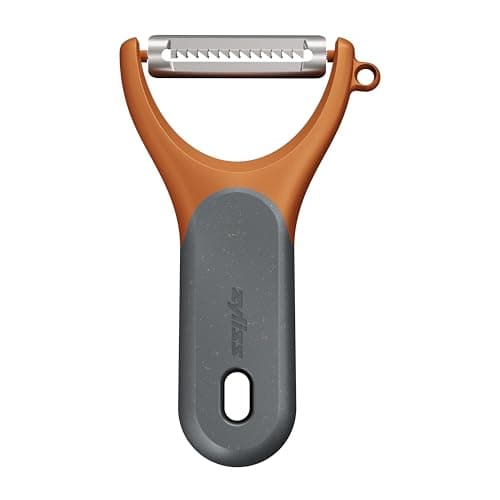
| Zyliss Julienne Y Peeler | Safety cover included | Not stated | Dishwasher safe; hand washing recommended to keep it sharp |
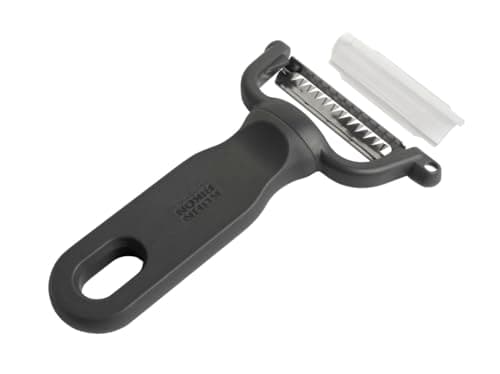
| Kuhn Rikon Family Y Julienne Peeler | Blade guard included | Right- and left-handed, stated | No dishwasher claim either way |
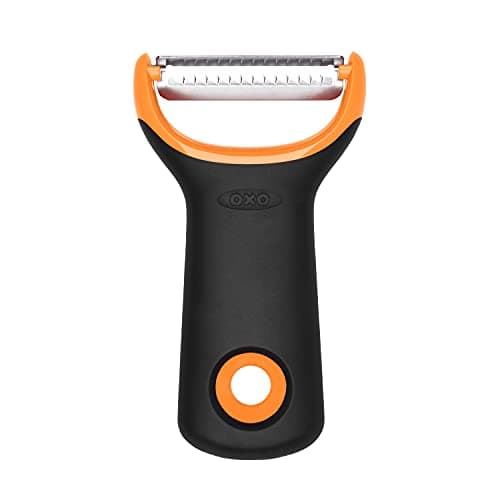
| OXO Good Grips Julienne Prep Peeler | None listed | “Works with every grip” | Dishwasher safe |
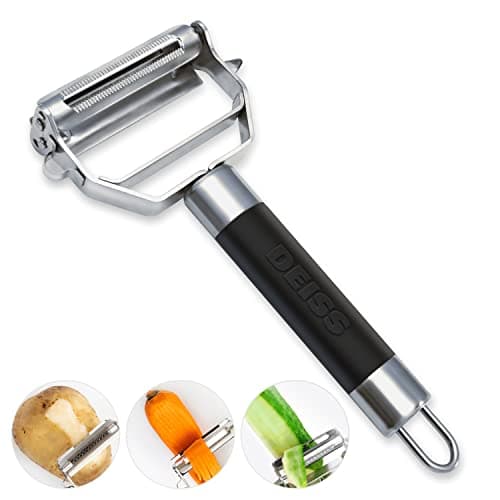
| Deiss PRO Dual Julienne & Vegetable Peeler | None listed | Not stated | Dishwasher safe; lifetime warranty stated |
Two of these ship with a cover and two do not, and on a tool whose working edge is a row of teeth that is the difference between a drawer you can reach into and one you cannot. If yours came without a cover, a cork pushed onto the teeth or a dedicated blade sleeve is worth the two minutes.
What to do with the strips
Raw, immediately. Slaws, salads, a garnish on a noodle bowl, a carrot-and- ginger side. Julienne strips are at their best raw and fresh — they lose structure within a couple of hours.
Quick-pickled. Carrot and daikon matchsticks in vinegar, sugar and salt for thirty minutes. The uniform thinness is exactly what makes a fast pickle work.
Stir-fried hard and fast. Thin strips cook in under a minute, which is the point — but they also go limp in two, so they go in last.
Not braised or roasted. Anything long and slow turns matchsticks to mush. Dice for those — the knife method is in how to dice vegetables, and the knife route to julienne itself is in how to julienne vegetables.
The hardware
The hardware this guide is about
The products this guide refers to, with prices pulled live from Amazon and dated on every card. Full rankings live in the roundups linked above.
Most kitchens
Zyliss Julienne Y Peeler
The cheapest julienne peeler here that ships with a blade cover — and a cover is the feature that matters most on a tool whose teeth are the most finger-hostile edge in the drawer.
Left-handed cooks
Kuhn Rikon Family Y Julienne Peeler
The same cover-and-eye-remover package as the Zyliss, plus the one thing it leaves out: Kuhn Rikon states outright that the grip works for right- and left-handed cooks.
Comfort and easy cleanup
OXO Good Grips Julienne Prep Peeler
The comfortable, dishwasher-safe default from the brand most people already own a peeler from — with no blade cover in the box.
One tool for both jobs, smallest budget
Deiss PRO Dual Julienne & Vegetable Peeler
The cheapest route to julienne strips, with a plain peeling edge on the same tool and the only lifetime warranty any maker here publishes.
#ad · As an Amazon Associate we earn from qualifying purchases.
Questions
Frequently asked
How do you use a julienne peeler?
Why are my julienne strips short and ragged?
Can you julienne cabbage with a julienne peeler?
Can a julienne peeler make zucchini noodles?
Do you peel a zucchini before julienning it?
How wide are the strips a julienne peeler cuts?
Keep reading
Related
Receipts
Sources
- Amazon listing - Zyliss Julienne Y Peeler (extra-hardened stainless julienne blade, safety cover included, built-in eye cutter, dishwasher safe with hand washing recommended)
- Amazon listing - Kuhn Rikon Family Y Julienne Peeler (stainless julienne blade, recessed non-slip grip, right- and left-handed use stated, blade guard included, integrated potato eye remover)
- Amazon listing - OXO Good Grips Julienne Prep Peeler (stainless blades, compact Y shape stated to work with every grip, non-slip handle, dishwasher safe, no blade cover listed)
- Amazon listing - Deiss PRO Dual Julienne & Vegetable Peeler (julienne and straight peeling blades on one Y head, dishwasher safe, lifetime warranty stated)
- Amazon listing - Benriner Super Slicer (flat blade plus 3 interchangeable julienne blades, screw-set thickness dial)
We do not run a testing lab and we do not pretend to. Specifications come from the manufacturer's own published documents and from published standards; prices come from the live Amazon API. Where a figure is not published, the page says “not published” rather than guessing. Read the full method.