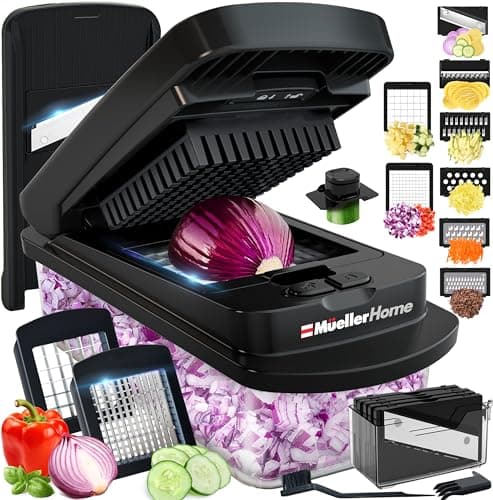
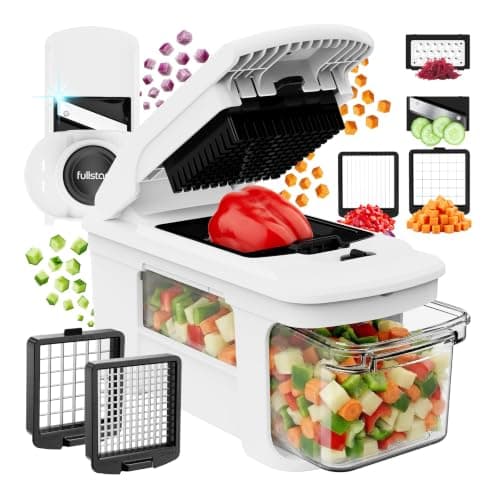
Buy the Fullstar Pro XL Vegetable Chopper & Mandoline if you want the biggest container and the fewest parts: four blades, a published 1.8 L catch box, and the only one of the two whose listing names the steel its blades are cut from. Buy the Mueller Pro-Series 10-in-1 Vegetable Chopper if you want the widest range of cuts from one tool — eight blades covering dice, slice, julienne, grate and shred — in a lighter body, with a food holder for small items that the Fullstar’s box does not list. At the prices these two trade at, nobody is overpaying either way. The question is which set of compromises you would rather own.
They make the same cut. This is the thing to understand before you read another word of comparison. Both are push-down dicers: you press food through a stationary grid of blades and it falls out the other side in even cubes. Neither has a motor, neither minces, and the cube one makes is not better than the cube the other makes. Anything you read that ranks one above the other on “performance” is ranking them on something nobody published.
What each listing actually publishes
We do not own either tool, so the comparison below is built from the two Amazon listings and nothing else. Where a listing does not state something, the table says so rather than filling in a figure from a review.
| Published spec | Fullstar Pro XL Vegetable Chopper & Mandoline | Mueller Pro-Series 10-in-1 Vegetable Chopper |
|---|
| Blades in the box | 4 — fine dicer, medium dicer, 2 mm slicer, grater | 8 — two chopper blades plus six for slicing, julienne, grating, shredding |
|---|
| Blade steel | 420J stainless, named on the listing | “High-quality stainless-steel”; no grade named |
|---|
| Container | 1.8 L, with an 8-cup XL body | 1.2 L |
|---|
| Food holder for small items | Not listed | Listed |
|---|
| Finger guard | Listed, plus a cleaning brush | Not listed separately |
|---|
| Body material | Extra-hard ABS, BPA-free and food-safe | Not stated |
|---|
| Dishwasher | Top rack, whole chopper and accessories | Yes, dismantled |
|---|
| Size and weight | 14.6 × 7.2 × 5.5 in; 3.7 lb | 11.18 × 5.47 × 5.2 in; 2.46 lb |
|---|
| Model number | None published; the model field repeats the product type | MC-780 |
|---|
| Warranty | No length published | “Manufacturers Warranty”; no length published |
|---|
Two rows in that table are more useful than the rest. Neither maker publishes a warranty length— Mueller’s listing has the field filled in with the words “Manufacturers Warranty” and no duration, and Fullstar’s is blank. If you have read a specific warranty figure for either of these, it did not come from the listing. And the Fullstar is the heavier, taller object: 3.7 lb against 2.46, and nearly 15 inches tall assembled against the Mueller’s 11-inch length. In a crowded cupboard that is the difference you will notice every week.
Four blades or eight: the only decision that matters
Mueller’s own pitch is “8 awesome blades for the price of 4,” and taken literally it is true — two chopper grids plus six inserts for slicing, julienne, grating and shredding, against Fullstar’s four. If blade count were the whole story this page would be one sentence long.
It is not, for a reason that has nothing to do with quality: the inserts beyond dice and slice are the ones you already own better versions of. A julienne insert on a push-dicer competes with a julienne peeler, which costs very little and does the job in your hand. A grating insert competes with a box grater, which has four surfaces and something to lean on. A shredding insert competes with the shredding disc on any food processor. In each case the dedicated tool is easier and the insert is one more sharp rectangle in a drawer.
So the honest version of “eight blades” is: two you will use constantly, two more you will use occasionally, and four that are a bonus if you have nothing else and clutter if you do. The Fullstar’s four are, in order of how often they come out, the medium dicer, the fine dicer, the slicer and the grater — which is close to the shortlist most people converge on anyway. That is the case for buying fewer blades deliberately.
There is a counter-case, and it is real. If this chopper is going to be the only prep tool in the kitchen — a first apartment, a dorm, an RV, a vacation rental — then eight blades genuinely does replace a drawer you do not have, and the Mueller is the better buy for exactly that reason — our Mueller Pro-Series review takes that case on its own. We say the same thing in prep tools for small kitchens.
Container size against counter footprint
Fullstar’s container is half again as large as the Mueller’s — 1.8 L against 1.2 L, in an 8-cup XL body. For anyone dicing for a batch — a tray of roasted vegetables, a big salsa, Sunday meal prep — that is the spec that decides how many times you stop to empty the box. It is also why the Fullstar is the pick on our Thanksgiving prep tools page, where the whole value of a dicer is prepping Tuesday’s vegetables into a lidded box that goes straight to the fridge.
The cost of that bowl is the cupboard. At 3.7 lb and 14.6 inches the Fullstar is a real object; the Mueller is a third lighter and sits lower. If your storage is a single drawer rather than a shelf, weigh that honestly, because a chopper that is annoying to get out is a chopper you stop using — which is the actual failure mode for this entire category, not a blade going dull.
The one place these two listings argue with each other
Mueller’s first bullet claims it is “the original pro chopper refined since 2013,” says “another well marketed lower quality white/black model claims to be the original,” and states that “more restaurants use Mueller than all the others combined.” We are quoting that because it is on the listing you would be buying from, not because we can check it. No evidence is published for any of it, there is no cited source for the restaurant claim, and the sentence is plainly aimed at the white-bodied competitor — which is the Fullstar.
Fullstar does not make a competing origin claim. What it does instead is publish the two things Mueller does not: the steel grade and the container volume. Our reading, and we will say it plainly: a named steel and a stated capacity are worth more to a buyer than an unsourced claim about restaurants. That is not a quality verdict — we have not tested either tool and we do not claim to — it is a documentation verdict, and documentation is the only thing either company has actually given us.
One more factual oddity worth knowing, because it surprises people at checkout: the Mueller’s brand byline on Amazon currently reads JANSKA while the product title reads MUELLER HOME. Both are on the same listing, and the model number on it is MC-780. It is not a red flag by itself — third-party sellers and brand registrations drift apart all the time — but if you are buying it as a gift and expecting a Mueller box, that is the thing you did not know.
Where both of them stop
Neither tool is the right answer for everyone, and the limit is the same on both: force. A soft onion goes through the grid easily. A raw carrot, a sweet potato or a chunk of winter squash takes a genuine, committed push with your body weight behind it. If grip strength, wrist pain or arthritis is a factor, this entire category is the wrong category — buy an electric chopper instead and accept a mince rather than a cube, or start from prep tools for weak grip.
Both are also slower to wash than a bowl-and-blade chopper, because a grid has dozens of small edges and food lodges in them. Fullstar lists a cleaning brush and a finger guard in the box; Mueller lists a food holder and says the unit dismantles for the dishwasher. Neither lists a cut-resistant glove, and you want one — the grid is a field of exposed blades and the moment people get caught is at the sink, not at the counter. Our cut-resistant glove roundup covers the three worth buying, and what the glove ratings actually mean explains why “Level 5” is an ambiguous claim.
The verdict, in one line each
Buy the Fullstar if you dice in batches, want the biggest published container, prefer four blades you will actually use to eight you will not, and have shelf space for a 3.7 lb tool. It is our pick for most kitchens and the one we rank first in the best vegetable dicers.
Buy the Mueller if this chopper is replacing a whole drawer of tools you do not own, if julienne or grating inserts are things you will genuinely reach for, if the food holder for small items matters to you, or if the cupboard is tight enough that a lighter, lower body wins.
Buy neither if hard produce is most of what you prep and pushing it is a problem. That is not a knock on either tool; it is the mechanism. See electric vs manual choppers for the full version of that fork.
What we could not settle, and will not pretend we did
Durability. Both are plastic-bodied tools with stainless blades under real hand force. Neither publishes a warranty length, neither publishes a cycle rating, and we have not used either one for a year. Anyone telling you which one lasts longer is telling you about their own kitchen, not about the tools.
Sharpness over time. Not published by either maker, and not measurable from a listing. What is knowable: on both tools the blades are fixed in removable grids, so a dull grid is a part to replace rather than an edge to hone — and neither listing names a replacement-part program.
Which one restaurants use. Mueller claims most of them. No source is given, and we found none. It stays a claim.