Skip to content
TheBench

HUB 05 · Prep Tools

The Best Potato Masher

Two head designs do two different jobs, and the pan you mash in rules out one material entirely. Five mashers compared on what their makers actually publish — plus the technique that matters more than any of them.

By Stephen V.Updated How we pick
#ad

We earn a commission if you buy through our links. It does not change the price you pay, and it does not decide our picks — our selection criteria are published in full. How this works.

The short answer

Quick picks

#ProductBest forScorePrice
01
KitchenAid KitchenAid Gourmet Stainless Steel Wire Masher
KitchenAid Gourmet Stainless Steel Wire Masher

The only masher here that publishes a wire gauge, on a wide head and a weighted handle — and it costs less than the obvious alternative.

Most kitchens
8.8
$14.99Amazon
02
OXO OXO Good Grips Stainless Steel Potato Masher
OXO Good Grips Stainless Steel Potato Masher

The cushioned handle is the whole argument: a masher is a tool you push through with your palm, and this is the one that does not punish it.

Anyone who mashes a big pot
8.6
$21.66Amazon
03
Cuisipro Cuisipro Potato Masher
Cuisipro Potato Masher

The plate masher: a wide solid bottom that moves far more potato per stroke, in 18/10 stainless, with a lifetime warranty behind it.

The finest mash without a ricer
8.2
$28.34Amazon
04
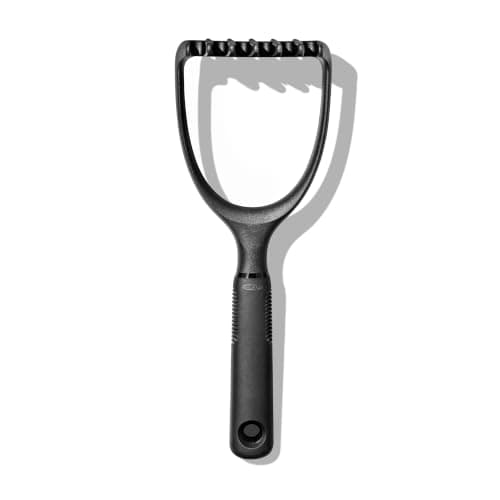
OXO OXO Good Grips Nylon Potato Masher
OXO Good Grips Nylon Potato Masher

The one to buy if you mash in the nonstick pan you cooked in — high-heat nylon that will not score the coating.

Nonstick pans
8.3
$11.99Amazon
05
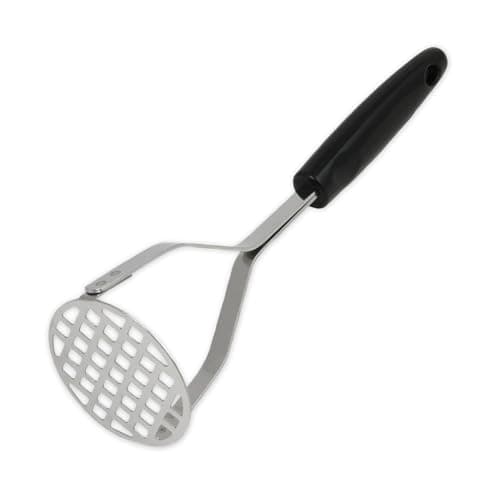
Chef Craft Chef Craft Select Sturdy Masher
Chef Craft Select Sturdy Masher

The one that costs about the same as the potatoes: stainless, dishwasher safe, and explicitly aimed at beans and smaller foods.

Spending as little as possible
8.0
$6.71Amazon

#ad · Prices pulled live from the Amazon Product API, last checked Aug 30, 2026. Where we have no verified live price we show none — we would rather leave a gap than print a number that has gone stale. Scores are our own, compiled from published specs; they are not test results.

For most kitchens the best potato masher is the KitchenAid Gourmet Stainless Steel Wire Masher: it is the only one of these five whose maker publishes a wire thickness — 4.5 mm — which is the number that decides whether a head splays the first time you lean on a firm potato. If you mash in a coated pan, none of the stainless picks are for you and the OXO Good Grips Nylon Potato Masher is the answer instead.

Wire head or plate head: the only decision that really matters

Every masher on the market is one of two tools wearing the same handle, and almost nobody says so on the packaging.

A wire headis a folded ribbon of stainless bar stock. It cuts down through the potato on narrow edges, so it needs less downward force to get through a pot, and there is no underside for potato to pack behind — you rinse it and it is clean. What it gives up is fineness. A wire head leaves lumps and texture unless you keep going, and “keep going” is exactly what you do not want to do with potato. Both OXO stainless models and the KitchenAid here are wire heads.

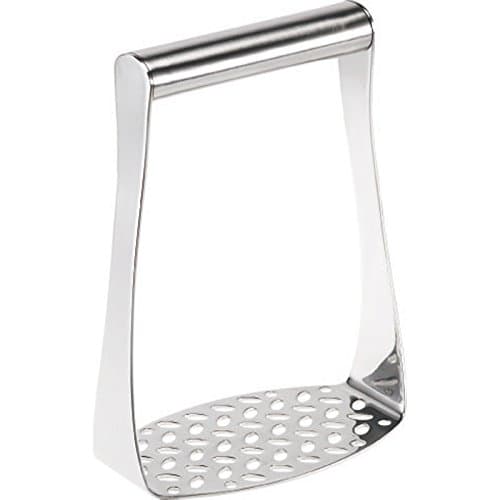
A plate head is a solid perforated disc. It presses far more potato per stroke and extrudes it through the holes, so it gets closer to a ricer’s even, fine result in fewer passes. The cost is real and it is the washing up: potato packs onto the underside and into the holes, and it does not rinse off. The Cuisipro Potato Masheris the plate design here, and Cuisipro is the only maker in this group that publishes the head footprint — 4-3/4 by 3 inches.

Neither is better. They are answers to different questions: how fine do you want the mash, and how much do you resent scrubbing a tool afterwards.

The tool is the smaller half of the result.Mash goes gluey because starch cells rupture and release free starch, and that happens from working the potato too much, not from which masher you own. A plate head gets you finer mash in fewer strokes, which is genuinely the point — but no masher rescues a waxy potato worked for two minutes. Our ricer vs masher guide explains what is happening to the starch, and why a food processor turns mash to paste in seconds.

The five mashers

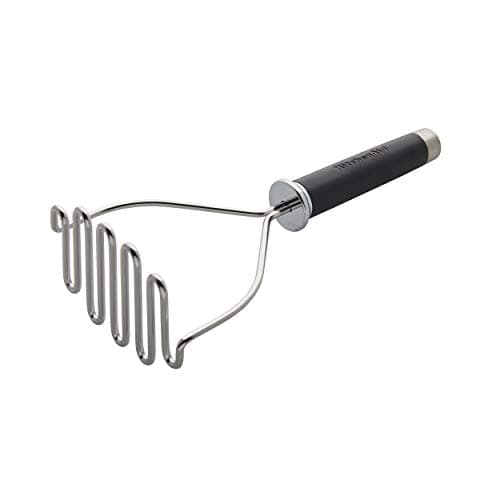
The KitchenAid Gourmet Stainless Steel Wire Masheris the pick because it is the one that shows its working. KitchenAid states a 4.5 mm stainless wire head and calls it rust-resistant, a 10.24-inch length, and a dishwasher-safe build; the handle is described as weighted and shaped for heavy use rather than simply padded. Every other maker here says “stainless” and stops. On a tool whose failure mode is a head bending open, a published gauge is not a marketing line — it is the spec. It also happens to cost less than the OXO stainless.

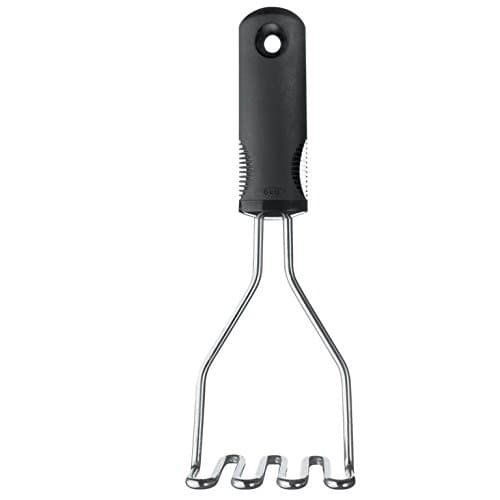
The OXO Good Grips Stainless Steel Potato Masheris the one to buy if your hands are the constraint. OXO’s declared feature is that the cushioned handle absorbs pressure, and on a full pot that is the part of the job that hurts — you are pushing through your palm, repeatedly, against resistance. It also has a large handle opening so it hangs on a rail instead of taking drawer space. The honest mark against it: OXO publishes no wire thickness for this head, so you are buying on the brand’s reputation rather than on a number, and paying more than the KitchenAid to do it.

The Cuisipro Potato Masheris the one to buy if you want mash as close to riced as a masher gets. It is the only 18/10 stainless tool here — the higher-nickel grade, stated outright rather than left vague — the listing states a lifetime warranty, and the 4-3/4 by 3-inch bottom is simply more working surface than a wire loop covers. It is also the most expensive by a clear margin and the one you will actually have to scrub. If your real goal is fine, lump-free mash and you do not care about the extra tool, buy a ricer instead and be done.

The OXO Good Grips Nylon Potato Masherexists for one situation and solves it completely: a nonstick pan. Steel — wire or plate — scores a coating, and once scored it is finished. OXO states the nylon is safe for nonstick cookware and high-heat resistant, so it can go into the pan straight off the burner, and the handle is the same soft non-slip design. The trade is stiffness. Nylon flexes under load, so a pot of firm potatoes takes noticeably more strokes than stainless would — and more strokes is the thing that makes mash gluey. Worth knowing before you decide the pan is worth it.

The Chef Craft Select Sturdy Masheris the honest budget answer. Stainless, dishwasher safe, 10.25 inches, and rated by its maker for stainless and cast iron pans; Chef Craft also calls out beans and smaller foods specifically, which is a fair description of where a fine head earns its money. It costs a small fraction of the branded tools. What you give up is the handle — a comfort-grip plastic handle rather than a cushioned or weighted one — and any published gauge, footprint or warranty term to compare against the others. For a couple of pots of mash a year, that is a completely reasonable trade.

The pan decides more than you think

This is the one place where the wrong choice costs you something other than the masher. A nonstick coating is a surface layer; a stainless wire edge dragged across it under load leaves a scratch, and a scratched coating sheds and stops being nonstick. If the pan you cook potatoes in is coated, the material question is already settled and only the nylon pick qualifies.

Stainless and cast iron are the opposite case. Both are harder than anything a masher will do to them, and there is no reason to accept nylon’s flex — Chef Craft explicitly rates its tool for both. If you are mashing in the pot you boiled in, and that pot is stainless, take the stiffer tool.

Head width against your actual pot

A masher head that is wider than the base of your pot rides up the curved sides instead of pressing potato against the bottom, and you end up mashing air at the edges. This is a real and slightly silly failure, and it is worth thirty seconds with a tape measure before you buy.

The published dimensions here are uneven, which is itself informative. KitchenAid states an overall 10.24-inch length; Cuisipro states a 4-3/4 by 3-inch head bottom; Chef Craft states 10.25 inches. OXO publishes neither head width for the stainless model in the listing specifications, which is the sort of gap this site will not fill with a guess. Where a number is not published, we have not invented one.

How they compare

MasherHeadPublished dimensionBest for
KitchenAid Gourmet Stainless Steel Wire MasherStainless wire, 4.5 mm10.24 in longMost kitchens
OXO Good Grips Stainless Steel Potato MasherStainless wire, gauge not publishedNot publishedBig pots, tired hands
Cuisipro Potato Masher18/10 stainless plate4-3/4 x 3 in bottomThe finest mash
OXO Good Grips Nylon Potato MasherHigh-heat nylonNot publishedNonstick pans only
Chef Craft Select Sturdy MasherStainless10.25 inSpending as little as possible

Which one to buy

Buy the KitchenAid Gourmet Stainless Steel Wire Masher unless something below describes you. It is the only one with a published wire gauge, it is dishwasher safe, and it is cheaper than the OXO stainless it sits beside.

Buy the OXO Good Grips Stainless Steel Potato Masherif you mash big pots or have hands that object — the cushioned handle is a real feature on a tool you push with your palm. Buy the Cuisipro Potato Masher if you want the finest mash a masher can give and will accept the scrubbing. Buy the OXO Good Grips Nylon Potato Masher if the pan is coated, in which case it is not really a choice. Buy the Chef Craft Select Sturdy Masher if you mash twice a year and want to spend accordingly.

And if what you actually want is restaurant-smooth, lump-free mash, buy a potato ricerrather than a better masher. A ricer extrudes the potato exactly once, which is why it gives a lighter result than any amount of mashing — the ricer vs masher comparison sets the two against each other properly. A masher earns its drawer space by being the tool that also does avocado, beans, cooked apple and squash, in the pot, with nothing to assemble.

In detail

The picks, in full

01
KitchenAid KitchenAid Gourmet Stainless Steel Wire Masher

Most kitchens

KitchenAid Gourmet Stainless Steel Wire Masher

Publishes its wire gauge
8.8/10

The only masher here that publishes a wire gauge, on a wide head and a weighted handle — and it costs less than the obvious alternative.

Mashing efficiency
8.5
Handle comfort
8.5
Cleaning
9
Build
9
Value
8.8

What it gets right

  • The only masher here with a published wire thickness — 4.5 mm, which is what stops a head splaying under load
  • Handle is weighted and shaped for heavy use rather than just padded
  • Wire head has no underside for potato to pack into, so it rinses clean

What it doesn't

  • A wire head leaves more texture than a perforated plate — this is not the tool for silky mash
  • Stainless wire will mark a nonstick pan

What it costs to run

KitchenAid publishes no usable wattage for this machine, so we do not show a running-cost figure for it. Here is the method we would have used.

Skip this if…

You mash in a nonstick pan — stainless wire scratches the coating, and the nylon OXO below is the tool for that pan.

$14.99on Amazon

Price last checked Aug 30, 2026. Prices move constantly — Amazon's at checkout is the one that counts.

#ad · we may earn a commission from this link to KitchenAid Gourmet Stainless Steel Wire Masher

02
OXO OXO Good Grips Stainless Steel Potato Masher

Anyone who mashes a big pot

OXO Good Grips Stainless Steel Potato Masher

Cushioned handle
8.6/10

The cushioned handle is the whole argument: a masher is a tool you push through with your palm, and this is the one that does not punish it.

Mashing efficiency
8.5
Handle comfort
9.2
Cleaning
9
Build
8.5
Value
8

What it gets right

  • OXO declares the handle absorbs pressure, which is the fatigue point on a big pot of potatoes
  • Large handle opening, so it hangs on a rail instead of eating drawer space
  • Same wire-head cleaning advantage, and dishwasher safe

What it doesn't

  • OXO publishes no wire thickness, so the head cannot be compared on paper with the KitchenAid
  • Costs more than the KitchenAid while publishing less about itself

What it costs to run

OXO publishes no usable wattage for this machine, so we do not show a running-cost figure for it. Here is the method we would have used.

Skip this if…

You want to compare build on published numbers before you buy — OXO states no gauge for this head, and the KitchenAid does.

$21.66on Amazon

Price last checked Aug 30, 2026. Prices move constantly — Amazon's at checkout is the one that counts.

#ad · we may earn a commission from this link to OXO Good Grips Stainless Steel Potato Masher

03
Cuisipro Cuisipro Potato Masher

The finest mash without a ricer

Cuisipro Potato Masher

18/10 stainlessPlate head — more to clean
8.2/10

The plate masher: a wide solid bottom that moves far more potato per stroke, in 18/10 stainless, with a lifetime warranty behind it.

Mashing efficiency
9.2
Handle comfort
8
Cleaning
7
Build
9.2
Value
7.8

What it gets right

  • The only published head footprint in this group — 4-3/4 by 3 inches of working surface
  • 18/10 stainless is the higher-nickel grade, stated outright rather than left as 'stainless'
  • The listing states a lifetime warranty, the longest here

What it doesn't

  • A perforated plate traps potato on its underside — this is the one you will scrub
  • The most expensive masher here by a clear margin

What it costs to run

Cuisipro publishes no usable wattage for this machine, so we do not show a running-cost figure for it. Here is the method we would have used.

Skip this if…

Washing up decides your tools — a plate head holds food behind it in a way a wire head simply does not.

$28.34on Amazon

$30.006% off

Price last checked Aug 30, 2026. Prices move constantly — Amazon's at checkout is the one that counts.

#ad · we may earn a commission from this link to Cuisipro Potato Masher

04
OXO OXO Good Grips Nylon Potato Masher

Nonstick pans

OXO Good Grips Nylon Potato Masher

Nonstick safe
8.3/10

The one to buy if you mash in the nonstick pan you cooked in — high-heat nylon that will not score the coating.

Mashing efficiency
7.5
Handle comfort
8.8
Cleaning
8.8
Build
7.8
Value
8.8

What it gets right

  • The only pick here you can use in a coated pan without ruining it
  • OXO states the nylon is high-heat resistant, so it can go into the pan straight off the heat
  • Cheapest of the OXO options and the lightest tool in the group

What it doesn't

  • Nylon flexes under load, so a pot of firm potatoes takes more strokes than stainless
  • OXO publishes no temperature ceiling for this model — 'high-heat resistant' is the whole claim

What it costs to run

OXO publishes no usable wattage for this machine, so we do not show a running-cost figure for it. Here is the method we would have used.

Skip this if…

You mash in stainless or cast iron — you gain nothing from nylon there and lose stiffness you would rather have.

$11.99on Amazon

Price last checked Aug 30, 2026. Prices move constantly — Amazon's at checkout is the one that counts.

#ad · we may earn a commission from this link to OXO Good Grips Nylon Potato Masher

05
Chef Craft Chef Craft Select Sturdy Masher

Spending as little as possible

Chef Craft Select Sturdy Masher

Cheapest here
8.0/10

The one that costs about the same as the potatoes: stainless, dishwasher safe, and explicitly aimed at beans and smaller foods.

Mashing efficiency
7.8
Handle comfort
7
Cleaning
8.5
Build
7.5
Value
9.2

What it gets right

  • A fraction of the price of the branded mashers and still stainless and dishwasher safe
  • Chef Craft calls out beans and smaller foods specifically, which is where a fine head earns its keep
  • Rated by the maker for stainless and cast iron pans

What it doesn't

  • The handle is plastic with a comfort grip rather than a cushioned or weighted design
  • No published wire gauge, head footprint or warranty term to compare against the others

What it costs to run

Chef Craft publishes no usable wattage for this machine, so we do not show a running-cost figure for it. Here is the method we would have used.

Skip this if…

You mash often or in quantity — at this price the handle is the compromise, and it is the part your palm meets.

$6.71on Amazon

$8.9925% off

Price last checked Aug 30, 2026. Prices move constantly — Amazon's at checkout is the one that counts.

#ad · we may earn a commission from this link to Chef Craft Select Sturdy Masher

Getting better mash out of whichever one you buy

None of the following is a test result — this site runs no kitchen lab, and how we pick says so plainly. What follows is standard cooking practice, offered because it changes the result more than the choice between these five tools does.

Start with the right potato.Floury, high-starch varieties — russets, King Edwards, Maris Pipers — break down into fluffy mash. Waxy potatoes hold their shape, which is exactly what you want in a salad and exactly what you do not want here; work them hard enough to smooth out and you get the gluey texture instead.

Cook them in big pieces, or whole. Small cubes have far more cut surface, so they take on more water, and waterlogged potato mashes to a slack paste no matter what you use. Start them in cold salted water so the outsides do not overcook before the middles are done.

Dry them before you mash. Drain, then leave them in the hot dry pan over a low burner for a minute so the surface moisture steams off. This is the step most people skip and it does more for the final texture than any tool on this page.

Warm the dairy, and add it after. Cold butter and milk hitting hot potato seizes the starch and tempts you into more mashing to fix it. Mash first, then fold warm dairy in with a spoon or spatula.

Stop early.Every stroke past “done” is rupturing more starch. A few lumps are a normal, and frankly correct, feature of hand-mashed potato. If lump-free is the requirement, that is a ricer or a food mill, not a harder-working masher.

What a masher does besides potatoes

This is most of the argument for owning one even if you also own a ricer. OXO and KitchenAid both list root vegetables and fruit; KitchenAid adds avocado, apples and nuts; Chef Craft points at beans. In practice a masher is the tool for guacamole, refried beans, cooked apple, roasted squash, banana for baking, and any small job where getting out a machine is absurd — all of it done in the pan you cooked in, with one thing to wash.

That is a different value proposition from a ricer, which does one job better than anything else and nothing else at all. If you have space for one tool and you mash more than potatoes, the masher is the more useful object. If you make Sunday mash and want it perfect, the ricer wins outright.
How we picked

Tools we claim to have lab-tested: 0

Every site in this category tells you they ran twenty machines through a lab. We have not, and we say so. Here is what we do instead: read the manufacturer's manual and spec sheet, record the published bowl capacity, motor rating, blade and disc counts and materials, cross-check the warranty against the manufacturer's own warranty document, and cite all of it so you can check the work. Prices come live from Amazon's API and disappear rather than go stale.

The scores above are judgments from that documented research — not test results. The full rubric, including what disqualifies a product, is published in full.

Questions

Frequently asked

What is the best potato masher?
For most kitchens, the KitchenAid Gourmet Stainless Steel Wire Masher— it is the only masher here whose maker publishes a wire thickness (4.5 mm), which is the figure that decides whether the head holds its shape under load, and it is dishwasher safe. If you mash in a nonstick pan, buy the OXO Good Grips Nylon Potato Masher instead; steel will score the coating.
Is a wire masher or a plate masher better?
They do different jobs. A wire head needs less force, has no underside to trap food and rinses clean, but leaves more texture. A perforated plate presses more potato per stroke for a finer mash, and is much more annoying to wash. Choose the plate if fineness matters most, the wire if cleaning does.
Can you use a metal potato masher in a nonstick pan?
No. A stainless edge dragged under load scratches the coating, and a scratched nonstick pan stops being nonstick. Use a nylon masher — OXO states its nylon model is safe for non-stick cookware and high-heat resistant — or transfer the potatoes to a bowl.
Why does my mashed potato go gluey?
Overworking it. Mashing ruptures starch cells and releases free starch, and the more strokes you make the more of that you get. Waxy potatoes and waterlogged potatoes make it worse, and a food processor does it in seconds. Use a floury variety, dry the potatoes after draining, and stop mashing sooner than feels finished.
Do I need a masher if I already have a potato ricer?
Only if you mash things that are not potatoes. A ricermakes better mash, full stop, but it does essentially one job and has to be loaded in batches. A masher handles guacamole, beans, cooked apple and squash in the pan, with nothing to assemble — which is why plenty of kitchens keep both.

Keep reading