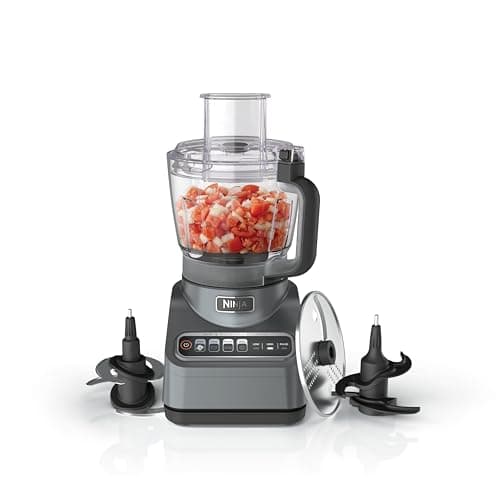
The Ninja BN601 is the value pick in the food processor roundup, and its case is straightforward: a lot of motor and a dedicated dough blade for well under half the price of the premium Cuisinart and Breville machines. If dough is on your list and budget matters, this is the machine to look at first.
About that “1,000 peak watts”
Ninja headlines a peak-watt figure — the draw in the first split-second of spin-up — because it is a bigger number than the continuous wattage that actually does the work, which Ninja does not publish. That is worth knowing: a 1,000-peak-watt Ninja and a 720-watt Cuisinart are closer in real, sustained power than the numbers suggest. It is still a strong motor for the money, and the included dough blade is a genuinely useful piece of kit that the pricier machines make you pay extra for.
The 9-cup bowl is the real trade-off
The catch is capacity. At 9 cups, the bowl is meaningfully smaller than the 13–16 cup full-size machines, so it fills faster and you will work in batches for a big cook. For a couple or a small family that is fine; for batch cooking it is the reason to size up to a Cuisinart. The Auto-iQ preset programs are a nice touch for hands-off chopping, though most cooks end up using the simple pulse. Skip this one if you want the biggest possible bowl; buy it if you want the most capable motor for the money and a dough blade in the box.
That dough blade is worth one more paragraph, because it does a job almost nobody buys it for. It is the correct tool for shredding cooked chicken — blunt plastic tears the meat into strands where the sharp S-blade minces it into paste — which makes the BN601 the cheapest machine in our catalog that comes ready for that job.
The brand most people cross-shop against it is KitchenAid, and that comparison turns on what is in the box rather than on power, because KitchenAid publishes no wattage for any of its processors: KitchenAid vs Ninja sets the dough blade against the dicing kit at full size, and the Express Chop against the 3.5-cup KitchenAid chopper at the small size.
How we picked
Tools we claim to have lab-tested: 0
Every site in this category tells you they ran twenty machines through a lab. We have not, and we say so. Here is what we do instead: read the manufacturer's manual and spec sheet, record the published bowl capacity, motor rating, blade and disc counts and materials, cross-check the warranty against the manufacturer's own warranty document, and cite all of it so you can check the work. Prices come live from Amazon's API and disappear rather than go stale.
The scores above are judgments from that documented research — not test results. The full rubric, including what disqualifies a product, is published in full.