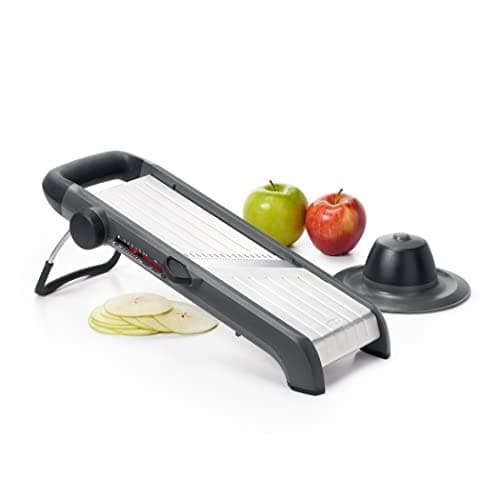
If you want the mandoline with the most published protection, buy the OXO Good Grips Chef's Mandoline Slicer 2.0. It is the only pick here whose listing states both a food holder and a runway guard — two separate pieces of hardware doing two separate jobs — alongside 21 thickness settings and a body that folds for storage. Then buy a pair of NoCry Cut Resistant Gloves (Food Grade) anyway, because a food holder protects the hand holding the food and does nothing at all for the hand steadying the frame, or for the last inch of a potato. The ranking below is ordered on exactly that: what the maker publishes, and where it stops.
Two hands, two risks, two pieces of kit. The hand pushing the food is protected by the food holder — the spiked cap you press the vegetable into. The hand bracing the mandoline, or reaching to clear a stuck slice, is protected by nothing the tool ships with; that is what a cut-resistant glove is for. Treat them as a pair rather than alternatives. Our honest assessment of what gloves stop explains why: knit defeats a blade sliding across it, which is exactly the mandoline injury, and does essentially nothing against a point.
The two moments a food holder does not cover
The last inch. A food holder grips a vegetable by pressing spikes into the top of it. As the vegetable shortens, there is less material for the spikes to hold, and the temptation to finish the job with bare fingers is where most of this category’s injuries happen. The discipline is simple and unpopular: when the piece is down to about an inch, stop. Keep the stub for stock, or finish it with a knife on a board.
Round and awkward food. A food holder is designed around a potato, an onion, a courgette — things with a flat-ish top the spikes can bite. A tomato, a ball of mozzarella, a small shallot or anything whose skin is slick will spin inside the holder instead of being held by it. Halve round food first to give the holder a flat face, and accept that some items are a knife job.
The five, ranked on published protection
1. A food holder and a runway guard
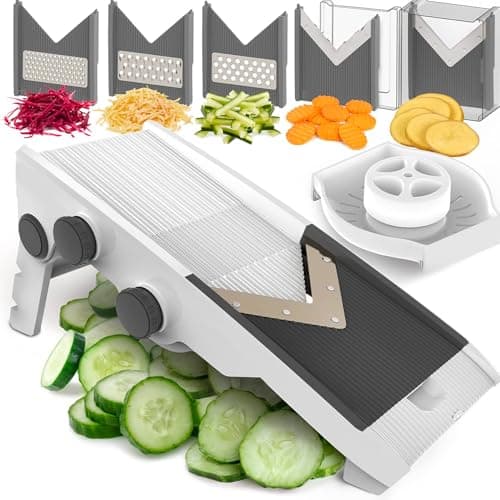
The OXOpublishes an included food holder plus a runway guard, which is the piece most makers leave out — it covers the blade bed when the slicer is not actively in use, which is when a hand reaching across a counter meets an exposed edge. The rest of the tool backs it up: 21 thickness settings on a dial, straight and crinkle slices plus julienne and French-fry cuts, and a stable body that does not skate. It is one of the pricier mandolines in the catalog and bulkier to store than a flat handheld, which are the two honest reasons to look elsewhere.
2. The guard included, for a third of the money
The Mueller Austria Multi-Blade Adjustable Mandoline publishes a hand-guard food holder, five interchangeable stainless blades and an adjustable thickness dial, and it folds reasonably flat. For an occasional slicer it is a lot of tool for very little money, and the guard is the same shape of protection as the OXO’s. What you give up is rigidity and edge life: the plastic frame flexes a little under hard pressure, and the blades dull faster than the premium tools. Flex is a safety matter as much as a cut-quality one — a frame that gives moves the blade while your hand is moving too.
3. Guard included, but you are holding it
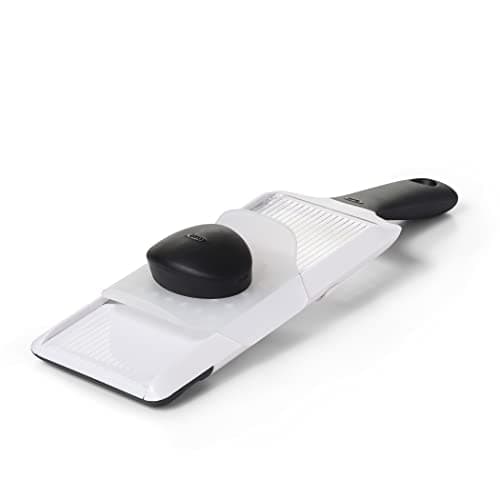
The OXO Good Grips Hand-Held Mandoline Slicer is a flat handheld slicer with a non-slip grip, a dial for thickness and an included hand guard. For a few slices over a bowl it is the quickest thing here and it lives in a drawer. The honest trade is stability: you hold it rather than resting it on the counter, so one hand is committed to the tool and the geometry is less predictable than a countertop frame. That is why it sits third on a page about protection rather than first on a page about convenience.
4. The sharpest blade, and the thinnest guard
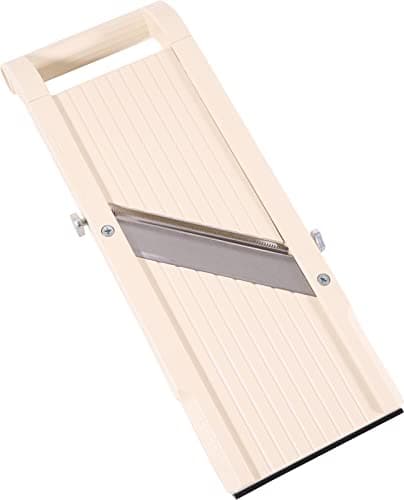
The Benriner Super Slicer (Japanese Mandoline) is the cut-quality winner on this site and it is ranked fourth here on purpose, because its own honest description is the reason: the included guard is minimal. It is an extra-wide Japanese slicer with a flat blade plus three interchangeable julienne blades and a screw-set thickness dial, and it is unforgiving of careless hands. Buy it for the cut, and buy a glove with it in the same order. If you are nervous around sharp tools, buy something else — we say that on its own card too.
5. The protection no mandoline ships
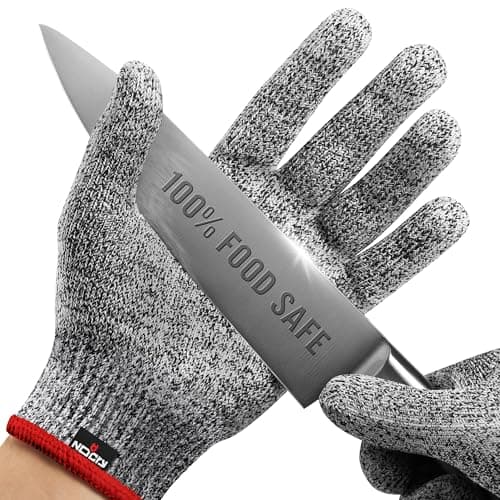
NoCry Cut Resistant Gloves (Food Grade) is the only pick here that covers the hand the food holder ignores. Its listing states EN388:2016 Level 5 and ANSI 105-2016 ratings, food-grade material, an ambidextrous fit and machine washability — which is the full set of claims you want, cheap enough that there is no argument against it. The limit is published too and it matters: cut resistance is not puncture resistance, so a knife tip or a fork still goes through. A glove converts a bad accident into a near miss; it is not permission to be careless.
What each listing says is in the box
| Pick | Published protection | Thickness control | Form factor | Where it stops |
|---|
| OXO Good Grips Chef's Mandoline Slicer 2.0 | Food holder and runway guard | 21 settings via a dial | Countertop, folds | The last inch; round food |
|---|
| Mueller Austria Multi-Blade Adjustable Mandoline | Hand-guard food holder | Adjustable dial | Countertop, folds fairly flat | Frame flexes under hard pressure |
|---|
| OXO Good Grips Hand-Held Mandoline Slicer | Hand guard; non-slip grip | Dial-adjustable | Handheld over a bowl | You are the stand — less stable |
|---|
| Benriner Super Slicer (Japanese Mandoline) | Guard included, stated as minimal | Screw-set dial | Fixed wide frame | Sharpest blade here; glove required |
|---|
| NoCry Cut Resistant Gloves (Food Grade) | EN388:2016 Level 5, ANSI 105-2016, food grade | Not applicable | Worn, ambidextrous | Not puncture resistant — points go through |
|---|
How to use the guard so it actually works
Press the food holder onto the vegetable firmly enough that the spikes seat before the first pass, and hold it by the cap rather than by the rim — fingers on the rim sit closer to the blade than they feel. Keep the stroke long and even; short, hurried strokes are what makes a holder jump off the food. Let go of the pressure at the end of each pass rather than dragging the holder back over the blade. And set the thickness before you start, not mid-batch with a hand on the bed. The full routine, including the setup that stops a mandoline sliding on a worktop, is in our mandoline safety guide.
Why this page is not the gloves page
Our cut-resistant glove roundup ranks gloves against each other on rating, fit and washability, and the glove levels explainer decodes EN388 and ANSI. This page ranks mandolines on the protection their own listings state is included, because that is what the search asks. The two sets of pages point at each other deliberately: the right answer is one tool with a published guard plus one glove, not a choice between them.
What "hand guard" means on a listing — and what it does not
Food holder. The spiked cap you press into the vegetable. Every countertop pick here publishes one. It protects the pushing hand only.
Runway or blade guard. A cover over the blade bed for when the tool is idle or being carried to the sink. Only the OXO 2.0 states one. This is the piece that stops the injury that happens when nobody is slicing.
Cut-resistant glove. Not supplied with any mandoline in this catalog. It is the only thing that protects the bracing hand, and it is the cheapest item on the page.
Nothing on this list is cut-proof. Mercer, which makes the most heavily constructed glove we rank, states on its own listing that its glove is not cut proof, not puncture resistant and must not be used with moving or serrated blades. That is a glove maker describing the limits of gloves, and it applies to food holders every bit as much.
What we are not claiming
We have not tested these tools, and we have not cut anything with or without a guard. Every claim above about what is in the box — food holder, runway guard, hand guard, blade counts, thickness settings, glove ratings — is the manufacturer’s own published wording, cited below. Where a maker describes its own guard as minimal, we quote that rather than soften it. The technique guidance is standard kitchen practice, not a test result. Prices come live from Amazon with the date attached.