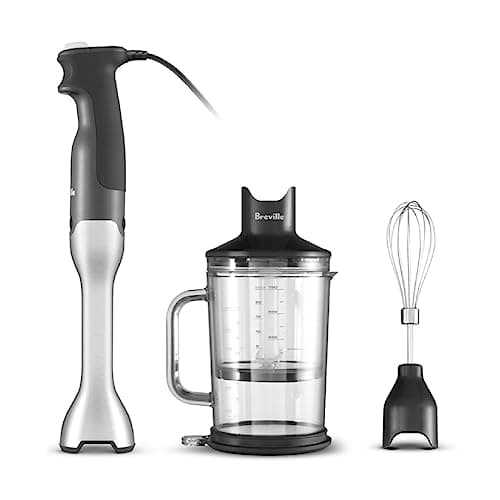
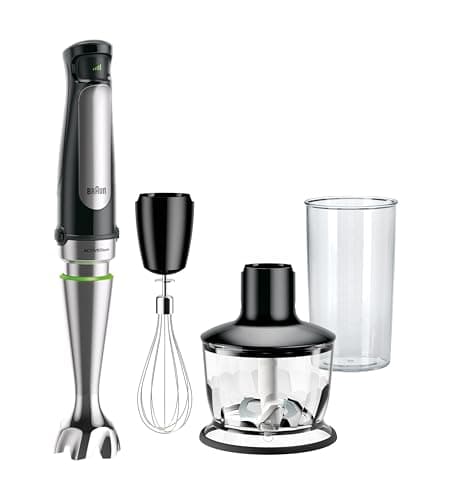
For soup, the Braun MultiQuick 7 (MQ7035X) is the pick, and the deciding spec is one almost nobody shops on: splash control. Blending a pot of hot soup is the single most likely way to burn yourself in a home kitchen, and the shape of the bell around the blade decides how much of that soup ends up on your forearm. Braun’s anti-splash bell is the best-shaped one here, and its variable speed is set by trigger pressure, so you can start gently instead of guessing at a dial.
The three specs that matter for soup
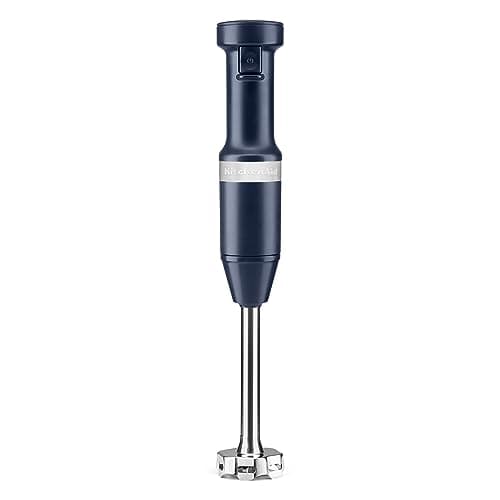
Shaft reach. A stick blender has to reach the bottom of your stock pot without the motor housing dipping toward the surface. The KitchenAid Variable-Speed Corded Hand Blender (KHBV53)publishes an 8-inch blending arm, which is the longest documented reach in this catalog and the reason it is here — if you make soup in a tall pot, that number is the one to shop on.
Splash control. The bell around the blade either directs the flow back down into the pot or lets it climb the sides. The Braun MultiQuick 7 (MQ7035X) and the Breville Control Grip Immersion Blender (BSB510XL) both publish anti-splash designs; the Breville also states its guard is anti-suction, which stops the blender clamping itself to the bottom of the pot mid-blend.
Whether it will wreck your pan. This is the one people learn the hard way. A bare metal guard spinning against a non-stick pot is a scratched pot. The Breville Control Grip Immersion Blender (BSB510XL) publishes a non-scratch base, and the KitchenAid Variable-Speed Corded Hand Blender (KHBV53) ships a removable pan guard specifically to protect cookware. If your soup pot is non-stick or enamelled, treat that as a requirement rather than a nicety.
The safety rule for hot soup. Take the pot off the heat, let it stop bubbling, and submerge the blade fully before switching on. Never lift a running blender to the surface. Most burns come from starting the motor with the head half out of the liquid, which throws boiling soup in an arc.
The table: motor, and what it costs to run
Motor wattage is worth a little more here than in most prep categories — a thick potato-and-leek soup is a real load — but not as much as the boxes imply. It is printed below in each manufacturer’s own words, with the annual electricity cost alongside to keep the number in proportion.
Running cost assumes 3 minutes a day, 365 days a year, at 17.45¢ per kWh (US EIA, Electric Power Monthly — average residential price, US total, retrieved July 2026) — generous for a tool that runs for a minute at a time. Where a brand publishes no wattage, the cell says so rather than carrying a guess.| Blender | Published motor | Est. cost / year |
|---|
| Braun MultiQuick 7 (MQ7035X) | Not published | not published |
|---|
| Breville Control Grip Immersion Blender (BSB510XL) | 280 W | $0.89 |
|---|
| KitchenAid Variable-Speed Corded Hand Blender (KHBV53) | 180 W | $0.57 |
|---|
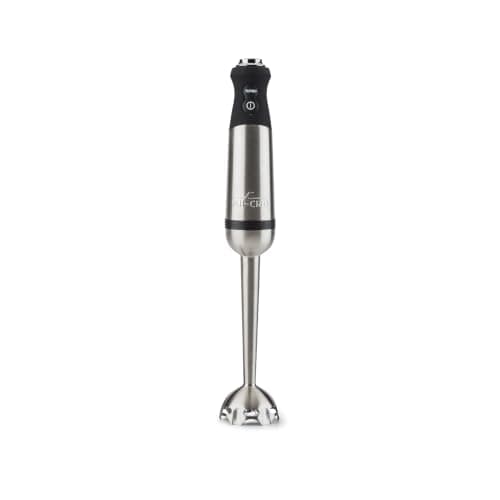
| All-Clad Stainless Steel Immersion Blender | 600 W | $1.91 |
|---|
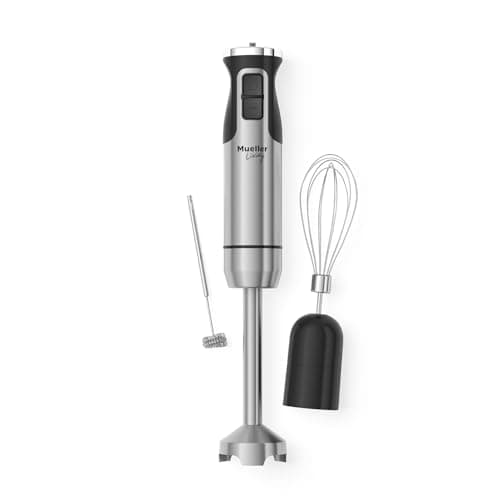
| MuellerLiving Ultra-Stick 500W Immersion Blender | 500 W | $1.59 |
|---|
Which one for which pot
Buy the Braun MultiQuick 7 (MQ7035X) for the best all-round soup blender: the least spatter, speed controlled by how hard you squeeze, and a food processor bowl and whisk in the box for everything else. Buy the Breville Control Grip Immersion Blender (BSB510XL)if your soup pot is non-stick or enamelled — the non-scratch, anti-suction bell is the design that respects cookware most, and its 280-watt motor is plenty for a puree.
Buy the KitchenAid Variable-Speed Corded Hand Blender (KHBV53) if you make soup in a genuinely deep stockpot; the 8-inch arm reaches where the others do not, and the removable pan guard covers the cookware question. The All-Clad Stainless Steel Immersion Blenderis the choice for thick, heavy purees — a published 600 watts in an all-stainless body — if you are willing to pay for it. And the MuellerLiving Ultra-Stick 500W Immersion Blenderis the value answer at a published 500 watts with a nine-speed dial, which makes an excellent soup blender for a fraction of the others’ price.
The other job this tool quietly owns is gravy, which is why a stick blender is one of the three things we would buy first in our Thanksgiving prep tool roundup— blending in the pan is both faster and far safer than pouring hot liquid into a sealed jar.
How we picked
Tools we claim to have lab-tested: 0
Every site in this category tells you they ran twenty machines through a lab. We have not, and we say so. Here is what we do instead: read the manufacturer's manual and spec sheet, record the published bowl capacity, motor rating, blade and disc counts and materials, cross-check the warranty against the manufacturer's own warranty document, and cite all of it so you can check the work. Prices come live from Amazon's API and disappear rather than go stale.
The scores above are judgments from that documented research — not test results. The full rubric, including what disqualifies a product, is published in full.