A cut-resistant glove costs about a tenth of the mandoline it protects you from, and it is the one piece of kitchen safety equipment that professionals actually wear. Our mandoline safety guide puts it in the method for a reason: the guard covers the hand you can see, and the glove covers the moment you stop paying attention. Buy one with the slicer, not after the accident.
What the ratings on the packet mean
Two published scales matter, and both appear on the products below. EN388 is the European standard; its cut-resistance result is what “Level 5” refers to on the 2003 scale, while the 2016 revision reports a letter grade (A to F) from a different test method. ANSI/ISEA 105 is the American scale, running A1 to A9, where A5 is well into the range used for meat processing. A glove that publishes neither is making a marketing claim, not a safety claim.
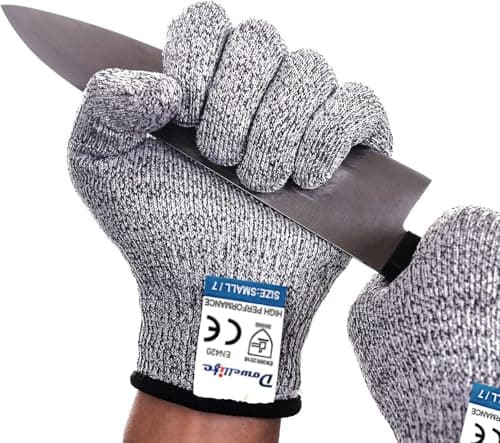
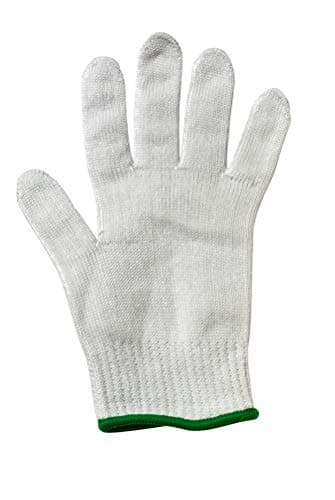
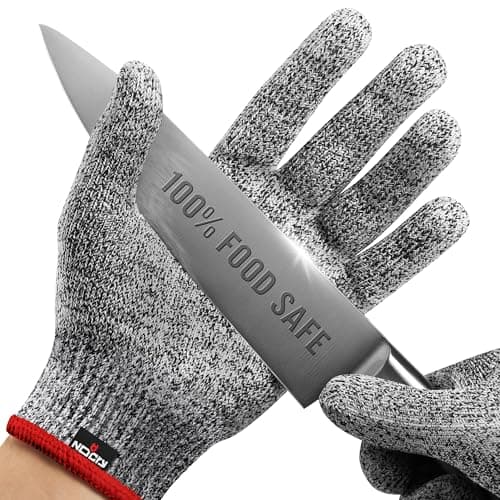
The NoCry Cut Resistant Gloves (Food Grade) states EN388:2016 Level 5 and ANSI 105-2016. The Dowellife Cut Resistant Gloves (Level 5) states EN388:2003 Level 5, which its listing maps to EN388:2016 Level C. The Mercer Culinary Millennia Level A5 Cut Glove states ANSI Level A5. All three are in the right territory for a mandoline; the differences that will actually change your experience are fit and whether you can wash them without ceremony.
If the ratings themselves are what you came for rather than a pick, we unpacked them properly in cut-resistant glove levels explained — the full ANSI A1 to A9 table with the gram thresholds, both EN 388 scales, and why two gloves can both say “Level 5” and not mean the same thing.
The limit worth reading twice. Cut resistance is not puncture resistance. These gloves resist a blade sliding across the fabric. A knife tip, a fork or a skewer will go straight through, and Mercer states explicitly that its glove must not be used with moving or serrated blades. A glove is protection for mandoline and grater work. It is not a license to be careless with a knife.
Which one to buy
For most kitchens, the NoCry Cut Resistant Gloves (Food Grade). It publishes the clearest current ratings, it is food grade, it is ambidextrous so either hand and either cook is covered, and it is machine washable — which matters more than it sounds, because a glove that is annoying to clean is a glove that ends up in a drawer instead of on your hand.
The Dowellife Cut Resistant Gloves (Level 5) is the pick if fit is your priority. Its HDPE knit is blended with elastic nylon, so it sits closer to the hand than the others, and a close fit is what lets you feel a potato shrinking under the guard. Each cuff has a hanging ring, so the pair lives next to the mandoline rather than balled up in a drawer.
The Mercer Culinary Millennia Level A5 Cut Gloveis the professional option: stainless-steel-reinforced knit, ANSI A5, color-coded cuffs so a shared kitchen can size at a glance, and washable at 180°F. The catch is that it is sold as a single glove rather than a pair, so covering both hands costs twice — which is fine, because you should only be gloving the guiding hand anyway.
How they compare
| Glove | Published rating | Construction | Washing | Sold as |
|---|
| NoCry Cut Resistant Gloves (Food Grade) | EN388:2016 Level 5; ANSI 105-2016 | Food-grade cut-resistant knit | Machine washable | Ambidextrous pair |
| Dowellife Cut Resistant Gloves (Level 5) | EN388:2003 Level 5 (2016 Level C) | HDPE with elastic nylon blend | Hand or machine | Ambidextrous pair |
| Mercer Culinary Millennia Level A5 Cut Glove | ANSI Level A5 | Stainless-steel reinforced knit, 10 gauge | Machine, up to 180°F | Single glove |
Wearing it properly
Glove the hand that holds the food, not the hand that works the tool. On a mandoline that is the guiding hand; on a box grater it is the hand holding the block of cheese as it gets small. Size matters: a loose glove bunches, and bunched fabric catches on a blade. It should feel snug enough that you can still pinch a coin off the counter through it.
And keep using the hand guard. A glove and a food holder protect against different failures — the holder keeps your hand physically above the blade, the glove catches the moment the holder slips or the last inch of a potato is too small to hold. Our safety guide is explicit that the answer to “guard or glove” is both.
When a glove is not the answer
If the reason you are reaching for a glove is that a mandoline frightens you, consider whether you need one at all. A food processorwith a slicing disc encloses the blade entirely and does the same job for most recipes — our mandoline vs food processor comparison lays out where each one wins. The mandoline earns its place on adjustability and on a cut quality a disc cannot match, not on being unavoidable.
It is also worth being clear about what a glove is and is not for before you rely on one. It defeats a sliding edge, which is exactly what a mandoline, a grater and a dicing grid present; it does very little against a knife point, and it should come off entirely near anything powered or serrated — Mercer says so on its own listing. Do cut-resistant gloves work? goes through those limits, plus the washing and food-safety answers, in full.