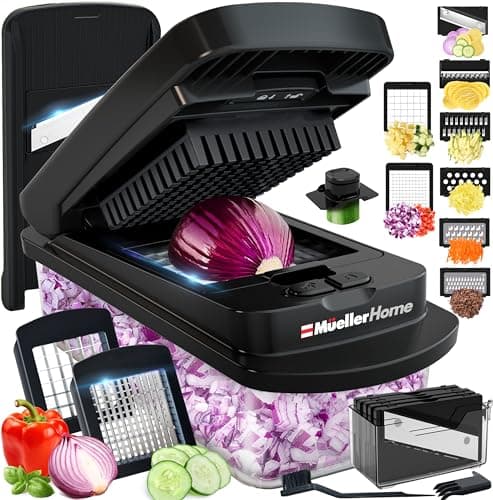
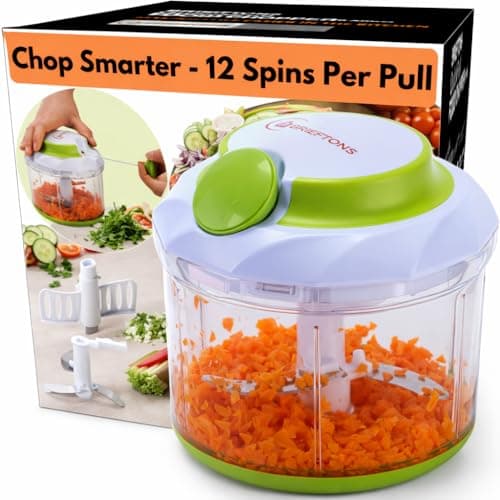
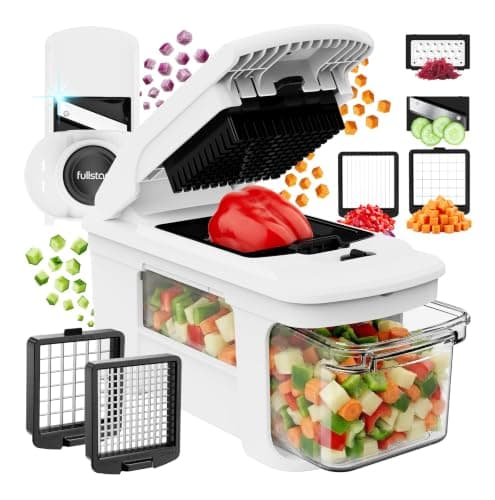
“Manual” covers two different tools here. The Fullstar Pro XL Vegetable Chopper & Mandoline and Mueller Pro-Series 10-in-1 Vegetable Chopperare push-dicers — press the lid and food drops through a grid as neat cubes — while the Brieftons QuickPull Manual Food Chopper (4-Cup) is a pull-cord chopper that minces like an electric with no outlet. The Fullstar wins overall because a tidy dice is the thing you cannot get any other cheap way.
Push-dicers: the even cube, no electricity
A push-dicer is the only affordable tool that produces a genuinely uniform dice — the even cubes a spinning blade turns to mush and a processor manages only with a pricey dicing kit. There is no motor to burn out, it stores flat, and a catch container keeps the counter clean. The trade is muscle: soft foods like onion and tomato drop through easily, but a raw carrot or sweet potato takes a firm, deliberate shove. If your hands or wrists are not up to that, an electric chopper from the electric roundup is the kinder tool.
Which manual chopper to buy
Buy the Fullstar Pro XL Vegetable Chopper & Mandolinefor the best all-round dicer — a well-judged set of blades, a finger guard and brush in the box, and the tidiest cube for the money. Choose the Mueller Pro-Series 10-in-1 Vegetable Chopperif you want the widest blade set, with eight inserts that add julienne and grate on top of dicing — more range, but more small parts to store and track; our full Mueller Pro-Series review goes through what each of the eight actually does. And pick the Brieftons QuickPull Manual Food Chopper (4-Cup) if you actually want a mince rather than a cube: pull the cord a few times and its stacked blades chop herbs and onions with no power and almost no noise, which is ideal for a small kitchen, an RV or a campsite.
One group should not buy the push-dicers on this page at all. Forcing a carrot or a sweet potato through a fine grid takes real downward force through both wrists, and if grip or joint strength is the constraint, that is the wrong tool however good it is — our kitchen tools for arthritic hands page says so plainly and points at the motorised alternative instead. The pull-cord Brieftons is the exception here, and it is also the pick for a kitchen with no spare socket, which is why it appears on our small-kitchen roundup too.
For the straight head-to-head — force, noise, washing-up, storage and what eventually fails on each — see electric vs manual food chopper, which also explains why the pull-cord Brieftons belongs with the electrics on the question of cut shape even though it has no motor.
Two practical follow-ups. The thing that actually decides whether a push-dicer stays in use is the washing-up, and how to clean a vegetable chopper is the sixty-second routine for a blade grid plus what each maker publishes about the dishwasher. And if what you really need is a flat slice rather than a cube, mandoline vs vegetable chopper is the comparison to read before you buy either.
One more use case worth naming, because it is the one these manual tools are quietly best at: batch prep. A push-dicer is the only mechanism here whose output lands in a lidded box rather than a bowl, and the best vegetable chopper for meal prep ranks the field on exactly that — container volume, whether it has a lid, and which cut survives four days in the fridge.
How we picked
Tools we claim to have lab-tested: 0
Every site in this category tells you they ran twenty machines through a lab. We have not, and we say so. Here is what we do instead: read the manufacturer's manual and spec sheet, record the published bowl capacity, motor rating, blade and disc counts and materials, cross-check the warranty against the manufacturer's own warranty document, and cite all of it so you can check the work. Prices come live from Amazon's API and disappear rather than go stale.
The scores above are judgments from that documented research — not test results. The full rubric, including what disqualifies a product, is published in full.