HUB 04 · Immersion Blenders
Immersion Blender Attachments, Explained
Stick blenders are sold on attachment count, which tells you nothing. Here is what each one actually does, which are worth the cupboard space, and where each stops.
We earn a commission if you buy through our links. It does not change the price you pay, and it does not decide our picks — our selection criteria are published in full. How this works.
Immersion blenders are marketed on how many pieces come in the box, which is a number that predicts almost nothing. Some of those pieces genuinely replace another appliance; others are a worse version of something you already own. This is what each one is for, in the order they are worth having.
The blending shaft
The one you bought it for: a small blade under a guard on the end of a stick. Almost all of the value of an immersion blender lives here, and the interesting variable is the shape of the guard rather than the blade.
A bell-shaped guard does two things a flat one does not. It reduces splatter, because liquid thrown outward hits the inside of the bell instead of the wall behind your stove — Braun designs the Braun MultiQuick 7 (MQ7035X)around exactly that. And it stops the head suctioning down onto the base of the pan, which is what makes a stick blender lurch and scratch. Breville’s Breville Control Grip Immersion Blender (BSB510XL) lists an anti-suction, non-scratch bell for that reason, which matters if you use non-stick pans.
Shaft length is the other spec worth checking, and it is the one nobody thinks about until they own a tall stockpot. The KitchenAid Variable-Speed Corded Hand Blender (KHBV53)publishes an 8-inch removable arm precisely so it reaches the bottom of a deep pot without you tilting it — and tilting a pot of hot soup is exactly what our hot-liquid guide tells you not to do.
The beaker
The least glamorous item in the box and the second most useful. Its value is that it is narrow: a tall, straight-sided vessel is what lets a small blade create a vortex, so mayonnaise emulsifies, a vinaigrette holds, and a smoothie blends instead of spinning away from the blade in a wide bowl. Most beakers are marked with measurements as well, which removes a measuring jug from the washing up.
If a blender you like does not come with one, any tall narrow container barely wider than the blade guard does the same job.
The whisk
A single wire whisk driven by the motor. It is genuinely good at the small jobs: a cup of cream, two egg whites, a pancake batter, a quick emulsion. It saves getting out a hand mixer and it washes in seconds.
It is not a hand mixer. Beating butter and sugar to a cream, or whipping enough egg whites for a meringue, is beyond a single whisk on a motor built for blending — it lacks the beater geometry and the sustained torque. Use it for the small jobs it is good at and do not expect it to replace a mixer.
The chopper bowl
The attachment most likely to genuinely replace another appliance, and the one people underestimate. A small bowl with an S-blade, driven by the motor head, is functionally a mini electric chopper: it does onions, garlic, herbs, nuts and a small batch of pesto. The Braun MultiQuick 7 (MQ7035X) and Cuisinart Smart Stick Variable-Speed (CSB-179) both include one.
What it does not replace is a food processor. There is no slicing disc, no shredding disc, and no dough capability — the bowl is typically two to three cups, and the mechanism is a chopping blade only. If you own an immersion blender with a chopper bowl, you probably do not also need a small chopper; you may still need a processor. Our food processor vs immersion blender comparison works through where that line falls.
The masher
A perforated plate on a shaft that presses rather than cuts. It exists because a blending blade destroys potatoes: it ruptures the starch cells and you get glue, which is the single most common immersion-blender mistake. A masher attachment avoids that.
It is a niche piece. If mash is the reason you are interested, a potato ricer makes a better result with no motor at all, and ricer vs masher explains why. The masher attachment is a convenience for people who already own the blender, not a reason to buy one.
Never put a blending blade in potatoes. This is the one attachment mistake with a genuinely bad outcome. Blending mashed potato ruptures the starch and turns it to wallpaper paste in about four seconds, and nothing recovers it. Use a masher attachment, a ricer, or a hand masher.
Which attachments are worth paying for
| Attachment | What it genuinely replaces | Where it stops |
|---|---|---|
| Blending shaft | The whole reason to own one | Cannot crush ice |
| Beaker | A measuring jug and a narrow vessel | Too small for batch work |
| Whisk | A hand mixer, for small jobs | Creaming butter; large meringues |
| Chopper bowl | A mini electric chopper | No slicing, shredding or dough |
| Masher | Nothing you must own | A ricer still makes better mash |
How to think about the count
A blender with a shaft, a beaker and a chopper bowl covers more real jobs than one with six pieces you will never fit in a drawer. Buy the attachments you can name a weekly use for. The rest are storage.
One practical note on cleaning: most blending shafts and beakers are dishwasher safe, most motor heads are emphatically not, and the fastest way to clean a shaft is to run it for five seconds in a jug of warm soapy water and rinse. Check your own manual before anything goes in a machine — the attachments differ more than the blenders do.
The hardware
The hardware this guide is about
The products this guide refers to, with prices pulled live from Amazon and dated on every card. Full rankings live in the roundups linked above.
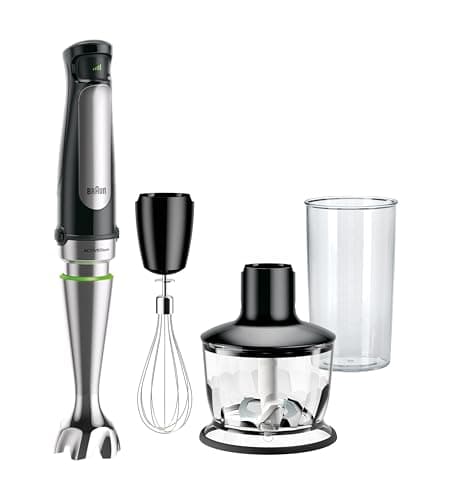
Most kitchens
Braun MultiQuick 7 (MQ7035X)
The one to own: Braun's anti-splash bell and smooth variable speed make it the most controllable stick blender here.
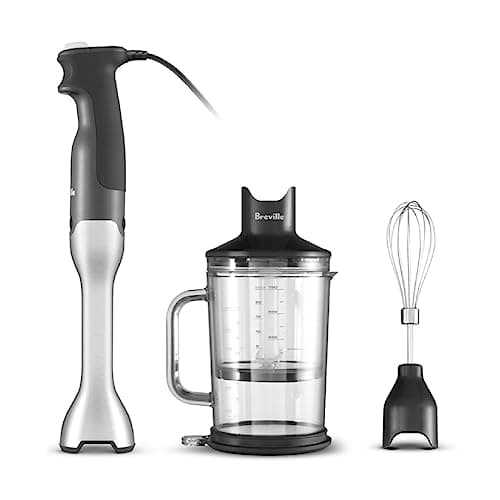
Non-stick pots and control
Breville Control Grip Immersion Blender (BSB510XL)
The enthusiast's stick blender: a bell-shaped guard that stops suction and scratching, on a 280-watt motor.
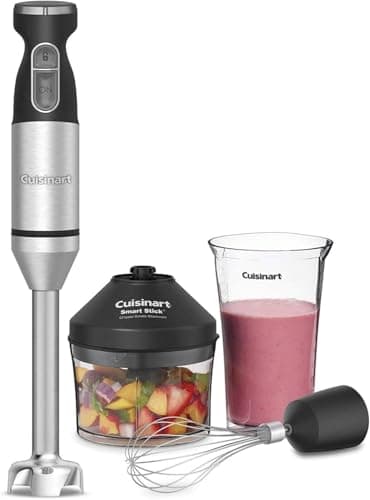
Value with attachments
Cuisinart Smart Stick Variable-Speed (CSB-179)
The sensible middle: a 300-watt Smart Stick with variable speed, a whisk and a chopper for a fair price.
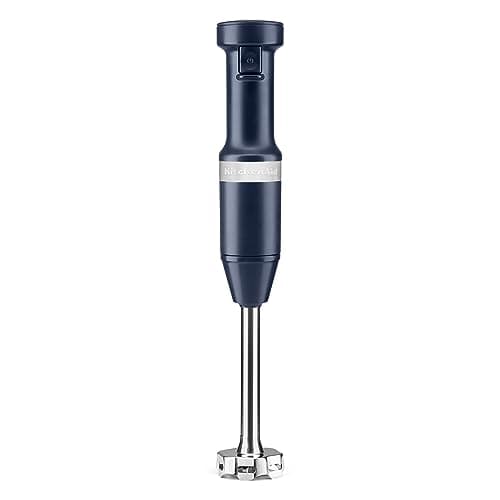
Deep pots
KitchenAid Variable-Speed Corded Hand Blender (KHBV53)
The reach specialist: an 8-inch blending arm that gets to the bottom of a tall stockpot, in solid KitchenAid metal.
#ad · As an Amazon Associate we earn from qualifying purchases.
Questions
Frequently asked
What are immersion blender attachments used for?
Can an immersion blender chopper replace a food processor?
Can you use an immersion blender for mashed potatoes?
Is an immersion blender whisk as good as a hand mixer?
Keep reading