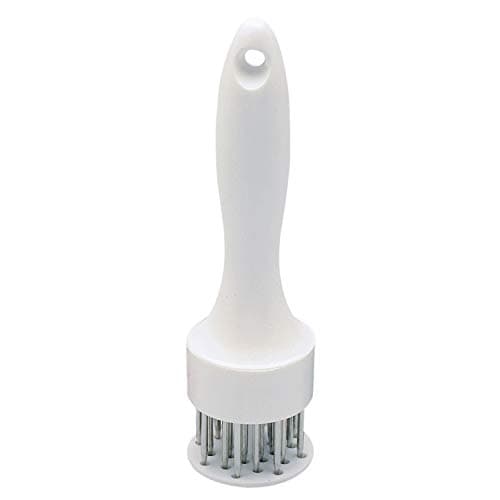
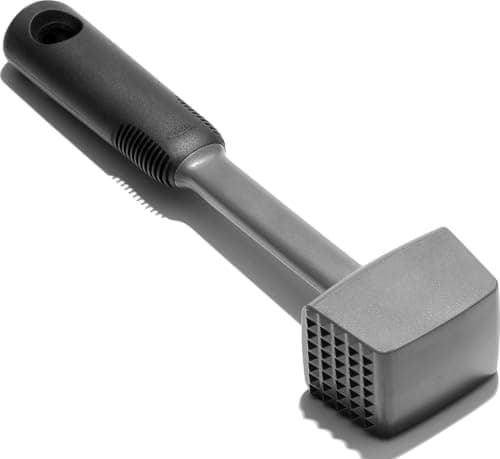
For most kitchens the best meat tenderizer is the OXO Good Grips Meat Tenderizer: a two-faced mallet that is the only one here to say what each of its faces is for, states what is inside the head, and goes in the dishwasher afterwards. But the more useful thing this page can tell you is that a mallet and a blade tenderizer are different tools for different problems. If you want to tenderize a thick steak without flattening it, you want the OXO Good Grips Easy-Clean Bladed Meat Tenderizer— and you need to know what piercing meat does before you buy one.
Two mechanisms, not two price tiers
Everything sold as a meat tenderizer works one of two ways, and they are not substitutes for each other.
A mallet is a hammer with two faces. The smooth face spreads the impact over a wide area and makes the meat thinner and wider — that is how a chicken breast becomes an even cutlet that cooks through before the outside dries out. The textured face concentrates the same blow onto a grid of points, which bruises muscle fibers apart without spreading the meat as much. A mallet is a shaping tool that tenderizes as a side effect.
A blade or needle tenderizer does the opposite. A dense comb of thin blades or sharp needles is pressed straight down into the cut, severing the connective tissue that makes meat chew tough, and then withdrawn. The cut keeps its thickness and its shape — a one-inch steak stays a one-inch steak. It is a cutting tool that changes texture without changing form.
So the first question is not which tenderizer is best. It is whether the thing you want is thinner meat or just softer meat. If you are making schnitzel, piccata, milanesa or any stuffed-and-rolled cutlet, a mallet is the entire answer and a blade tenderizer cannot help you. If you are working on a flank steak, a chuck steak, a pork shoulder or a cheap round roast that you want to stay the shape it is, a mallet is the wrong tool and a blade tenderizer is the right one.
The thing no maker on this page mentions
Piercing meat carries whatever is on the surface into the middle of it. That is not a marketing quibble, and it is not our opinion — it is the reason the US Department of Agriculture regulates commercially tenderized beef as a separate product.
Under 9 CFR 317.2(e)(3), a raw or partially cooked beef product that has been mechanically tenderized “whether by needle or by blade” has to carry the term mechanically tenderized, needle tenderized or blade tenderized in its product name. The same rule requires the label to carry validated cooking instructions telling the buyer the minimum internal temperature, whether it has to be held at that temperature, and that the temperature should be measured with a thermometer — all so that “potential pathogens are destroyed throughout the product.”
Your kitchen is not a federally inspected establishment, and nobody is going to make you label a steak. But the physics does not change at your counter. The moment you put 45 or 50 blades through a steak, the surface of that steak is now also its interior, and a rare center is no longer a rare center of a sealed cut.
If you use a blade tenderizer, cook the meat through and use a thermometer. A blade-tenderized steak should not be served rare. That is the real cost of the tool, and it is a cost worth paying on a tough, cheap cut you were going to cook to medium anyway — and a bad trade on a good steak you wanted pink. Three of the six tools here carry a “cook it through” caution for exactly this reason. A mallet does not, because it does not break the surface.
What to judge a mallet on
What it is made of, because mass is the whole function. A mallet works by momentum, so the material is the specification. The Rösle is solid 18/10 stainless. The KitchenAid states aluminum. The OXO states something more interesting: impact-resistant ABS plastic around a solid steel core, so the weight is metal but the surface meeting raw chicken is not. The awkward part is that not one of these makers publishes an actual weight, including the one with “heavy weight” in its product name. We are not going to invent a figure for any of them.
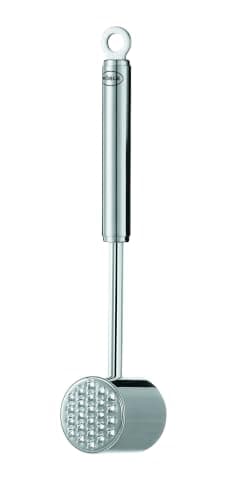
Whether the two faces are genuinely different. Every mallet here claims to be double-sided, but only two explain the difference. OXO describes pyramid-shaped teeth on one side and a smooth face sized to flatten quickly on the other. Rösle describes a smooth face for flattening and a riveted face for tenderizing — rivets, not points, which bruise rather than puncture. That matters on a thin cutlet, where sharp teeth can tear the surface into holes.
Whether it goes in the dishwasher. This is the spec most people skip and the one they live with. A mallet gets used on raw chicken and raw pork, and then it has a textured face full of grooves. OXO and Rösle both state dishwasher safe. KitchenAid says hand wash with warm water and mild detergent, rinse and dry immediately — which is a real chore attached to a $10 saving.
What to judge a blade tenderizer on
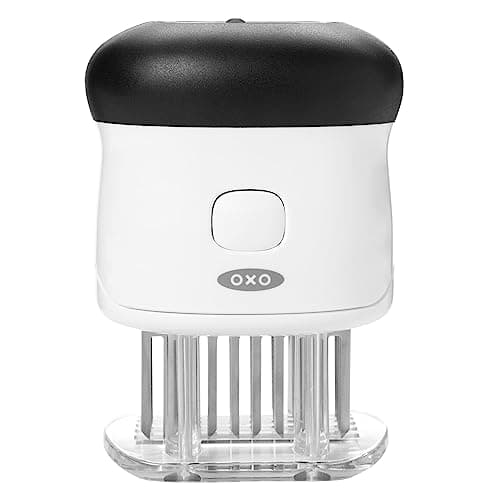
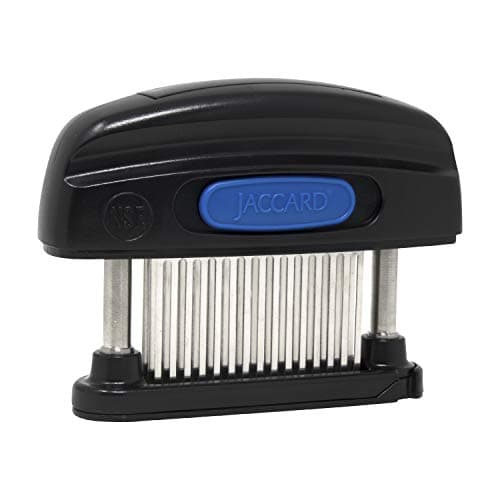
Whether you can clean it, which is the hardest problem in the category. A blade tenderizer is a tight comb of sharp metal that has just been inside raw meat. You cannot scrub between 50 blades with a sponge without destroying the sponge and your hand. Only one tool here solves this structurally: OXO’s top comes off, and the whole thing is top-rack dishwasher safe. Jaccard’s blade cartridge is removable, which is second best. The Norpro is hand wash only and does not come apart at all.
Whether the blades can be covered. A loose blade comb in a drawer is a genuine hazard. OXO states a recessed toggle lock that keeps the blades covered and will not unlock on its own. Norpro’s needles are spring-loaded and retract into their own base plate between presses, which solves the same problem differently. The Jaccard listing describes no cover or lock at all.
Blade count, and how little the big numbers mean. More blades means fewer presses for the same coverage: 50 on the OXO, 45 on the Jaccard, 24 on the Norpro. What blade count does not tell you is anything about results, and this is a category full of numbers with nothing behind them. Jaccard advertises up to 40% less cooking time and up to 600% more marinade absorption and publishes no basis for either figure. We are repeating those as the claims they are, not as specifications.
The six tools
The OXO Good Grips Meat Tenderizer is the pick because it is the best-documented mallet at a sensible price. It is the only one that tells you what each face does rather than just calling itself double-sided, it states its construction, and it is dishwasher safe. Honest marks against it: the body is plastic over a steel core rather than solid metal, so the Rösle will outlive it, and OXO publishes no weight for the head — the one number you would most want on a tool whose job is momentum.
The OXO Good Grips Easy-Clean Bladed Meat Tenderizer is the one to buy if you want tenderness without flattening, and it wins its half of the page on cleaning alone. The top removes, it is top-rack dishwasher safe, the blades lock covered, and the clear base lets you see where you have already stamped so coverage is deliberate rather than guesswork. Against it: it does exactly one job, the plastic body and 50 thin blades make it the most fragile tool here, and it comes with the cook-it-through obligation described above.
The Rösle Stainless Steel Heavy Weight Meat Tenderizer Mallet (12820) is the buy-once mallet. One piece of 18/10 stainless with nothing to delaminate or absorb odors, dishwasher safe, evenly balanced, and a riveted face that bruises instead of tearing. It is also several times the price of the mallets that do the same job, it never publishes the weight it names itself after, and solid steel has no give — a heavy swing on a delicate fillet will tear it rather than thin it.
The Jaccard 45-Blade Meat Tenderizer (200345NS) comes from the company that invented this category, and it is the only tool on the page claiming a certification: NSF approved, a commercial-kitchen hygiene standard. The blade cartridge is removable and the warranty is a lifetime one. Against it: the headline percentages have no published basis, the listing describes no blade cover or lock, and Jaccard makes no dishwasher claim where OXO does.
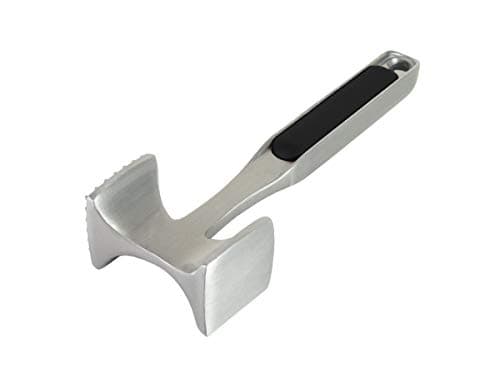
The KitchenAid Gourmet Multi-Sided Meat Tenderizer is the budget mallet that still tells you what it is: aluminum, light enough to work through a tray of cutlets one-handed, with a hang hole so it need not share a drawer. The catch is the care instruction — hand wash, rinse and dry immediately, on a tool used for raw chicken. Aluminum is also the softest metal here, and a light head means more swings on thick beef.
The Norpro Meat Tenderizer (7032) is the cheapest way into the no-flattening mechanism, and the only tool here that publishes its dimensions. The 24 needles retract into a protective base plate on their own, so nothing sharp waits in the drawer. But 24 needles against 45 and 50 means far more presses for the same coverage, a palm-pressed cylinder gives less control than a flat stamp with a clear base, and it is hand wash only and does not come apart — the worst combination for a tool whose working parts live inside raw meat.
How they compare
Every entry is the maker’s own published claim from the product’s Amazon listing. Head weight is absent because not one maker here publishes one.| Tool | Mechanism | Material stated | Blades / prongs | Comes apart | Dishwasher |
|---|
| OXO Good Grips Meat Tenderizer | Mallet | ABS over solid steel core | Pyramid teeth face | No | Yes |
|---|
| OXO Good Grips Easy-Clean Bladed Meat Tenderizer | Blades | Not stated | 50 blades | Yes — top removes | Yes, top rack |
|---|
| Rösle Stainless Steel Heavy Weight Meat Tenderizer Mallet (12820) | Mallet | 18/10 stainless steel | Riveted face | No | Yes |
|---|
| Jaccard 45-Blade Meat Tenderizer (200345NS) | Blades | Stainless steel columns | 45 blades | Yes — cartridge | Not stated |
|---|
| KitchenAid Gourmet Multi-Sided Meat Tenderizer | Mallet | Aluminum | Textured face | No | No — hand wash |
|---|
| Norpro Meat Tenderizer (7032) | Needles | Stainless steel needles | 24 needles | No | No — hand wash |
|---|
Which one to buy
Buy the OXO Good Grips Meat Tenderizer if you want one tenderizer and you are not sure which problem you have. Flattening is the job most home cooks actually need, a mallet does it and nothing else does, and this is the one that documents itself and washes easily.
Buy the OXO Good Grips Easy-Clean Bladed Meat Tenderizer if the cuts you cook are tough rather than thick — and buy it as a second tool rather than instead of a mallet. Buy the Rösle Stainless Steel Heavy Weight Meat Tenderizer Mallet (12820) if you would rather pay once, and the KitchenAid Gourmet Multi-Sided Meat Tenderizer if you want a mallet for the least money and will tolerate hand washing it.
Buy the Jaccard 45-Blade Meat Tenderizer (200345NS) if you tenderize often enough to want NSF and a lifetime warranty, and the Norpro Meat Tenderizer (7032) if you want to try the mechanism cheaply before committing to it.
And if the cut is tough because it is full of connective tissue, consider whether the real answer is grinding it instead of stabbing it. Our meat grinder roundup covers the tools that turn a cheap chuck into something genuinely tender, and food processor vs meat grinder explains which of the two you already own can do it.
How to use a mallet without turning meat into lace
Put the meat between two sheets of plastic wrap or in a zip-top bag before you start. This is the single thing that separates an even cutlet from a torn one: the covering spreads the blow, stops the surface from shredding and keeps raw chicken from spattering across the kitchen. It also means the textured face is hitting plastic rather than meat, which is why a covered cutlet comes out smooth.
Work from the center outward, in overlapping strokes, with the smooth face if what you want is even thickness. Use your wrist rather than your shoulder — the mass of the head does the work, and a hard swing is how you tear through. Stop when the thickest part matches the thinnest; that is the entire goal, because an even cutlet is one that finishes cooking all at once.
Save the textured face for cuts that are already the thickness you want and merely tough. And use a board you are happy to pound on: a mallet transmits every blow through the meat into the surface underneath, which is hard on glass and on thin plastic. Our cutting board roundup covers which boards take that kind of punishment and which ones should keep a separate board for raw meat.
How to use a blade tenderizer
Press straight down and lift straight up. The blades are designed to enter and leave along the same path; rocking or dragging the tool sideways tears channels instead of cutting them, and bends the blades. Work in a grid across the whole surface, then turn the cut over and do the other side.
Keep the cut flat on a board and your free hand off the meat. The blades go all the way through a thin piece, so anything underneath your fingers is a bad idea. If a cut is thin enough that the blades pass clean through it, it did not need this tool in the first place.
Then cook it through, and check it with a thermometer rather than by eye. This is the part that the regulation above exists to communicate, and the part that no listing on this page states. Pierced meat has no sealed interior left.
Cleaning, which is the real maintenance question
Rinse any tenderizer the moment you put it down. Protein dries into a textured mallet face and between blades like glue, and a tool left through dinner takes a brush and real patience. Rinse under a running tap first, then wash.
With a blade tool, take it apart if it will come apart — the OXO’s top lifts off and the Jaccard’s cartridge pulls out, and both exist precisely so the part that was inside the meat can be reached. Never run a cloth or a sponge along a blade comb; flush it with water in the direction the blades point. Where a maker says hand wash only, as KitchenAid and Norpro both do, that is the instruction to follow, and it is a cost of ownership rather than a detail.
You may not need one of these at all
It is worth saying plainly, because nobody selling a tenderizer will. Several tenderizing jobs do not need a tool.
Salt and time do more for a thick steak than any blade. Salting a cut well ahead of cooking changes its texture throughout, with nothing to wash and no pierced surface. Slicing thinly across the grain after cooking shortens the same muscle fibers a blade tenderizer cuts, costs nothing, and is the reason a correctly carved flank steak is tender and an incorrectly carved one is not. Low, slow, moist cooking is what actually dissolves the connective tissue in a chuck or a shoulder — a braise does what no mechanical tool can.
Buy a mallet because you want to make cutlets, which genuinely requires one. Buy a blade tenderizer because you regularly cook tough cuts hot and fast and want to shorten the gap, and because you are willing to cook them through. Both are cheap, useful tools. Neither is a substitute for buying the right cut or cooking it the right way, and if a page tells you otherwise it is selling rather than explaining. The rest of our manual prep tool picks work the same way: one pick per job, and an honest note on the jobs that need no tool.