For pie and pastry, the J.K. Adams French Tapered Rolling Pin (FRP-1-AM) is the pick: a tapered maple dowel that publishes both of the figures that matter — 20.5 inches long, 1.75 inches across — and pivots on the counter so you can turn a round of dough without ever lifting it. If your problem is even thickness rather than control, buy the Joseph Joseph PrecisionPin Adjustable Rolling Pin (40113) instead: it is the only pin here whose maker states an actual dough thickness, in five removable rings from roughly 2 mm to 10 mm. And if your dough is butter-heavy and your kitchen is warm, the OXO Good Grips Non-Stick Steel Rolling Pin is the one OXO says you may chill before you start.
Read the barrel, not the box. “18-inch rolling pin” usually means the whole tool, handles included, and the handles do not roll dough. Farberware is unusually straight about it: an 18-inch pin with a stated 10-inch barrel. That is the width of dough you can cover in one pass, and it is the figure to compare across pins — when a maker publishes it at all.
Three designs, and they do not do the same job
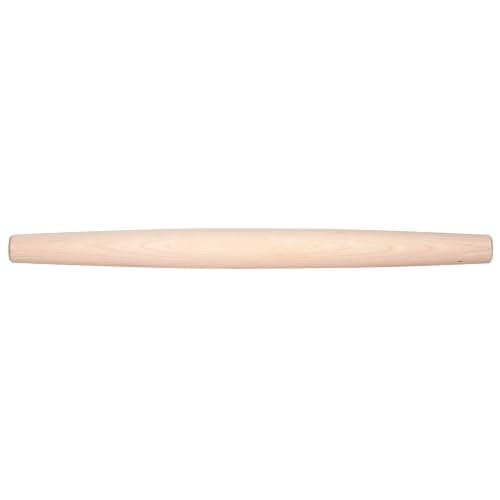
A French (tapered) pin is a single piece of wood, thickest in the middle and narrowing toward each end, with no handles and no axle. You drive it with the flats of your palms. Because the ends are narrow, it pivots in place: you can swing the pin around a round of pie dough and roll outward in every direction without picking the dough up. That is why pastry cooks use them, and it is also why the first twenty minutes with one feel wrong if you grew up with handles.
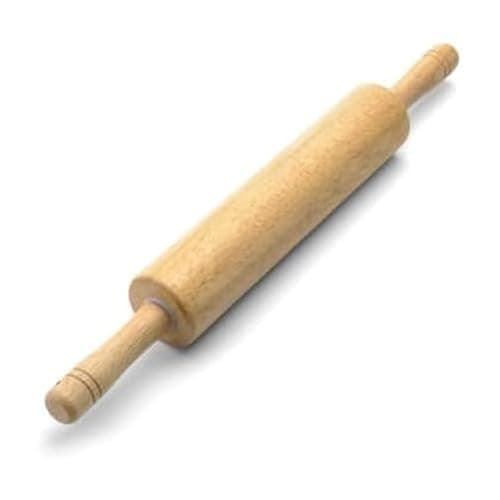
A handled pin is a barrel on an axle between two grips. The dough sees a fixed-width cylinder and you see leverage: you can lean on it, and the motion is the one almost everybody already knows. The trade is that it cannot pivot, so a round crust gets rotated by hand, and the barrel is shorter than the tool.
A straight dowel — the bakery pin — is a plain cylinder with no taper and no handles. It gives you the full barrel width everywhere, which is what you want for a sheet of pasta or a slab of bread dough, and it gives you no mechanical help at all.
Nobody needs all three. What you need is the one that matches what you bake most, which is why this page ranks on published figures rather than on a single “best”.
The four figures that decide a rolling pin
1. Barrel length — the one most listings hide. This is the usable rolling width. A 10-inch barrel on an 18-inch tool means a 12-inch pie round needs at least two overlapping passes, and every overlap is a place the thickness can step. Of the six picks here, Farberware states a 10-inch barrel, Fox Run states a 10-inch barrel, OXO states a 12-inch working length, and J.K. Adams and Fletchers’ Mill publish a total length for a tool that is barrel from end to end.
2. Barrel diameter. A fat barrel covers more dough per rotation, tracks straighter and is less likely to dig an edge into the dough. Fletchers’ Mill states 2.75 inches, which is bakery-pin territory; J.K. Adams states 1.75 inches at the thickest point, which is a pastry pin. Nobody else in this field publishes the number at all.
3. Mass. Weight substitutes for force. The Fox Run marble pin publishes 4.6 pounds with its cradle, and heavy means you guide rather than press — easier on the shoulders for a long batch, harder on the wrists to control, and unforgiving if you drop it. Wooden pins in this field publish no weight at all.
4. Thickness control. Every pin on this page rolls to “however thick it looks” except one. Joseph Joseph’s PrecisionPin carries five sets of removable end rings and states the thicknesses they produce: approximately 2 mm, 4 mm, 6 mm, 8 mm and 10 mm. If your cookies bake unevenly because half the tray is thinner than the other half, that is the feature that fixes it — and it is the only published thickness figure in this entire category.
The six picks
1. The pastry pin — J.K. Adams French Tapered Rolling Pin (FRP-1-AM)
J.K. Adams states 20.5 inches long by 1.75 inches wide, in maple, made in Vermont. The length is the argument: it is the longest working surface here by a clear margin, so a full pie round or a sheet of cookie dough goes under it in one pass with no overlap seam. The taper is the other argument — narrow ends mean the pin pivots on the dough, and pivoting is how you roll a circle instead of an oval. J.K. Adams also makes an unusually specific surface claim: that the slightly textured maple holds a fine dusting of flour better than metal or silicone does, which is the difference between dough that releases and dough that tears.
The honest costs are technique and maintenance. There are no handles, so the force comes from your palms and the control comes from practice; a first attempt with a French pin is usually worse than a first attempt with a handled one. It is hand wash only and wants periodic food-safe mineral oil, and J.K. Adams publishes no warranty term on this listing.
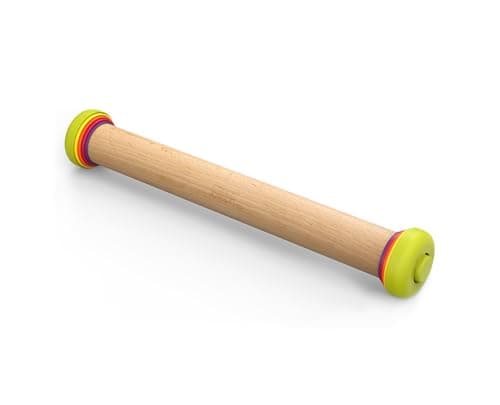
2. The one that makes thickness a setting — Joseph Joseph PrecisionPin Adjustable Rolling Pin (40113)
Five sets of rings twist onto the ends of a beech barrel and stop the pin at a stated thickness: approximately 2 mm, 4 mm, 6 mm, 8 mm or 10 mm. Take them off and it rolls like an ordinary pin. Joseph Joseph names biscuit dough, pizza bases and pastry sheets as its jobs, and those are exactly the cases where consistency beats feel — a tray of cookies bakes evenly only if every round is the same thickness, and a hand-rolled tray never quite is.
Three real limits. Joseph Joseph words every thickness as approximate, so this is a repeatable target and not a measured gauge. The rings sit at the ends of the barrel, which means the dough has to stay inside their span — roll wider than the rings and the setting stops meaning anything, so this is a cookie-and-pizza pin more than a large-crust pin. And five pairs of small rings are five pairs of small parts to keep track of; there is no dishwasher claim published, and rings plus barrel is more surface for dough to pack into than a bare dowel has.
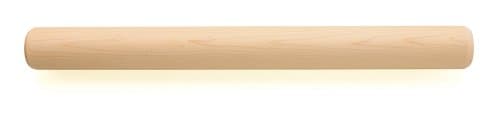
3. The bakery dowel — Fletchers' Mill Bakery Rolling Pin, Maple 18.5-Inch (BAKRP12)
Solid rock maple, handcrafted in Maine, published as 2.75 inches wide by 18.5 inches long. That diameter is the widest in this roundup and it changes how the pin behaves: more dough per rotation, a flatter contact patch, and far less tendency to dig in at the edges. For bread dough, pasta sheets and anything you are rolling in volume, a fat straight dowel is the professional answer, and Fletchers’ Mill is one of only two makers here that publishes the diameter at all.
It is third rather than first because of what it asks and what it withholds. The care instruction is the strictest on the page — wipe with a damp cloth only, do not submerge, do not put it in the dishwasher — and a straight dowel offers neither the pivot of a tapered pin nor the leverage of handles, so it is the least forgiving shape for a beginner. No warranty term is published.
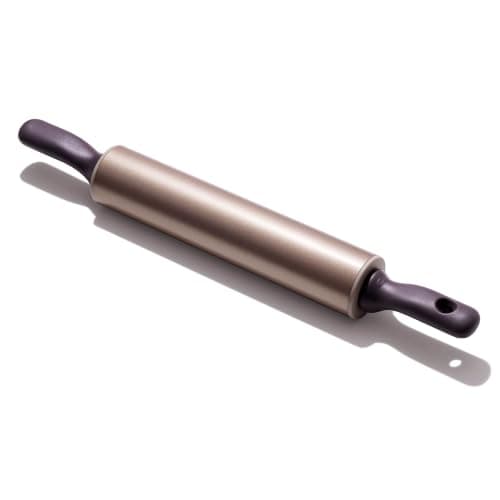
4. The one you can chill — OXO Good Grips Non-Stick Steel Rolling Pin
Steel with a non-stick ILAG coating, raised offset handles, and a stated 12-inch length. Two features earn its place. OXO states the metal pin can be chilled, which no wooden pin here claims, and cold is the single biggest variable in butter pastry — a cold tool keeps the butter in the dough solid, and solid butter is what makes layers. The offset handles sit above the barrel so your knuckles clear the counter, which matters more than it sounds when you are pressing hard on a thin sheet.
Its limits are length and surface. Twelve inches is the shortest working width here, so large crusts need more passes. A non-stick coating is a coating: it can scratch or wear, and unlike wood it cannot be sanded back and re-oiled. OXO publishes no dishwasher claim for this pin either, so treat it as a hand-wash tool.
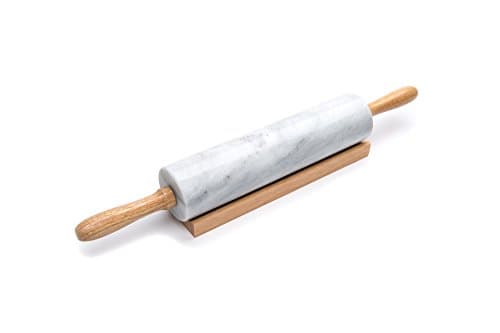
5. The cold, heavy one — Fox Run Polished Marble Rolling Pin with Cradle (4050COM)
A 10-inch marble barrel on wooden handles with nylon ball bearings, 4.6 pounds with its cradle, dimensions published as 2.5 by 18 by 2.5 inches. Stone holds cold, so this is the traditional answer to warm-kitchen pastry, and the mass means you are steering the pin rather than leaning on it — which, over a long batch, is genuinely less tiring for your upper body. The wooden cradle is not decoration: a round stone barrel on a counter rolls off counters.
The costs are honest and physical. A 10-inch barrel is short for the weight you are moving. Marble is brittle, and one knock against a sink or a tile floor ends it; Fox Run publishes no warranty. And 4.6 pounds is the wrong tool for anyone whose hands or wrists are the reason they are shopping in the first place.
6. The cheap handled pin — Farberware Classic Wood Rolling Pin, 18-Inch (5215807)
Eighteen inches overall with a stated 10-inch barrel, in moisture-resistant hardwood, with comfort-grip handles that Farberware describes as balanced end to end. It is the least expensive pick here and it does the thing most people picture when they say “rolling pin”. It also does something the premium pins mostly do not: it publishes the barrel length separately from the overall length, which is the honest number and the one a handled-pin buyer actually needs.
It ranks last on what the listing leaves out. “Hardwood” names no species, so the density and grain are unknown; no warranty term is published; and with a 10-inch barrel and none of the marble pin’s mass, every bit of the pressure comes from you.
What each one publishes
| Pick | Type | Published size | Thickness control | Care as stated |
|---|
| J.K. Adams French Tapered Rolling Pin (FRP-1-AM) | Tapered (French) | 20.5 in L x 1.75 in W | By feel | Hand wash; mineral oil |
|---|
| Joseph Joseph PrecisionPin Adjustable Rolling Pin (40113) | Handled, with rings | Not published | Rings: approx. 2 / 4 / 6 / 8 / 10 mm | Not published |
|---|
| Fletchers' Mill Bakery Rolling Pin, Maple 18.5-Inch (BAKRP12) | Straight dowel | 18.5 in L x 2.75 in W | By feel | Damp cloth only; do not submerge |
|---|
| OXO Good Grips Non-Stick Steel Rolling Pin | Handled steel | 12 in / 30 cm | By feel | No dishwasher claim published |
|---|
| Fox Run Polished Marble Rolling Pin with Cradle (4050COM) | Handled marble | 10 in barrel; 4.6 lb with base | By feel | No dishwasher claim published |
|---|
| Farberware Classic Wood Rolling Pin, 18-Inch (5215807) | Handled wood | 18 in overall; 10 in barrel | By feel | Wipe clean; mineral oil |
|---|
Two of the six publish a barrel diameter. One publishes a weight. One publishes a dough thickness. Four publish a care instruction. That is the honest state of this category, and it is why the picks that state their numbers rank above the ones that describe themselves instead.
Cold is the variable nobody puts on the box
Flaky pastry is layers of solid fat separated by dough. If the butter softens while you are rolling, it stops being layers and starts being a paste, and the crust comes out short and dense instead of flaky. That is the entire reason professional recipes keep sending you back to the fridge.
The tool is part of that equation. Steel and marble both start cold and stay cold longer than wood, which is why OXO states its steel pin can be chilled and why a marble pin has been the traditional pastry pin for a century. Wood is the opposite: it sits at room temperature and it is a poor conductor, which is fine for bread and pasta and a mild disadvantage for butter-heavy pastry in a warm kitchen. None of that makes a wooden pin wrong — it makes chilling the dough, not the pin, the thing you cannot skip. The same logic is why a pastry blender with rigid blades beats a wire one on fridge-cold butter, and why Fox Run sells a marble cheese board on the same “stone stays cold” argument.
Rolling pins, grip and sore hands
A rolling pin is one of the few kitchen tools where the design choice really does change who can use it. A handled pin lets you transfer body weight through your arms into the dough, which is the easiest motion if your hands are weak but your shoulders are fine. A tapered pin asks your palms and wrists to do the pressing, which is harder on arthritic hands. And a heavy marble pin cuts the force you have to supply but demands the grip strength to control four and a half pounds — a trade that is good for some people and bad for others.
If grip is the limiting factor, the practical answer is a handled pin plus thinner dough targets: roll in short strokes from the center outward, rotate the dough a quarter turn instead of reaching across it, and rest the dough in the fridge when it fights back rather than pushing harder. We make the same case across the whole drawer in the best prep tools for arthritic hands.
Caring for wood, steel and stone
Wood is the fussiest and the longest-lived. Every wooden pin here is wipe-or-hand-wash, never a dishwasher, and Fletchers’ Mill goes further and says do not submerge it at all. Water swells the grain and repeated soaking is what cracks a pin; a periodic coat of food-safe mineral oil is what J.K. Adams and Farberware both recommend instead.
Steel needs none of that, but a coated pin needs care of a different kind: do not scrape dough off it with a metal bench scraper, because the coating is the non-stick and once it is gone it does not come back. Marble is almost maintenance-free in use and almost unforgiving in storage — it is a stone, it chips, and it should live in its cradle rather than loose in a drawer with a cast-iron skillet.
Where this page stops
This page is about shaping dough. Making it is a different question: a food processor with a dough blade brings pastry together in seconds with the warmth of your hands never touching it, and the food processor versus stand mixer comparison is the honest version of which machine earns the counter space. If you are rolling a pie crust this week, the filling is its own job, and the best apple slicers and corers ranks the tools that get a bushel of fruit ready faster than a knife does. For the surface you roll on, the best cutting boards covers the wood-versus-plastic question that decides whether dough sticks to your counter.
Which one should you buy?
You make pie and pastry. Buy the J.K. Adams. 20.5 published inches of tapered maple pivots on the dough, and one pass beats three overlapping ones.
Your cookies bake unevenly. Buy the Joseph Joseph PrecisionPin. It is the only pin here that turns thickness into a stated setting instead of a judgment.
You roll bread dough, pasta or pizza in quantity. Buy the Fletchers’ Mill. A 2.75-inch barrel covers more ground per rotation and tracks straight.
Your kitchen is warm and your dough is buttery. Buy the OXO steel pin and put it in the fridge first — it is the only one whose maker says you can.
You want the tool to supply the pressure. Buy the Fox Run marble pin, and store it in its cradle.
You want a familiar pin and the smallest outlay. Buy the Farberware, and accept that the wood species is never named.
What these cost, and what the money buys
Rolling pins are cheap tools, and the whole field here sits inside a narrow band — from a few dollars for a plain handled pin up to the price of a nice bottle of wine for a hand-made maple one. What the extra money actually buys is published figures and named materials: rock maple instead of “hardwood”, a stated diameter instead of a stated overall length, a chillable steel barrel, or a set of thickness rings that no cheap pin offers. None of it buys a warranty — not one pin in this roundup publishes a warranty term, which is worth knowing before you spend up.
What we are not claiming
We have not rolled dough with these six. Every dimension, weight, wood species, coating, ring thickness, bearing type and care instruction above is the manufacturer’s own published wording on the listing the buy button points at, cited below — including Joseph Joseph’s own “approximately” on its thickness figures, and including the pins that publish no barrel diameter at all. Where a maker says only “hardwood”, this page says only “hardwood”. The physics of cold butter and barrel width are general baking facts, not measurements we took. Prices come live from Amazon with the date attached.