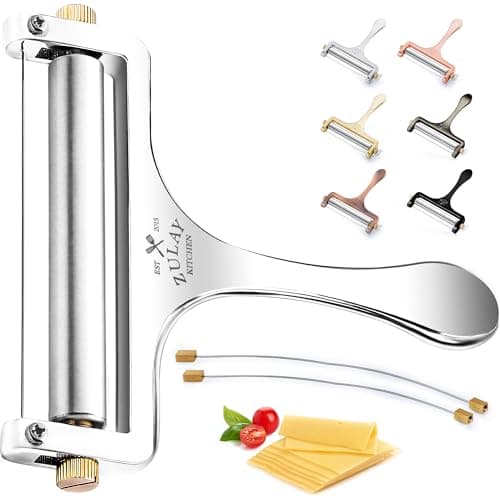
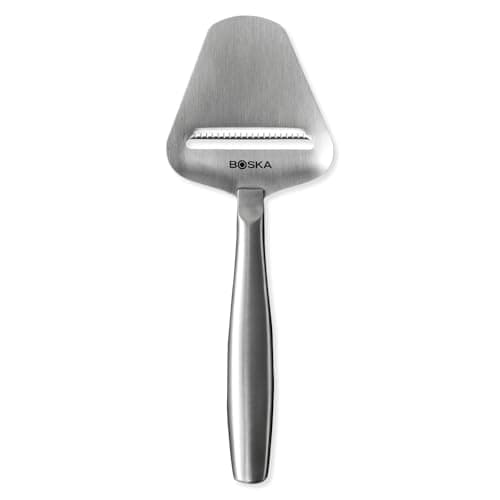
For a block of cheddar, jack or gouda out of the fridge, the OXO Good Grips Cheese Slicer with Replaceable Wires (1071567) is the pick: it is the only tool here with a tension wheel to retighten the wire, it ships with two spare wires, and it is the only wire slicer in the roundup that states it is dishwasher safe. If your blocks are the big warehouse-store kind, buy the Zulay Kitchen Stainless Steel Wire Cheese Slicer instead — it publishes a 3.8-inch block width, which nothing else here does. And if what you actually slice is hard aged cheese, a wire is the wrong mechanism: get the plane, the Boska Copenhagen Cheese Slicer (357600).
Match the tool to the hardness, not to the price. Zulay states outright that its wire slicer is not suitable for extra-hard cheeses such as parmigiano reggiano, grana padano and pecorino romano. Boska states its plane is for semi-hard, aged and extra-mature cheese. Those two sentences are the whole buying decision, and they are the only two places in this category where a maker tells you where its tool stops.
Three tools, one search term
A wire slicer is a frame carrying a taut steel wire, usually with a roller that rides on top of the block and sets how deep the wire bites. You pull it toward you and the wire parts the cheese. It is brilliant on semi-hard block cheese — cheddar, jack, gouda, young gruyere — because the wire is thin enough to pass through without dragging the slice sideways. It is the commonest type sold and the type most people mean.
A plane (the flat Scandinavian tool, sold as a cheese slicer or a cheese knife) is a slotted blade on a handle. You draw it over the face of the block and a slice curls up through the slot. Because the slot is a fixed opening in rigid steel rather than a flexing wire, a plane keeps working on hard, dry, aged cheese where a wire binds or crumbles.
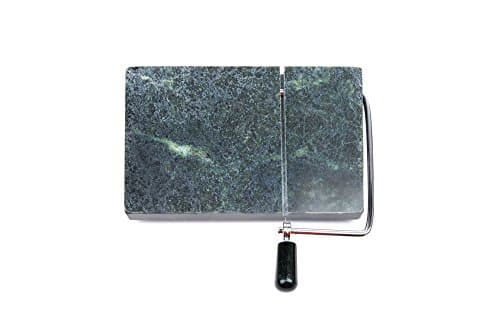
A board slicer is a stone or wooden base with a hinged arm carrying a wire. The board holds the cheese and the arm does the cutting, so your free hand is not steadying the block. It is the best mechanism for a cheese board you are serving from, and the worst one for a drawer.
Buying across those three by accident is the normal mistake here. All three are listed under the same words, at roughly the same prices, with photographs that do not make the mechanism obvious.
The five things that decide a cheese slicer
1. The cheese hardness the maker names. This is the real spec, and almost nobody treats it as one. OXO states medium and hard cheeses. Westmark states soft and semi-hard, naming gouda, emmental and edam. Boska states semi-hard, aged and extra-mature. Zulay states a list of extra-hard cheeses it is not for. Match that sentence to what is in your fridge and the rest of this page is detail.
2. Block width — published exactly once. A wire slicer’s frame limits how wide a block can pass under the roller. Zulay states up to 3.8 inches. Nobody else states anything, which means whether a two-pound brick fits is a surprise that arrives with the parcel.
3. How thickness is set. There are three systems here and they are not equivalent. A dial (Zyliss) is set once and repeats. A hand-adjusted roller (Zulay, stated paper-thin to a quarter inch) repeats roughly. An angle (OXO, Westmark) means the thickness is whatever your wrist is doing, which is fine for snacking and useless for twelve matching sandwich slices.
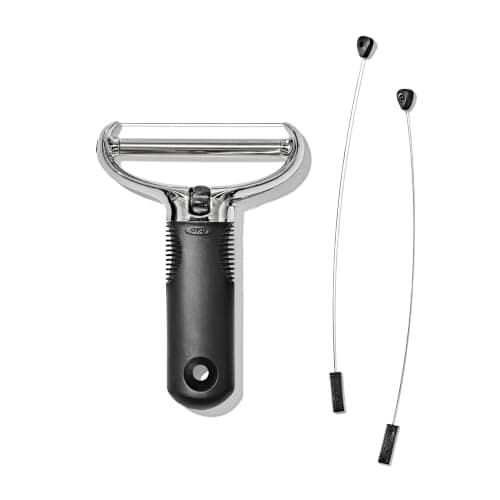
4. Whether the wire is replaceable. A wire slicer fails one way: the wire slackens, then it snaps. OXO ships two spares and a tension wheel to take the slack out before that happens; Zulay ships two spares; Fox Run ships one. Westmark ships none, and the Boska plane and the Zyliss dial have no wire to replace in the first place.
5. Cleaning and storage. Two picks here publish a dishwasher claim — the OXO and the Boska. Zulay recommends hand washing, Fox Run says hand wash only and not dishwasher safe, Westmark says soap and water, and Zyliss publishes no care claim at all. Only the Zyliss closes its blade flush with the body, which makes it the one tool here that is sensible to keep loose in a drawer.
The six picks
1. The wire slicer to buy — OXO Good Grips Cheese Slicer with Replaceable Wires (1071567)
OXO builds the one feature that addresses how these tools actually die. Every wire slicer eventually goes slack, and a slack wire wanders instead of cutting; this is the only pick with a tension wheel that lets you pull it taut again. Two additional stainless wires are in the box, so the first break costs nothing. The body is die-cast zinc with a soft non-slip handle, the listing states thick or thin slices depending on the angle of your wrist, and OXO states the whole thing is dishwasher safe — which no other wire tool here claims.
Two honest limits. Thickness really is wrist angle: there is no stop, no dial and no detent, so consecutive slices will differ and a sandwich stack will not look machine-cut. And OXO publishes no maximum block width, so a very large brick may not pass the frame — the one figure its cheaper rival does state.
2. The one that fits a big block — Zulay Kitchen Stainless Steel Wire Cheese Slicer
Zulay publishes the two numbers everybody else withholds: blocks up to 3.8 inches wide, and a slice range from paper-thin to a quarter inch set by adjusting the roller by hand. The body is one-piece zinc-aluminum alloy with a 304 stainless wire, two spare wires are included, and it carries a lifetime warranty. For anyone who buys cheese in bricks rather than wedges, that stated width is the difference between a tool that works and a tool that does not fit the cheese.
It is second rather than first because of the sentence Zulay deserves credit for printing: it is not for extra-hard cheeses, and it names them — parmigiano reggiano, grana padano, pecorino romano. For a lot of households those are exactly the cheeses that get bought most. It is also hand wash only, where the OXO is dishwasher safe, and its roller has no printed settings, so “a quarter inch” is a limit rather than a repeatable number.
3. The right tool for aged cheese — Boska Copenhagen Cheese Slicer (357600)
A plane, not a wire, and the only pick here whose maker uses the words aged and extra-mature. The mechanism is the reason: a fixed steel slot shears the cheese rather than dragging a flexible wire through it, so a dry, crystalline, two-year gouda comes off in slices instead of crumbs. Boska also states it slices cucumber and carrots, the handle is hollow so the tool is unusually light, it is dishwasher safe, and it is the cheapest thing in this roundup.
The trade is control. The slot is fixed, so slice thickness is whatever Boska set it to — there is no adjustment of any kind, and no slot width is published. Boska publishes no warranty term on this listing. And a plane is genuinely wrong for soft cheese: it needs a firm face to pull against, so fresh mozzarella and brie smear rather than slice.
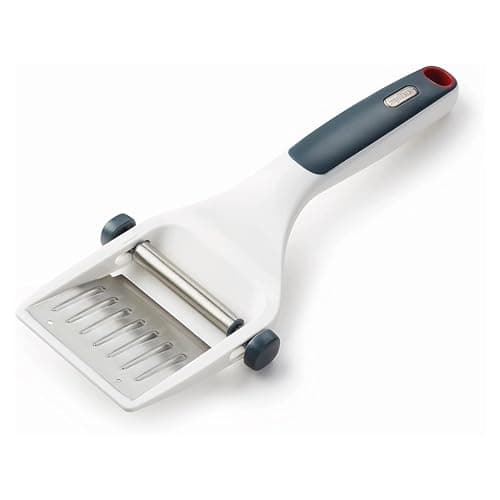
4. The repeatable one — Zyliss Dial & Slice Cheese Slicer (E900036U)
Zyliss replaces wrist angle with an adjustable wheel: you set the thickness and every slice after that matches. For sandwiches, a cheese board or a child’s lunchbox — anywhere “twelve the same” matters more than “one as thick as I feel” — that is the most useful feature in this roundup. The stainless edge also closes flush with the body of the tool for storage, which makes it the only pick here that belongs loose in a drawer rather than in a block or a box.
What Zyliss does not do is publish numbers. The dial range is described as “extra thin to thick” with no millimetre or fraction figures anywhere, so you are buying a relative scale. No dishwasher claim and no warranty term appear on the listing, and the edge is not described as replaceable — where all three wire tools here ship with spares.
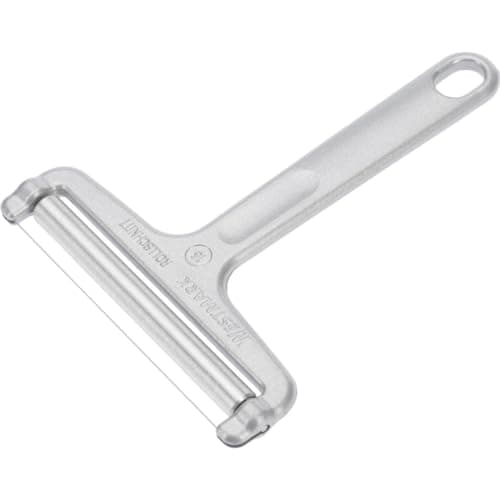
5. The one with a warranty — Westmark Wire Cheese Slicer (71002270)
Made in Germany, a stainless wire on a one-piece cast aluminum handle, and backed by Westmark for five years — the only warranty term in years anywhere on this page. The one-piece casting matters more than it reads: the joint between handle and frame is where cheap slicers loosen and start to twist, and this design does not have one. Westmark names its cheeses too — soft and semi-hard, with gouda, emmental and edam called out — which is more useful than another claim to cut everything.
It ranks fifth on the small things. No spare wires are included, where the OXO and the Zulay each ship two, so the first failure is an order rather than a swap. Thickness is angle-based again. And its stated range stops at semi-hard, so the aged cheeses are the plane’s job, not this tool’s.
6. The one you serve from — Fox Run Marble Cheese Slicer Board (3824)
A marble base with a hinged wire arm: the board clamps nothing but it does hold the block steady while the arm cuts, so neither hand is near the wire. Fox Run publishes the dimensions — an 8 by 5 inch base, with the board measuring 5 by 8.25 by 1.25 inches — includes one replacement wire, and puts padded feet underneath. Marble stays cold and wipes clean, and the whole thing goes to the table as a cheese board, which is the real reason to own one.
Three honest limits. The 8 by 5 inch base is a hard ceiling on the block you can lay on it. It is hand wash only and not dishwasher safe, and marble chips if it is knocked against a sink. And it is counter furniture rather than a tool: you cannot carry it to the block in the fridge door the way you can a handheld.
What each one publishes
| Pick | Type | Stated cheese range | Thickness set by | Spares / warranty |
|---|
| OXO Good Grips Cheese Slicer with Replaceable Wires (1071567) | Wire | Medium and hard | Wrist angle | 2 wires; no warranty stated |
|---|
| Zulay Kitchen Stainless Steel Wire Cheese Slicer | Wire | Not for extra-hard (named); blocks to 3.8 in | Hand-adjusted roller, to 1/4 in | 2 wires; lifetime warranty |
|---|
| Boska Copenhagen Cheese Slicer (357600) | Plane | Semi-hard, aged, extra-mature | Fixed slot | None stated |
|---|
| Zyliss Dial & Slice Cheese Slicer (E900036U) | Dial slicer | Not stated | Dial (no figures published) | None stated |
|---|
| Westmark Wire Cheese Slicer (71002270) | Wire | Soft and semi-hard | Wrist angle | No spares; 5 years |
|---|
| Fox Run Marble Cheese Slicer Board (3824) | Board + wire | Not stated; 8 x 5 in base | Marble handle arm | 1 wire; no warranty stated |
|---|
One block width. One slice range. Two dishwasher claims. One warranty in years, one lifetime warranty, and three picks with no warranty statement at all. That is what this category publishes, and ranking on anything else would mean inventing numbers.
Why a wire fails on parmesan
Hard aged cheese is low in moisture and high in calcium lactate crystals — the crunchy specks in an old gouda or a parmigiano. A wire cuts by concentrating force on a very small contact area and parting the cheese ahead of itself, which works beautifully when the cheese is plastic enough to flow around the wire. When the cheese is dry and crystalline it does not flow: it fractures. So instead of a slice you get a crumbled face, and the wire itself takes the punishment, which is why slack-wire failures show up fastest in households that slice hard cheese.
A plane solves it by changing the geometry. The slot presents a rigid edge at a shallow angle and the slice has somewhere to go as it curls up through the opening, so the force stays in shear rather than becoming a wedge. That is the whole reason this one shape has survived unchanged in Scandinavian kitchens for a century. And if the cheese is harder still — a wedge of parmigiano for pasta — then the honest answer is that you do not want slices at all, you want a rasp or a grater, and the cheese-by-cheese version of that argument is on the best zesters and rasps.
Slicers, safety and the fridge-door cut
Cheese slicers do not have the injury record a mandoline does, because the cutting element is fixed, slow and shallow. The injuries they do cause come from two habits. The first is cutting toward your palm with a handheld wire tool while holding the block in the other hand — the wire is set in a frame and the frame is what should be braced, not your hand. The second is reaching into a drawer past an uncovered plane or an exposed wire frame, which is precisely why the Zyliss folding its edge flush is worth more than it sounds.
The other practical safety note is cheese temperature. Cold cheese slices cleanly; cheese at room temperature deforms, binds the wire and tempts you to force it. Forcing a wire slicer is how the wire snaps, usually while your hand is moving toward it. Take the block out, slice it cold, and let the slices come up to temperature on the board instead.
Where this page stops
This page is about slices. Shreds and dust are a different mechanism: the best cheese graters ranks the box graters, rotaries and rasps by the cheese you are grating, and the best box graters goes deeper on the four-sided workhorse. For very thin, very even slices of firm cheese — the kind you want fanned on a tart — a rotary will not help, but a mandoline will, with the safety rules that come with it. And if the board is for entertaining, the best rolling pins covers the other half of a holiday table, on the same argument that cold stone beats warm wood.
Which one should you buy?
You slice blocks of cheddar, jack or gouda. Buy the OXO. The tension wheel and two spare wires address the only failure this type of tool has.
You buy cheese in big bricks. Buy the Zulay. 3.8 inches of stated block width is the only such figure in the category.
Your cheese is hard and aged. Buy the Boska plane. A wire is the wrong mechanism, and Boska is the only maker here that says aged and extra-mature out loud.
You want twelve identical slices. Buy the Zyliss. A dial repeats; a wrist does not.
You want the longest published cover. Buy the Westmark — five stated years, one-piece cast aluminum, and no joint to loosen.
You are building a cheese board. Buy the Fox Run marble board, and accept the 8 by 5 inch limit and hand washing.
What these cost, and what the money buys
Every slicer here is an inexpensive drawer tool, and the spread between the cheapest and the dearest is small enough that price should not decide this purchase — cheese hardness should. What a few extra dollars actually buys is a tension wheel, spare wires in the box, a stated block width, a dishwasher claim or a warranty term. The board costs the most and buys something different: a serving surface, not a better cut.
What we are not claiming
We have not sliced cheese with these six. Every cheese range, block width, slice range, material, wire count, warranty and care instruction above is the manufacturer’s own published wording on the listing the buy button points at, cited below — including Zulay’s own statement of what its slicer cannot cut, and including the five picks that publish no block width at all. Why a wire fractures hard cheese and a plane does not is general food science, not a test we ran. Prices come live from Amazon with the date attached.