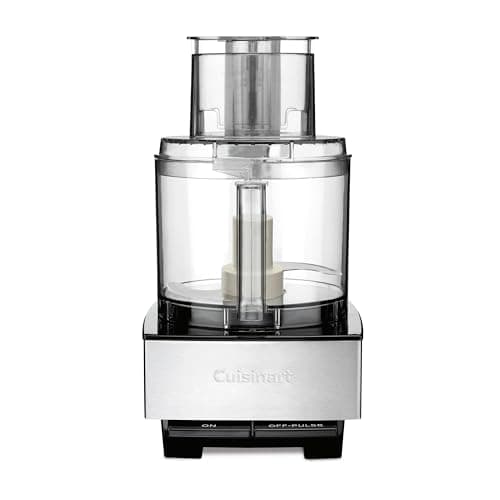
The Cuisinart DFP-14 is the machine we recommend to most people, and its appeal is almost entirely about what it does nothave. There is no bank of buttons, no nested bowls, no dial, no accessory tray. There is a 14-cup bowl, a lid with a wide feed tube, a chopping blade and two discs. Fewer parts means less to wash, less to store, and less to go wrong — and after decades on the market, this design has proven it lasts.
What the 720-watt motor handles
The 720-watt motor is comfortably into the range where power stops being a limitation for the everyday jobs and starts to matter for the hard ones. It chops, slices and shreds without a thought. It kneads pizza and bread dough — not effortlessly, but genuinely, where an 8-cup budget machine strains. It grinds nut butter with a few rest breaks. It is not the 1,450-watt Breville, and if you make dough several times a week you will feel the difference over years; for the once-a-week baker it is plenty.
What DFP-14BCNY means, and which one to buy
Cuisinart gives this machine the model and part number DFP-14BCNY, and that is the one we rank: the brushed-stainless 14-cup. The suffix is a finish code, not a capability code — Cuisinart sells the same 14-cup platform in other finishes under their own numbers, such as the copper DFP-14CPY, which is currently listed well above the brushed-stainless version. If you are choosing between them, you are choosing a color, and the brushed-stainless one is the cheaper way to the same machine.
That is worth stating plainly because the model numbers are the part of a Cuisinart listing most people skim. There is no “pro” version of the DFP-14 hiding behind a different suffix; there is one machine, and a paint chart.
What is actually in the box
Short, which is the point. Cuisinart lists a stainless chopping/mixing blade, a 4 mm standard slicing disc and a medium shredding disc, plus a detachable disc stem and an extra-large feed tube with a bowl sleeve assembly that takes both a small and a large pusher. All of it is listed as dishwasher-safe.
Two things are worth noticing about that list. There is no mini bowl, so small jobs are done in the big bowl or not at all. And there is no separate dough blade named in the kit — the chopping/mixing blade is what kneads, which it does perfectly well; Cuisinart markets the machine for kneading dough. If a dedicated dough blade matters to you, the machines that name one are the 11-cup Pro Custom and the Breville, compared in 14-cup vs 11-cup vs Sous Chef.
The discs do not adjust, and Cuisinart says so
This is the single most useful line in the listing and the one buyers most often miss: Cuisinart notes outright that the shredding and slicing blades on this machine are not adjustable. You get one slice thickness — 4 mm — and one shred. That is a perfectly good general-purpose thickness for slaw, gratin-adjacent potatoes and vegetables for a tray bake.
What it means in practice is that fine work has to go somewhere else. Wafer-thin potato for a proper gratin, 2 mm cucumber for pickles, paper slices of fennel — those are jobs for a mandoline, or for a processor with an adjustable slicing dial. It is the clearest single reason to spend up to the Breville, and the reason the adjustable-disc Cuisinart Core Custom exists as a middle option.
The warranty is the part nobody reads
Cuisinart publishes a limited three-year warranty on the whole unit and a full five-year warranty on the motor. For a machine most people expect to keep for a decade or more, that is a more meaningful number than any watt figure, and it is consistent with why these have a reputation for outliving their owners’ kitchens.
For context, Breville publishes two years on the product and thirty on the motor for the Sous Chef — a longer motor cover, on a machine that costs considerably more. Neither is a reason on its own to choose; both are worth knowing before you decide a cheap machine is the same deal.
Living with a 14-cup bowl
A work bowl is only usefully full to about two-thirds, so “14 cups” is really about nine cups of working volume. That is still a full bread dough, two heads of cabbage for slaw, or a party-sized batch of hummus in one go rather than three.
The cost is footprint. Cuisinart publishes a height of 14.8 inches and a weight of 18 pounds, which is why this is a machine that lives on the counter rather than one you lift out of a cupboard for ten minutes. If your counter has upper cabinets above it, measure before you buy — the height is the specification that surprises people, not the width.
Where it sits against the 11-cup and the Sous Chef
The three-way version of this decision has its own page, because the answer turns on bowl size more than on anything else. In short: the 11-cup Pro Custom is the same idea three cups smaller and 95 watts down, the Sous Chef adds an adjustable slicing dial and a mini bowl for a lot more money, and the DFP-14BCNY sits in the middle as the one most kitchens should actually buy. The full comparison, including what is in each box and what each warranty covers, is in Cuisinart 14-cup vs 11-cup vs Breville Sous Chef.
Who should buy something else
Two kinds of cook. If you cook for one or two and mostly do small jobs — a bit of herbs, one onion, a small dressing — washing this 14-cup bowl every time is a chore, and the Cuisinart Mini-Prep Plus (DLC-2ABC) will make you happier for a third of the price. And if you slice vegetables daily and want to set an exact thickness, the adjustable dial on the Breville from the main roundup is worth the premium. For everyone in between, this is the buy.