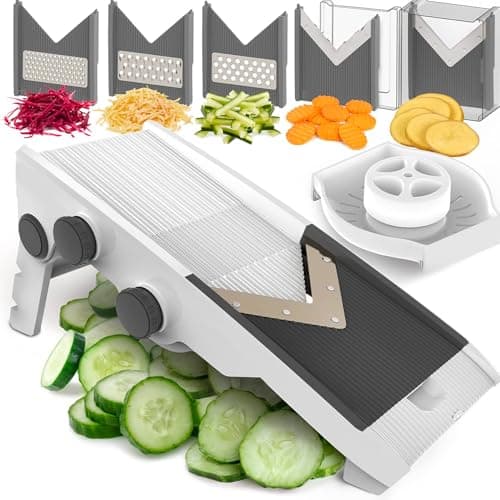
The Mueller Austria Multi-Blade Adjustable Mandolineis the cheapest honest way into this category, and “honest” is the operative word: it is a real mandoline with a real adjustable dial and five stainless blades, not a novelty slicer. What it asks in return is that you accept a lighter build and that you take the safety part seriously, because a low price does not make a blade less sharp.
What five blades actually gets you
Mueller lists five interchangeable stainless blades and dial-adjustable thickness. In practice that means straight slicing across a usable range plus julienne and finer shred cuts, which is the full working set for a home kitchen: gratin slices, slaw, julienned carrots for a salad, thin onion for a burger.
Compare that with the OXO Good Grips Chef's Mandoline Slicer 2.0, which publishes 21 thickness settings and adds a French-fry cut, or the Benriner Super Slicer (Japanese Mandoline), which trades adjustability for the sharpest blade here. The Mueller is not competing on either axis. It is competing on giving you eighty per cent of the capability for a small fraction of the money, and at that it succeeds.
The two compromises
Build. This is a lighter tool than the premium options, and you feel it when a dense vegetable resists. The fix is technique rather than force: keep the frame braced against the counter or the edge of a bowl and use a long, even stroke instead of a short, hard one. Pressing harder on a light mandoline is how it skids.
The guard. A hand-guard food holder is included, and it works, but this is the point in the review to be blunt: a mandoline at any price is the most common source of serious cuts in a home kitchen, and a cheap one does not cut you any less. Every habit in our mandoline safety guide applies exactly as much here as it does to the expensive tools, and a cut-resistant glove is a sensible thing to buy alongside it.
Swapping blades is the moment to be careful.Multi-blade mandolines mean handling loose blades, and that is when hands get caught — not during slicing. Change blades before you start cooking rather than mid-recipe with wet hands, and store the spares in their holder rather than loose in a drawer.
Where it sits in the field
Against the OXO Good Grips Chef's Mandoline Slicer 2.0, our overall pick: the OXO has a better food holder, a finer thickness dial, a sturdier body and a French-fry cut. If you will use a mandoline weekly, the OXO is worth the difference. Against the Benriner Super Slicer (Japanese Mandoline): the Benriner cuts thinner and cleaner and is what a professional kitchen reaches for, with a minimal guard to match.
Against the handheld OXO Good Grips Hand-Held Mandoline Slicer: the Mueller is a countertop tool with more range and more stability; the handheld is the one that lives in a drawer and slices a few cucumbers over a bowl. Different jobs, and the handheld is the better buy if the honest use case is “occasionally, a small amount”.
Who should buy it
Someone who wants to find out whether a mandoline earns a place in their kitchen without committing real money, and someone who makes gratin or slaw a handful of times a year. It is also a sensible choice for a second kitchen — a holiday place, a student flat — where the premium tool would be overkill.
Skip it if you slice weekly, in which case the sturdier body and better guard of the OXO repay themselves, or if the job is specifically cabbage in volume, where blade width matters more than blade count.