HUB 06 · Guides
Ninja vs Cuisinart Food Processor
A value challenger against the category default. The wattage headline is misleading, the capacity gap is real, and the right answer depends on what you cook.
We earn a commission if you buy through our links. It does not change the price you pay, and it does not decide our picks — our selection criteria are published in full. How this works.
Choose Ninja if you want dough capability and a strong published motor for the least money. Choose Cuisinart if you want more bowl, a broader range of machine sizes, and a design that has been in production long enough for its quirks to be well known. The wattage difference in the headline specs is far less decisive than it looks.
Peak watts are not continuous watts
This is the single most misleading comparison in the category, so it is worth being precise. The Ninja Professional Plus Food Processor (BN601) publishes 1,000 peak watts. The Cuisinart 14-Cup Food Processor (DFP-14BCNY) publishes 720 watts. Those are not the same measurement. A peak figure describes the momentary maximum draw; a continuous figure describes sustained output. Comparing one against the other tells you almost nothing, and the difference is not that the Ninja is 40 per cent stronger.
What can be said honestly is that both publish a figure at all, which is more than some competitors manage, and that both handle dough. The Ninja ships a dedicated dough blade; the Cuisinart does not, which for bread specifically is a more meaningful difference than the watt numbers.
The comparison table
| Factor | Ninja Professional Plus Food Processor (BN601) | Cuisinart 14-Cup Food Processor (DFP-14BCNY) |
|---|---|---|
| Work bowl | 9 cups | 14 cups |
| Published motor | 1,000 peak watts | 720 watts |
| Dough blade | Included | Not included |
| Slicing disc | Adjustable slicing/shredding disc | Fixed slicing and shredding discs |
| Parts to wash | Bowl, lid, blade, disc | Three |
| Range of sizes in the brand | Narrow | Wide — from 5-cup upward |
Where the Ninja is the better buy
Baking on a budget. A dough blade plus a published 1,000 peak watts plus an adjustable slicing disc, at a price well below the Cuisinart, is a genuinely strong package — and it is why the Ninja is our value pick in the dough guide. Nine cups is enough for a single pie crust or a one-pound pizza dough, which covers most home baking.
Where the Cuisinart is the better buy
Volume and breadth. Fourteen cups against nine is a real difference the moment you are slicing a cabbage or making a double batch of anything, and Cuisinart’s range means you can buy the same design philosophy at almost any size — from the Cuisinart 5-Cup Chop & Shred Food Processor (FP-5) up to the 14-cup. It is also the simpler machine: three parts to wash rather than four, and no accessory you will forget you own.
The rule. Bake more than you batch-cook, and want to spend less? Ninja. Prep in volume, or want the option of a smaller or larger machine from the same family? Cuisinart. Both are honest buys; neither is a mistake.
The thing neither brand solves
Neither machine dices. Both mince with the blade and slice with a disc, and a genuine cube needs either a dicing kit — which KitchenAidoffers and neither of these does — or a cheap manual push-dicer. If an even dice is on your list, buy either of these and add a twelve-dollar dicer rather than paying more for the machine.
Capacity is the difference that will actually bother you
Nine cups against fourteen sounds like a small step and is not. Remember that usable capacity is roughly two-thirds of the printed figure for solids and about half for anything wet, so the Ninja is a six-cup machine in practice and the Cuisinart a nine-cup one. A whole cabbage for slaw, a double batch of dip or two pounds of dough will fit one and need two passes in the other.
Set against that, the Ninja is shorter assembled and considerably more likely to fit under an upper cabinet, which is the difference between a machine that gets put away and a machine that becomes permanent counter furniture. Our size guide maps both figures to households and to specific jobs, and it is the piece to read if capacity is what you are undecided about.
Ecosystem: what happens when you want a second machine
This is the quiet argument for Cuisinart and it is worth stating. Most people who own a full-size processor eventually want a small one too, because washing a big bowl to chop a shallot is enough friction that they reach for a knife instead. Cuisinart makes that easy: the same design philosophy runs from the 3-cup Mini-Prep Plus through the Cuisinart 5-Cup Chop & Shred Food Processor (FP-5) and the 8-cup Elemental to the 14-cup, so a second machine behaves like the first.
Ninja’s range in this category is narrower. That is not a mark against the BN601 itself — it is a very good machine for the money — but if you expect to build a small collection rather than buy once, it is a real consideration. The alternative, and often the better one, is to pair either machine with a cheap chopper rather than a second processor. KitchenAid sits between the two on that point, with a 7-cup processor and a 3.5-cup chopper beneath its 13-cup machine; KitchenAid vs Ninja compares the brands at both the full size and the mini size.
Noise, parts and living with either
Both are loud in the way all food processors are loud; neither publishes a figure, so we will not invent a comparison. Both have dishwasher-safe bowls, lids and blades, with the motor base wiped rather than washed. The Ninja gives you one more item to wash than the Cuisinart because its adjustable disc is a separate piece.
The thing genuinely worth checking before you buy either is replacement-part availability. On any processor the plastic bowl is the part that fails first — cracks around the handle, a warped lid — long before the motor gives up, and a machine whose bowl cannot be replaced is a machine with a fixed lifespan. Look that up for whichever model you choose; it is the most useful five minutes you can spend and almost nobody spends it.
The hardware
The hardware this guide is about
The products this guide refers to, with prices pulled live from Amazon and dated on every card. Full rankings live in the roundups linked above.
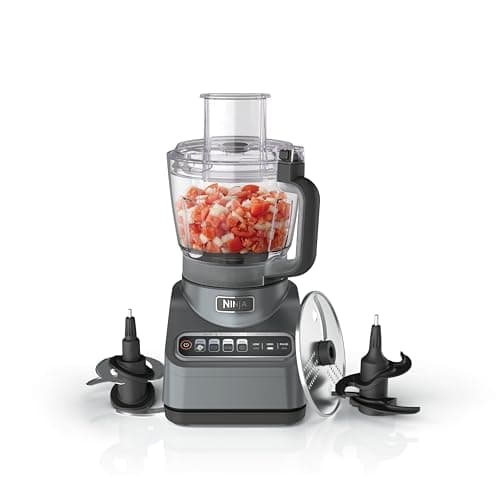
Value and dough
Ninja Professional Plus Food Processor (BN601)
The value pick: a 1,000-peak-watt motor and a dough blade for well under half the price of the premium machines.
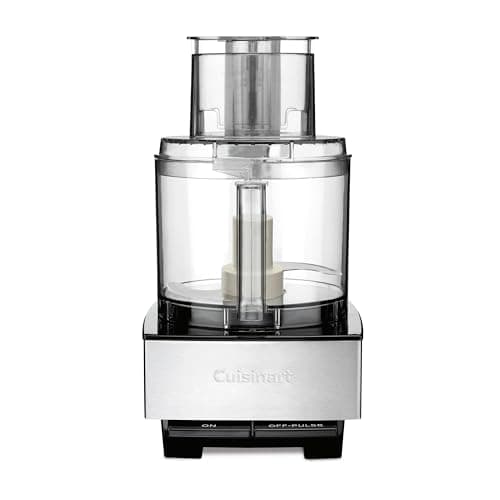
Most full-size kitchens
Cuisinart 14-Cup Food Processor (DFP-14BCNY)
The default full-size processor for a reason: a big, simple, 720-watt workhorse with the shortest parts list to go wrong.
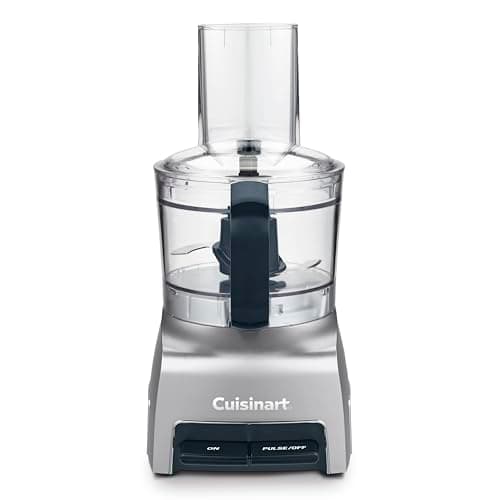
Small kitchens that still shred
Cuisinart 5-Cup Chop & Shred Food Processor (FP-5)
The smallest machine here that still shreds: a 5-cup bowl with a real reversible disc, so it slots between a chopper and a full-size processor.
#ad · As an Amazon Associate we earn from qualifying purchases.
Questions
Frequently asked
Is Ninja or Cuisinart better for food processors?
Is 1,000 watts better than 720 watts on a food processor?
Does the Cuisinart 14-cup come with a dough blade?
Which is easier to store?
Keep reading