HUB 06 · Guides
How to Julienne Vegetables
Julienne is a matchstick: a long, square-sided strip. The knife method is three cuts you can learn in ten minutes, and there are three tools that will do it for you — each of which is right for a different vegetable and wrong for the others.
We earn a commission if you buy through our links. It does not change the price you pay, and it does not decide our picks — our selection criteria are published in full. How this works.
Julienne is a shape rather than a technique: a long strip with square sides, roughly the proportions of a matchstick. Because it is a shape, there are several ways to get there, and the right one depends entirely on the vegetable. A knife owns anything you can cut into a flat plank. A julienne peeler owns anything long, firm and round. A mandoline blade owns volume. And a food processor disc owns the case where you need a great deal of it and do not care whether the strips are perfect.
The knife method: plank, stack, strip
- Square it off. Trim the vegetable into a rectangular block by slicing a thin piece off each rounded side. A carrot becomes a rough rectangle; a zucchini becomes a block with the seedy core cut away. This is the step people skip and it is the reason their julienne comes out as wedges.
- Cut planks. Slice the block lengthwise into flat slabs about as thick as you want the strips to be square. Thin planks give fine julienne; thicker ones give batons.
- Stack and strip. Lay two or three planks on top of each other, hold them flat with the fingertips of your guiding hand curled back, and cut down through the stack at the same spacing. That is julienne.
The whole technique is about making flat surfaces before you make cuts. A round vegetable rolls, and a rolling vegetable is both the reason your strips are uneven and the reason you might cut yourself. Everything in step one exists to stop that.
If you want dice instead, you are already most of the way there: line up the julienne strips and cut across them. Every small dice in every recipe you have ever read is a julienne that got one extra cut.
Julienne, batonnet, brunoise. These are the same idea at different sizes. Batonnet is a chunkier baton — the shape a French fry is. Julienne is the matchstick. Brunoise is what you get when you dice julienne. Recipes use the words loosely, so if one says julienne and shows a photograph, trust the photograph.
The tools, and what each one is genuinely for
A julienne peeler
This is the cheapest and the most underrated of the three. It is a Y-peeler with a toothed blade: you draw it down a carrot or a zucchini and it produces strips in one stroke, with no board, no planking and no stacking. For carrot salad, for a garnish, for zucchini strips in a stir-fry, it is faster than a knife and far faster than setting up a mandoline.
Its limits are real. It only works along the length of something long and firm — carrots, zucchini, cucumber, daikon, firm apples and pears, a peeled beet. It cannot do peppers, onions, cabbage or anything you would need to lay flat. And it stops when the vegetable gets too thin to hold, exactly like an ordinary peeler.
The honest oddity of this category, which our julienne peeler roundup makes its centerpiece: no maker publishes the width of the strip its teeth cut. Not one of the peelers we resolved states it. So you cannot choose one on strip size, and we do not pretend otherwise — we rank them on the things makers do state, starting with whether a blade cover is included.
A mandoline with a julienne blade
This is the volume answer. A julienne insert on a mandoline turns a whole vegetable into strips in a few passes, and the strips are more uniform than anything a hand can produce. For a slaw, for a large batch of pickles, for a dish where the look is the point, it is the right tool.
The OXO Chef’s Mandoline offers julienne and French-fry cuts from its dial without swapping a blade in, which is a genuine safety advantage. The Benriner gives the finest, cleanest julienne of anything in our catalog, using three interchangeable blades — and it demands the attention its own card warns about. If a mandoline would be your first, our beginner mandoline page covers which one to start on and the glove to buy with it.
A food processor with a julienne disc
The hands-off option, and the least precise. A julienne or French-fry disc pushes food through a grid at speed, which gives you a great deal of julienne very quickly with ragged ends and inconsistent lengths. For a slaw that will be dressed and for anything that gets cooked, that is completely fine. For a garnish, it is not. Our guide to blades and discs explains which machines ship a julienne disc and which sell it separately.
Which vegetable, which tool
| Vegetable | Best approach | Why |
|---|---|---|
| Carrot | Julienne peeler, or knife | Long, firm and round — the peeler’s ideal shape |
| Zucchini | Julienne peeler | Stop at the seedy core; the peeler does this naturally |
| Bell pepper | Knife | Cut into flat panels first; no tool handles the curve |
| Potato | Mandoline or processor disc | Volume, and evenness matters for cooking |
| Cabbage | Mandoline (slice, then cross-cut) | Leaves are flat already — slicing beats julienne blades |
| Ginger | Knife | Small, fibrous and irregular; grain direction matters |
| Apple or pear | Julienne peeler | Firm fruit, and speed matters before it browns |
Getting it even
Evenness matters for cooking, not for looks: strips of different thicknesses cook at different rates, and in a stir-fry that means some pieces are raw and some are collapsing. Three habits fix nearly all of it.
Make a flat face first, every time. Whether you are using a knife, a peeler or a mandoline, a vegetable that cannot roll cuts evenly.
Cut with the length, not across it. Julienne runs along the fiber of the vegetable. Cut across the grain and the strips break up, which is why carrots juliennes lengthwise hold together and ones cut across do not.
Stop before the last bit. With a knife, the final plank has nothing to hold onto; with a peeler or a mandoline, the last inch is where fingers meet blades. Keep the ends for stock. Our mandoline safety guide makes the same point rather more forcefully, because on a mandoline it is the one rule that matters.
What to do with julienne once you have it
Raw, dressed: carrot salad with lemon and oil, cucumber and daikon for a banh mi, apple and celeriac in a remoulade. This is where evenness shows most and where a peeler or a mandoline earns its place.
Stir-fried: peppers, carrots, zucchini and ginger, all julienned so they cook in the same couple of minutes. The whole reason the cut exists is that thin strips cook fast and evenly.
Fried: julienned potato is the shape of a shoestring fry, and a slightly thicker batonnet is the shape of a standard one. If fries are actually what you are after, a dedicated french fry cutter pushes a whole potato through a grid in one stroke and gives far more consistent results than any of the methods here.
What to buy, in order of what you cook
If you julienne carrots and zucchini a few times a month, buy a julienne peeler. It is the cheapest tool on this page, it lives in a drawer, and it removes the whole plank-and-stack routine for exactly the vegetables most people julienne. Our julienne peeler roundup ranks five of them, and the first criterion is a blade cover — because a toothed blade loose in a drawer is the one that catches you.
If you make slaws, pickles or anything in quantity, buy a mandoline with a julienne setting. The evenness is a different order from hand cutting and the time saving on a whole cabbage or a bag of carrots is large.
If you already own a food processor, check whether a julienne disc is in the box before you buy anything. Several machines include one and most owners have never fitted it.
If you julienne twice a year, buy nothing. The knife method is three cuts and you already own the knife.
The spec that would help, and does not exist
On a mandoline you can set a thickness, and good mandolines publish their range. On a julienne peeler you cannot set anything, and no maker in our catalog states the width of the strip its teeth produce. That means the only way to know what a given peeler cuts is to buy it and look.
We are not going to fill that gap with a number from a blog. What we can tell you is what makers do publish — blade material, whether a cover is included, whether it works left-handed, whether it is dishwasher safe — and that is what our ranking uses. If a maker starts publishing a strip width, we will cite it.
Handling and storage
Julienned vegetables have a lot of surface area, which is why they cook fast and also why they dry out and discolor fast. Cut them as close to serving as you reasonably can. Carrots and daikon hold up for a day in a sealed container; zucchini weeps; apple and pear brown within minutes unless they are tossed with something acidic.
If you are prepping ahead for a stir-fry, keeping the strips in cold water crisps them and buys you a few hours — then drain and dry them thoroughly, because water in a hot wok is the difference between frying and steaming. A salad spinner dries them better than a towel and in less time.
The hardware
The hardware this guide is about
The products this guide refers to, with prices pulled live from Amazon and dated on every card. Full rankings live in the roundups linked above.
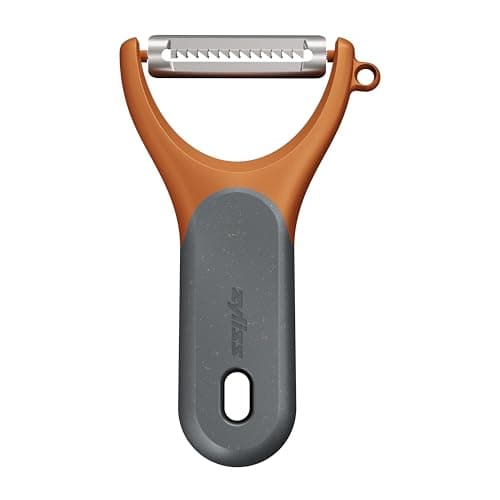
Most kitchens
Zyliss Julienne Y Peeler
The cheapest julienne peeler here that ships with a blade cover — and a cover is the feature that matters most on a tool whose teeth are the most finger-hostile edge in the drawer.
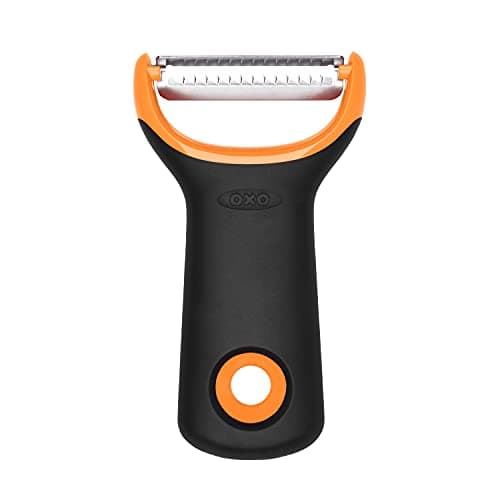
Comfort and easy cleanup
OXO Good Grips Julienne Prep Peeler
The comfortable, dishwasher-safe default from the brand most people already own a peeler from — with no blade cover in the box.
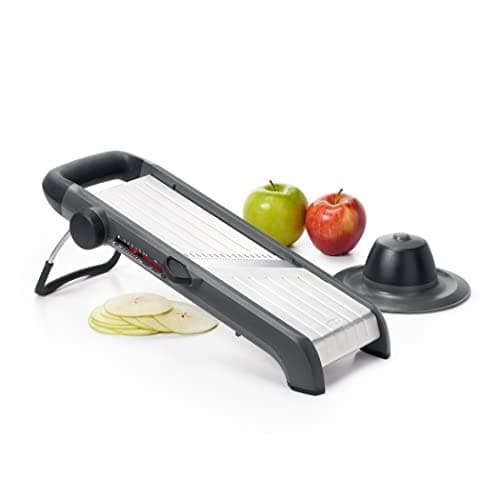
Most home cooks
OXO Good Grips Chef's Mandoline Slicer 2.0
The mandoline to buy: a solid, foldable slicer with a runway of thickness settings and a genuinely usable hand guard.
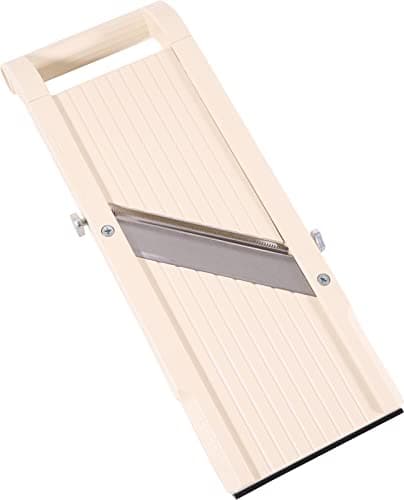
Sharpest slices
Benriner Super Slicer (Japanese Mandoline)
The professional's mandoline: a wide Japanese slicer whose razor-sharp blades chefs quietly rely on.
#ad · As an Amazon Associate we earn from qualifying purchases.
Questions
Frequently asked
What does julienne mean?
How do you julienne with a knife?
Is a julienne peeler worth buying?
Can a food processor julienne vegetables?
What size should julienne be?
Should you julienne with or against the grain?
Keep reading
Related
- Best julienne peelersFive ranked, starting with whether a cover is included.
- Best Japanese mandoline slicersThe finest julienne in our catalog, and its demands.
- Best mandoline for beginnersWhere to start if a julienne blade would be your first.
- Food processor blades and discs explainedWhich machines ship a julienne disc.
- Best french fry cuttersIf batons rather than matchsticks are what you want.
- Mandoline vs box graterThe boundary between slicing and shredding.