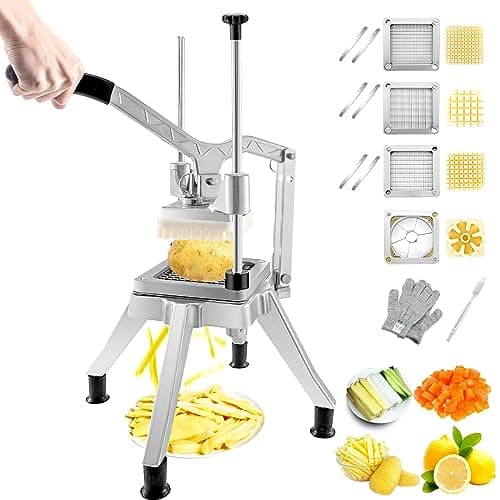
For most kitchens the best french fry cutter is the VEVOR Commercial French Fry Cutter, 4 Blades: it is the only one of these five whose maker publishes every cut size it makes — 1/2″, 3/8″, 1/4″ and a 6-wedge slicer — and it drives them with a lever rather than your palm. If you want one tool that will outlive the kitchen and you only ever eat standard fries, the New Star Foodservice 42306 French Fry Cutter is the cast-iron answer. If fries are an occasional treat and cupboard space is the real constraint, the Cuisinart PrepExpress French Fry Cutter is the compact one, and it is the only pick here that publishes its own footprint.
Two decisions, and everything else is detail
Every fry cutter on the market is the same machine: a fixed grid of blades, and something that forces a potato through it in one stroke. There is no motor, no speed setting and nothing to adjust mid-cut. That leaves exactly two things to decide, and the listings bury both of them under the word “professional”.
The first is the grid size, because the grid is the fry.A 3/8-inch grid is the standard restaurant cut — crisp outside, soft middle, the fry most people picture. A 1/2-inch grid gives thick steak fries and wedge-style batons: more fluffy interior, slower to cook, much harder to dry out. A 1/4-inch grid gives shoestrings, which cook fast, go crisp all the way through and burn if you look away. You are not choosing a setting here. On a single-grid cutter you are choosing the only fry that tool will ever make.
The second is where the force comes from.A raw potato is dense, and pushing one through a grid of blades takes real effort. A lever-arm press — the commercial shape, with a long handle hinged over the frame — multiplies a light pull into that force; VEVOR describes its handle in exactly those terms, as using the principle of leverage. A compact cutter has no lever: you press a lid down with your palm and your body weight, which is fine on a modest potato and unpleasant on a big one. Neither design is wrong. But if grip strength, wrists or arthritis are part of your kitchen, this is the decision, not the price.
A fry cutter is not a slicer and not a dicer. It makes batons of one fixed thickness and nothing else. If what you want is thin, even slices, that is a mandoline job— and a mandoline with a French-fry or julienne blade will cut fries too, thinner and more fiddly than a press. If what you want is cubes, that is a push-through dicer, which is the same mechanism with a shorter grid.
The five cutters
The VEVOR Commercial French Fry Cutter, 4 Bladesis the pick because it is the one that shows its working. VEVOR states the four blade sets in inches — 1/2″, 3/8″, 1/4″ and a 6-wedge slicer — says the blades are food grade 420 stainless, and supplies two spare blades with every set, which is a quietly serious detail on a tool whose only wearing part is the blade. The frame is stainless and aluminum alloy on four non-slip feet, the handle works by leverage, and the blades and push block come out to be washed. The honest marks against it: aluminum is not the cast iron the New Star is built from, four cassettes plus spares is a drawer of loose blades to store, and VEVOR publishes no warranty term at all.
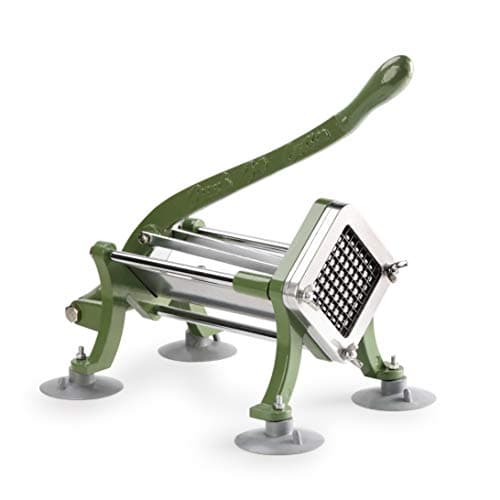
The New Star Foodservice 42306 French Fry Cutteris the one to buy if you will still be cutting fries with it in ten years. It is the commercial design: a powder-coated cast iron body on a stainless rod, mounted to a table or a wall, with suction feet so you can anchor it without drilling into anything. The detail that matters most is not the metal, it is that New Star sells replacement parts for it — a maker stocking spares is telling you the tool is expected to be repaired rather than replaced. What you give up is choice. It cuts 3/8-inch fries and that is the whole tool; it is the most expensive thing here by a wide margin, and it is heavy enough that it wants a permanent home on the counter or the wall rather than a cupboard.
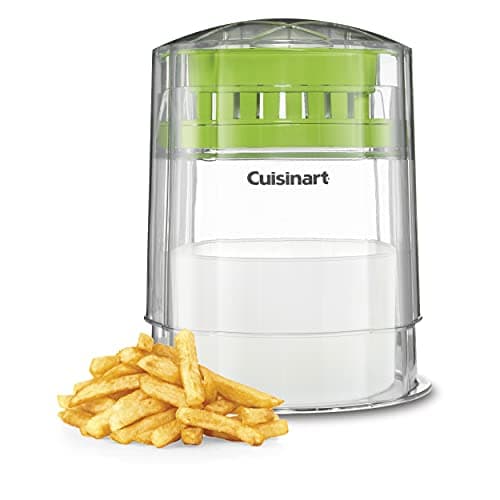
The Cuisinart PrepExpress French Fry Cutteris the one to buy if fries happen a few times a month and the kitchen is small. It ships two stainless grid blades — regular and steak — that store inside the unit, a food pusher so your fingers stay off the grid, a non-slip base and a container that catches the fries instead of scattering them. It is also the only cutter here that publishes its own dimensions, 6.38 by 6.38 by 8.25 inches, which is exactly the number you need before you buy a single-purpose object for a full cupboard. The trade is force and precision: it is a pressed lid, not a lever, so a large raw potato is your arm’s problem, and Cuisinart names the two cuts only as “regular” and “steak” without publishing a dimension for either.
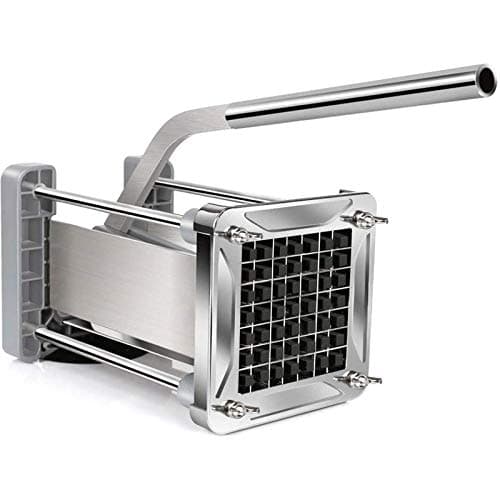
The Sopito French Fry Cutter, 1/2 Inchis the specialist. One grid, 1/2 inch, on an all-stainless lever frame, and Sopito is the only maker in this group that names low hand strength as the design brief: it states the lever needs minimal force and calls out older cooks and anyone with joint discomfort, either handed. Thick batons are genuinely the right cut for oven fries, where a thin fry dries out before it browns. Two honest limits. There is no 3/8-inch option and never will be, and Sopito’s own instructions tell you to microwave sweet potatoes for one to three minutes before cutting them — useful advice, and also a clear statement of where the force ceiling sits.
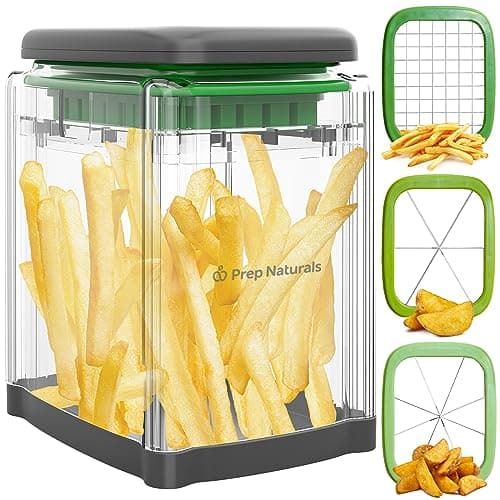
The Prep Naturals Medium Stainless Steel French Fry Cutteris the cheap route to the most shapes. Three interchangeable blades cover fries, wedges and diced vegetables, the chop box catches everything, and it arrives with the two accessories people usually buy after the fact: a cut-resistant glove and a brush for the grid. It comes apart to be cleaned, which on a blade grid is the difference between a rinse and a fight. What you are accepting is vagueness and effort: Prep Naturals publishes no grid dimension for any of the three blades, the tool is sold in more than one size so “Medium” needs checking in the cart, and it is another pressed lid rather than a lever.
Anchoring: the difference between a tool and a wrestling match
A cutter that slides is a cutter that jams. When the frame moves under load the potato stops going through the grid squarely, it wedges, and you end up levering it back out around a field of blades. Every pick here addresses this, and the four approaches are worth knowing before you decide where the thing will live.
The New Star has suction feet and can be table or wall mounted, which is the most secure arrangement available and also the one that costs you a permanent piece of counter or wall. The VEVOR stands on four non-slip shock-absorbing feet and is heavy enough to stay put without being fixed to anything. The Cuisinart states a non-slip base, which on a compact palm-press is doing a different job — it is stopping the unit skating, not resisting a lever. The Sopito is a lever frame with no mounting stated in its listing, so it wants a clean, dry counter and a firm hand on the body.
The practical rule: the longer the lever, the more the frame needs to be anchored. If you are buying a lever press and you have a spot for it, mount it. If you are buying a compact press, clear the counter and dry it first.
How they compare
| Cutter | Published cut sizes | Force | Best for |
|---|
| VEVOR Commercial French Fry Cutter, 4 Blades | 1/2″, 3/8″, 1/4″ + 6-wedge | Lever arm | Most kitchens |
|---|
| New Star Foodservice 42306 French Fry Cutter | 3/8″ only | Lever arm | Weekly fries, for years |
|---|
| Cuisinart PrepExpress French Fry Cutter | Regular and steak, no dimension published | Pressed lid | Small kitchens, occasional fries |
|---|
| Sopito French Fry Cutter, 1/2 Inch | 1/2″ only | Lever arm, stated low force | Steak fries, tired hands |
|---|
| Prep Naturals Medium Stainless Steel French Fry Cutter | Fries, wedges, dice — no dimensions published | Pressed lid | Spending as little as possible |
|---|
Which one to buy
Buy the VEVOR Commercial French Fry Cutter, 4 Blades unless something below describes you. It is the only cutter here that tells you, in inches, every cut it can make, it includes spare blades, and the lever means a raw russet is a pull rather than a shove.
Buy the New Star Foodservice 42306 French Fry Cutterif fries are a weekly habit and you want the last cutter you will buy — cast iron, mountable, with spares sold for it. Buy the Cuisinart PrepExpress French Fry Cutter if the cupboard is the constraint and you want a known brand at the low end of the money. Buy the Sopito French Fry Cutter, 1/2 Inch if thick fries are what you actually eat and hand strength is a genuine consideration. Buy the Prep Naturals Medium Stainless Steel French Fry Cutter if you want fries, wedges and cubes from one cheap box and can live without a published dimension for any of them.
And buy none of them if you make fries twice a year. A sharp knife and ten minutes does the same job badly-shaped, and an adjustable mandoline with a French-fry blade already covers thin fries if you own one. A fry cutter earns its space on repetition: the twentieth potato is where a fixed grid stops being a gadget and starts being the reason the fries are all the same size.
Getting good fries out of whichever one you buy
None of what follows is a test result — this site runs no kitchen lab, and how we pick says so plainly. It is standard cooking practice, included because it changes the result far more than the choice between these five tools does.
Start with a starchy potato. Russets and other floury varieties fry to a dry, fluffy interior. Waxy potatoes hold water and stay dense, which is what you want in a salad and not what you want in a fry. Size matters too, and in a way that is specific to this tool: the potato has to fit the chamber. A cutter has a fixed opening, so an outsized russet either gets trimmed to fit or gets halved, and half a potato pushed through a grid gives you half-length fries.
Peel or do not peel, but decide before you cut.Skin-on fries hold together better and are less work; peeled fries brown more evenly. Either way it happens before the potato meets the grid, because peeling a baton is not a thing anyone does twice — a good swivel or Y-peeler takes about twenty seconds per potato.
Rinse the cut fries, then dry them properly.Cutting releases surface starch; leave it on and the fries glue together and brown unevenly. Rinse in cold water until it runs clear, then dry them — genuinely dry, in a towel — because water on the surface is the enemy of both a hot oven and hot oil. This is the step most people skip and it does more for the outcome than any tool on this page.
Cook them twice. Fries that go crisp outside and stay fluffy inside are cooked in two stages: a gentler first pass to cook the middle through, then a hotter second pass to color and crisp the surface. In oil that is the classic blanch-then-fry; in an oven it is a par-boil or a moderate first roast, then high heat to finish. One pass at one temperature gives you the choice of pale-and-soft or dark-and-hollow.
Match the cut to the method.Thin shoestrings are for hot, fast cooking and burn in a slow oven. Thick 1/2-inch batons need time to cook through and reward it with a fluffy interior. If you own a multi-grid cutter, this is what those extra cassettes are actually for — not novelty, but matching the fry to how you cook.
Salt after, not before. Salt draws moisture to the surface, and surface moisture is what you spent the drying step removing. Season the moment they come out, while the surface is still hot enough to hold it.
Cleaning a blade grid without cutting yourself
A fry cutter grid is a field of exposed blades pointing at you, and washing up is when people get caught — the same warning the dicer roundup gives, for the same reason.
Rinse it immediately, before starch dries in the squares and turns to glue. Push stuck pieces through from the back, in the direction the potato traveled, with the pusher or a brush — never pick at them from the blade side with a finger. Prep Naturals supplies a brush and a glove for exactly this; VEVOR states the blades and push block are removable and washable; the Cuisinart grids come out and store inside the body. If you do not have a glove, a cut-resistant glove is a few dollars and belongs in any drawer that holds a grid or a mandoline.
Two more things worth knowing. Dry the grid rather than leaving it to drain, because standing water on a blade edge is how a cheap stainless grid starts spotting. And store it with the grid covered or inside the unit if the design allows — a loose blade cassette in a utensil drawer is a hand injury waiting for a distracted moment.
What else a fry cutter will cut
More than the name suggests, and it is worth knowing before you decide it is a single-purpose object. Sopito lists carrots, cucumbers and zucchini; VEVOR lists potatoes, carrots, cucumbers, apples and pears; Cuisinart lists sweet potatoes, zucchini and carrots. The common thread is dense produce of roughly potato dimensions — anything soft enough to squash rather than cut will come out mangled, and anything wider than the chamber will not go in.
Sweet potatoes deserve their own note. They are denser than a russet and they are what most often defeats a cutter, which is precisely why Sopito publishes the microwave trick: one to three minutes to soften the flesh slightly before it meets the grid. If sweet potato fries are the reason you are buying a cutter, buy a lever press.