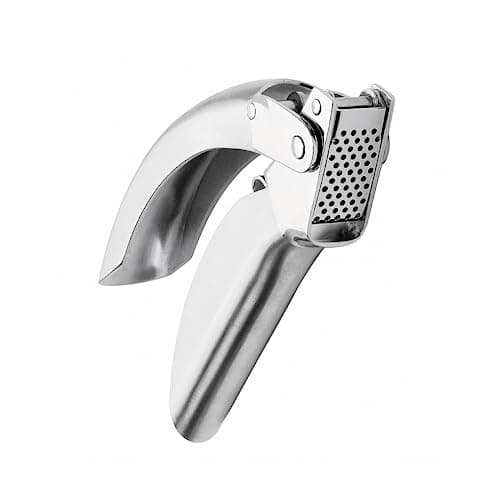
Garlic presses are a category where the cheap ones are genuinely bad, in a way that is easy to feel: a flexing handle, a hopper that bulges, and a clove that squashes without going through. The Kuhn Rikon Epicurean Garlic Pressis the answer at the other end — stainless steel throughout, long-handled, and built with enough leverage that the press does the work rather than your hand.
What long handles actually do
Leverage. Kuhn Rikon lists a long-handled, high-leverage design, and the physics is the whole product: a longer handle means less force at your hand for the same force at the hopper. On a soft clove that is a nicety. On a large, firm, freshly harvested clove — the kind that makes a cheap press flex and let go — it is the difference between crushing it and fighting it.
It presses unpeeled cloves, which is the feature that saves the most time in practice. The skin stays behind in the hopper as a flat disc you pick out and bin, so you skip peeling entirely for anything going through the press.
Stainless throughout, and why that matters
There is no plastic in the load path. That is a durability claim, and it is also a garlic-specific one: garlic is sulfurous and it stains and eventually smells in porous materials. A one-piece stainless body has nothing to absorb it and nothing to go cloudy.
It is a heavy tool, which reads as reassuring in the hand and as a small nuisance in a crowded drawer. Both are fair.
Rinse it immediately, always. This is the whole maintenance story for any garlic press. Wet garlic pulp comes out of the holes with a brush in seconds; dried garlic pulp is cement and takes a pin. Rinse it under the tap the moment you have used it, before you go back to the pan.
The trade against the OXO
The OXO Good Grips Garlic Pressis our overall pick, and the gap between the two is narrower than the price difference suggests. OXO’s advantage is a built-in cleaner — a comb of pegs that pushes through every hole and clears the pulp in one motion. On a tool whose only real chore is cleaning, that is a meaningful convenience, and it is exactly what the Kuhn Rikon does not have.
Kuhn Rikon’s advantage is the crush itself and the build. It takes less hand force, it has no plastic to age, and it is the one to buy if a press is a tool you expect to keep for decades rather than replace. Its own skip line is honest about the flip side: if you crush a lot of garlic and dislike cleaning presses, the OXO’s cleaner — or a knife and salt paste — may suit you better.
Our garlic press roundup puts them side by side on the specs.
When not to use a press at all
A press ruptures more cells than a knife does, which releases more of the compounds responsible for garlic’s sharpness. That is exactly what you want in a vinaigrette, a marinade or a garlic butter, and it is not what you want in a slow-cooked braise where sliced garlic is meant to sweeten and melt.
For large quantities, neither a press nor a knife is the fastest route — a small electric chopper does a whole head in seconds, which is the right tool when you are prepping garlic confit or a big batch of sofrito rather than three cloves for dinner.
Who should buy it
Cooks who use garlic constantly and want a tool with nothing to break, and anyone who has already worn out a cheap press and does not want to do it again. It is also the better choice for anyone who finds pressing hard work, because the leverage is the point.
Skip it if cleaning is your objection to garlic presses in general — the built-in cleaner on the OXO addresses that directly — or if you crush garlic rarely enough that the flat of a knife and a pinch of salt is genuinely all you need.