HUB 06 · Guides
Immersion Blender vs Blender
One goes to the food; the other makes the food come to it. That single difference decides soup, smoothies, safety and how much washing-up you do — here is the rule.
We earn a commission if you buy through our links. It does not change the price you pay, and it does not decide our picks — our selection criteria are published in full. How this works.
Buy an immersion blender if most of what you blend is already in a pot: soup, sauce, puree, a batch of mayonnaise. Buy a countertop blenderif most of what you blend starts cold and needs to be liquefied: smoothies, frozen drinks, silky soups, nut milks. The difference is not power — it is whether the food has to move to the blade or the blade moves to the food.
The difference in one table
| Job | Immersion blender | Countertop blender |
|---|---|---|
| Hot soup in the pot | Excellent — and safest | Risky: steam can force the lid |
| Silky, restaurant-smooth puree | Good | Better |
| Smoothies with frozen fruit | Struggles | Excellent |
| Crushing ice | No | Yes |
| Mayonnaise and emulsions | Excellent — the classic method | Workable |
| Small quantities | Excellent | Poor — too little to reach the blade |
| Washing-up | One shaft, rinsed under the tap | A whole jar, lid and blade assembly |
| Storage | Drawer | Counter or cupboard shelf |
The hot-liquid argument, which is not really about convenience
Pouring a pot of hot soup into a sealed blender jar is genuinely dangerous. Hot liquid gives off steam, steam expands, and a sealed jar with a spinning blade builds pressure fast enough to lift the lid and throw boiling soup across the kitchen. Every blender manual addresses this — vent the lid, fill no more than half, start slow — and it remains one of the more common serious kitchen burns.
An immersion blender removes the problem rather than managing it. The soup never leaves the pot, there is no sealed vessel, and there is nothing to pour. If you make soup even occasionally, that alone is a strong argument, and it is why our soup-specific ranking exists.
Where the countertop blender genuinely wins
Texture and frozen food. A blender jar is tall and narrow, and its blade creates a vortex that keeps pulling the contents back down through the cutting edge. That circulation is what produces a genuinely silky puree, and it is what lets a blender pulverize frozen fruit and ice. An immersion blender in a wide pot has no such circulation — you have to move it around yourself, and it will never get quite as smooth.
So: a velouté you want glossy and completely smooth is a blender job. A chunky-then-blended vegetable soup is an immersion blender job. Frozen smoothies are a blender job, full stop.
If you can only own one.For most home kitchens the immersion blender is the more useful single purchase: it costs less, stores in a drawer, washes in ten seconds, handles small quantities, and does the hot-soup job safely. The exception is a household that makes smoothies most mornings — then buy the blender first and add a stick blender later.
The washing-up factor decides real use
This sounds trivial and is not. A countertop blender means disassembling and washing a jar, a lid, a gasket and a blade base every time. An immersion blender means running the shaft under the tap, or blitzing a squirt of soapy water in a jug for ten seconds. That gap decides which one you reach for on a Wednesday evening, and a tool you use is worth more than a better tool you avoid.
The same logic applies to quantity. A countertop blender has a minimum useful load: below roughly a cup, the contents sit under the blade and spin without being cut, which is why a single portion of soup or a small batch of dressing is genuinely awkward in one. An immersion blender has no minimum at all — it will blend two tablespoons of vinaigrette in the jar you are going to store it in. For a household of one or two, that single fact changes the calculation more than any specification.
Price, counter space and the honest sequence
These two tools do not occupy the same price bracket. A capable immersion blender with a whisk and a chopper attachment costs a fraction of a capable countertop blender, and the gap widens fast at the top: high-performance jug blenders are among the most expensive small appliances in a kitchen, while stick blenders top out modestly. If you are equipping a kitchen from scratch and cannot buy both at once, the immersion blender buys more capability per pound.
Space follows the same pattern. A jug blender is a permanent counter resident in most kitchens, because it is heavy and awkward to lift in and out of a cupboard, and because a blender in a cupboard is a blender you stop using. A stick blender goes in a drawer with its attachments and comes out in two seconds. In a small kitchen that is not a minor consideration; it is frequently the deciding one.
What about the attachments?
Several immersion blenders narrow this comparison considerably by shipping with a chopper bowl and a whisk. The Cuisinart Smart Stick Variable-Speed (CSB-179) includes both, and the Braun MultiQuick 7 (MQ7035X) adds a food processor bowl on top. That turns one motor into a stick blender, a small food chopperand a hand mixer — three appliances in one drawer. A countertop blender does not multiply like that; its jar does one thing extremely well and nothing else.
The counter-argument, and it is a fair one, is that an attachment is only useful if it is good. A chopper bowl on a stick blender holds a couple of cups and will not slice or shred, so it is a supplement to a proper chopper rather than a replacement. What it does do is cover the occasional small job well enough that you never buy the separate gadget — which for most kitchens is the point.
The hardware
The hardware this guide is about
The products this guide refers to, with prices pulled live from Amazon and dated on every card. Full rankings live in the roundups linked above.
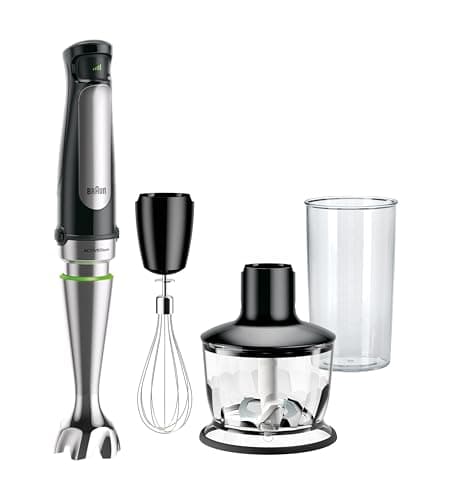
Most kitchens
Braun MultiQuick 7 (MQ7035X)
The one to own: Braun's anti-splash bell and smooth variable speed make it the most controllable stick blender here.
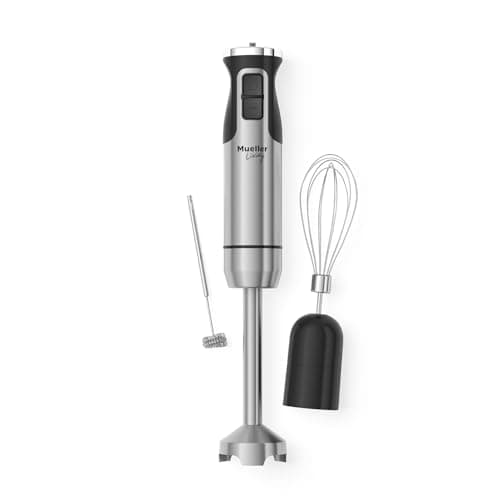
Best cheap immersion
MuellerLiving Ultra-Stick 500W Immersion Blender
The budget champion: a 500-watt, nine-speed stick with whisk and chopper for the price of a basic model.
#ad · As an Amazon Associate we earn from qualifying purchases.
Questions
Frequently asked
Can an immersion blender replace a blender?
Is it safe to blend hot soup in a countertop blender?
Which is better for smoothies?
Do immersion blenders scratch pots?
Keep reading