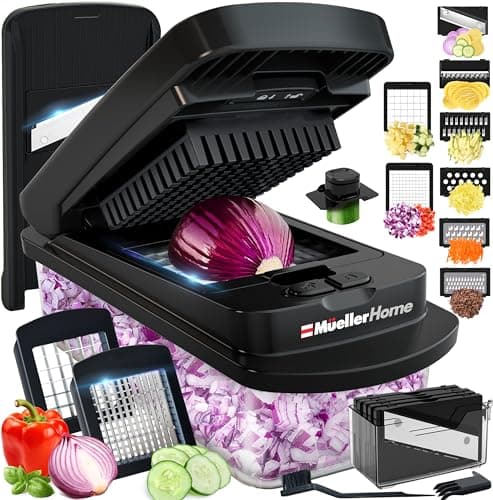
The Mueller Pro-Series 10-in-1 Vegetable Chopper is a push-down dicer: you load produce onto a blade insert, bring the lid down with your palm, and the food comes out the other side in even pieces. What separates it from every other tool of that kind is the blade count. Mueller supplies eight inserts — two dicing grids in different sizes, plus six more for slicing, julienne, grating and shredding — which makes it the most versatile manual prep tool on this site and, for a certain kind of cook, six parts too many.
The cut it makes, and why that is the whole decision
A bladed chopper — electric or pull-cord — spins an edge through food until the pieces are small. The result is a mince: irregular, with juice released. A push-dicer presses food through a stationary grid, and the result is a dice: square, even, each piece the size the grid decided. For anything where the pieces are visible in the finished dish — salsa, a mirepoix, a chopped salad, a stir-fry — that difference is the entire reason this category exists. Our electric vs manual chopper comparison sets out the fork in full; this review is about how well Mueller executes the manual side of it.
What the eight blades actually are
The listing is specific, and the breakdown matters because the blades are where your money goes. There are two dicing blades in different sizes, which is the pair you will reach for almost every time: the larger grid for onion, pepper, potato and anything going into a pan, the finer one for salsa and relish where you want the pieces to disappear into the mix. Then there are six interchangeable inserts for slicing, julienne, grating and shredding — the mandoline half of the tool, which is why Mueller calls it a chopper and mandoline slicer in the same breath.
The grating and shredding inserts are the ones most owners underuse, and they are genuinely good value: a whole cabbage for coleslaw goes through in a couple of minutes, which is the job most people buy a separate box grater for. If you only want that job, our box grater roundup is the cheaper route. If you want it alongside dicing, this is the tool that does both with one body and one catch container.
What “10-in-1” counts. It is not ten blades. The listing names eight inserts; the ten is a count of functions — chop, dice, slice, julienne, grate, shred and so on, with the container and food holder folded in. Nothing dishonest is happening, but if you are comparing it against a rival badged “4-in-1” you are not comparing like with like. Count blades, not hyphens.
The container and the food holder
Everything you cut lands in a 1.2 L catch container, and that is a larger share of the value than the spec sheet suggests. It removes the step people find tedious about prep — scraping a board into a bowl — and the container goes into the fridge as it is. The food holder is the other accessory worth knowing about: a small gripper that holds the last inch of a carrot or a shallot so your fingers are not the thing travelling toward the blade.
Note what is not in the box: a cut-resistant glove. The dicing grid is a field of exposed edges, and the most likely injury with any tool of this design happens while you are washing it rather than while you are using it. Our cut-resistant glove roundup covers what the ratings mean, and a glove costs a fraction of what this does.
What it asks of you
Force, and this is the honest limit of the whole design rather than a flaw in this particular machine. A soft onion goes through easily. A raw carrot, a sweet potato or a chunk of squash takes a committed push with your body weight behind it. If you have weak grip strength, wrist pain or arthritis, do not buy this — buy an electric chopper, and read the best kitchen tools for arthritic hands first. No amount of technique substitutes for the load the grid requires.
The second cost is storage. Eight inserts have to live somewhere, and unlike a four-blade rival this is a tool with a small parts problem: the two you use weekly are easy to find, the six you use occasionally are easy to lose. Mueller supplies the container they sit in, which helps, and the body is dishwasher safe once dismantled.
Cleaning it
Rinse the grid before anything dries onto it. That one habit is the difference between a ten-second job and a ten-minute one, and it matters most with tomato, which cements itself into a grid faster than almost anything else in a kitchen. Mueller says the tool can be taken apart and put in the dishwasher, which is the right way to do the weekly clean; the between-jobs clean is a rinse, with a glove on. Our guide to cleaning a vegetable chopper covers the awkward parts — the grid corners, the lid seam and the blade carrier — in detail.
Against the Fullstar, which is the real decision
Almost nobody chooses between the Mueller and an electric chopper; they choose between the Mueller and the Fullstar Pro XL Vegetable Chopper & Mandoline, because the two sit at the same price in the same shape. The short version: Fullstar supplies four blades in 420J stainless and a 1.8 L container, Mueller supplies eight blades and a 1.2 L container. You are trading catch capacity for cutting range. If you dice onions and tomatoes and nothing else, the Fullstar is the better buy — fewer parts, bigger box. If you want the julienne and grating inserts too, the Mueller is the only one of the pair that has them. We settle it properly in Fullstar vs Mueller.
Against an electric chopper such as the Ninja Express Chop (NJ110GR): the Ninja is faster, needs no strength at all and washes in seconds, and it cannot dice — it minces. Against a proper mandoline: the OXO slices thinner, more precisely and with a thickness dial, and it does not dice. Against a full-size food processor with a dicing kit: the processor does all of it faster and with no effort, at five to ten times the money.
One claim we are not repeating
Mueller’s own listing states that more restaurants use its chopper than all the others combined, and takes a swipe at a rival it does not name. We have no way to verify either claim and it plays no part in the assessment above. Everything we have said about this tool comes from the published specification — blade count, blade types, container volume, accessories, care instructions — and from the mechanics of how a push-dicer works, which you can check against your own hands.
Who should buy it
Cooks who want even dice and shredded cabbage, julienned carrot and sliced potato from one cheap tool, who have the hand strength for hard produce, and who will not resent storing eight inserts. Anyone who wants the simplest possible dicer should buy the Fullstar; anyone who mainly wants garlic, herbs and a fast mince should buy an electric chopper from the electric roundup; and anyone prepping in real volume should be reading food processor vs chopper instead.
We have not tested this chopper. The blade count, blade types, container volume, accessories and care instructions above are all stated on Mueller’s own live listing, linked in the sources below and re-verified in stock on 15 October 2026; the judgments are arguments from those facts, in the method set out on how we pick.