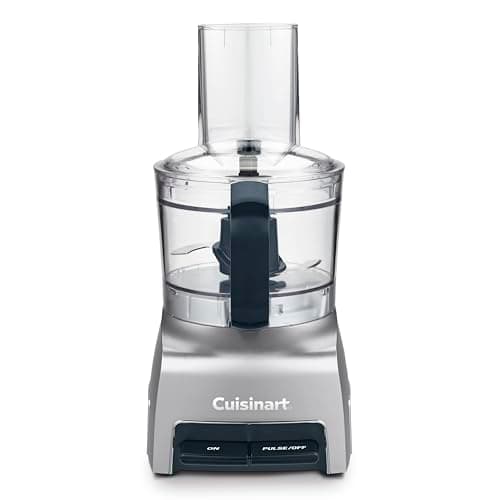
For a small kitchen the best single prep machine is the Cuisinart 5-Cup Chop & Shred Food Processor (FP-5), because it is the only powered processor in our catalog whose maker publishes a storage design: the parts nest inside the work bowl and the cord stores in the base, so it packs down to roughly the size of a chopper and still carries a shredding disc. Around it, the picks that follow are ranked on the same question — not what the tool does, but where it goes afterward. The Epicurean Kitchen Series Cutting Board (11.5×9) stands in a cabinet slot and doubles as a trivet, the Zyliss Easy Spin 2 Salad Spinner (Large) has a flat lid built to stack, the OXO Good Grips Hand-Held Mandoline Slicer is a drawer tool rather than a countertop one, and the two choppers at the end answer the two different versions of “no room”: no counter, and no outlet.
The spec that would settle this, and why you will not find it
A small-kitchen buying guide ought to be a table of dimensions. It cannot be. Board makers publish sizes, because a board is a rectangle and the size is the product. Bowl makers publish capacity. Almost nobody publishes the assembled height of a food processor, the stored footprint of a salad spinner, or how tall a machine is with its feed tube on — which is the number that decides whether it lives under your upper cabinets.
We are not going to measure products we do not own, and we are not going to copy numbers off a forum. So this page ranks on the storage claims makers do publish: whether parts nest, whether the cord stows, whether the lid is flat, whether the body is slim enough for a drawer, and whether the tool needs mains power at all. Every one of those is a stated claim you can check on the listing before you buy.
One number we can give you is the exception that proves the rule. The full-size Cuisinart DFP-14, the default recommendation on our main ranking, carries a plainly stated drawback in its own catalog entry: its tall footprint does not fit under most upper cabinets when assembled. That is the kind of honesty a small kitchen needs, and it is rarer than it should be.
The four questions that actually decide it
- Does it pack down? A machine whose blades, discs and cord live inside its own bowl occupies one cupboard slot. The same machine with four loose accessories occupies a shelf.
- Is the lid flat? A domed lid makes a bowl unstackable, and a stack is the whole storage strategy in a small cupboard. Zyliss publishes this as a design feature; most spinner makers do not mention it because theirs are domed.
- Does it need an outlet? Small kitchens are usually short of sockets, not just counters. A hand-powered tool needs neither.
- Does it do two jobs? A board that is also a trivet, a spinner bowl that is also a serving bowl, a processor that also shreds. Dual use is how you own fewer things without doing less.
The one machine worth the cupboard space
The Cuisinart 5-Cup Chop & Shred Food Processor (FP-5) sits in a genuine gap. Our mini processor roundup covers the three-cup choppers that chop and grind but do not slice or shred; our large processor roundup covers the machines that do everything and need a cupboard to themselves. The FP-5 is the small one that still carries a reversible shredding disc, which means cheese and carrots stay on the menu in a kitchen that cannot house a 14-cup machine.
Its honest limits are on the card and they are real: Cuisinart publishes no wattage for it at all, so there is no motor figure to compare against a bigger machine, and there is one reversible disc rather than an adjustable one. Five cups fills fast. If you make dough or cook in batches, this is not the machine — and in that case the honest answer for a small kitchen is a bigger processor that lives in a cupboard and comes out twice a week, rather than a smaller one that disappoints daily.
Boards, bowls and the things that stack
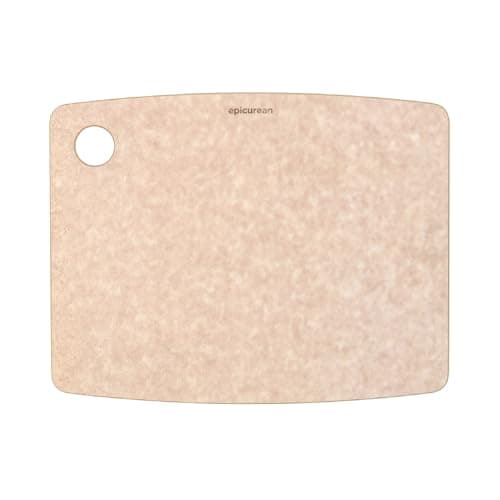
The Epicurean Kitchen Series Cutting Board (11.5×9) is on this page for a reason its own listing states: at 11.5 by 9 inches and a thin profile, it stores in a cabinet slot rather than leaning against a backsplash, it needs no oiling, and it is rated to 350°F so a hot pan can go straight onto it. Two jobs, one object. The price of that is size — it is a small board, and a whole chicken will not fit on it. Our cutting board roundup has the full material argument, including why a second dishwasher-safe board for raw meat is worth the slot even in a tiny kitchen.
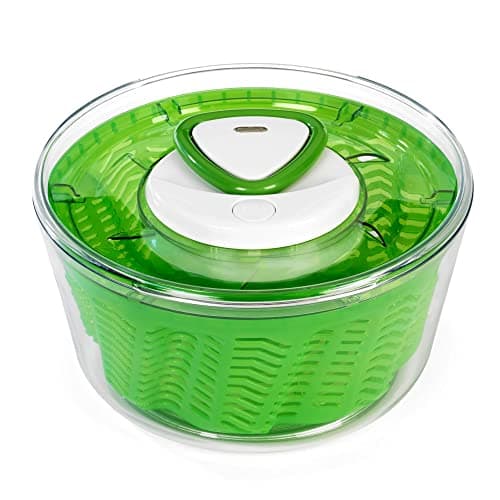
The Zyliss Easy Spin 2 Salad Spinner (Large) is the spinner with the published packing claim: a flat see-through lid, made to stack in a cupboard or in the fridge. In a small kitchen that matters more than drying performance, because every spinner dries greens well enough and only one of them stacks. Its wear point is the retracting pull cord, which is the classic failure on spinners — the pump-driven OXO we rank first overall is arguably the more durable mechanism, and it is domed.
Drawer tools instead of counter tools
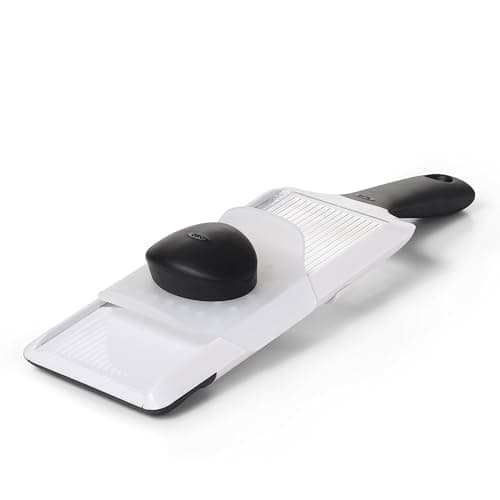
The OXO Good Grips Hand-Held Mandoline Slicer is the same swap in a different category. A countertop mandoline is a stable, excellent tool and it is also a rigid frame you have to find a home for; the handheld version is a flat slicer you hold over a bowl and then put in a drawer. You give up stability, and we say so plainly: holding a slicer over a bowl is less steady than resting one on a counter, and it is not the tool for volume. For a few cucumbers, a couple of potatoes or a fennel bulb, it is all the mandoline a small kitchen needs.
It is also the pick that carries the most risk of the six, so read the mandoline safety guide before the first use, and read our beginner mandoline page if this would be your first one. The handheld design is not the easiest place to start.
The two kinds of “no room”
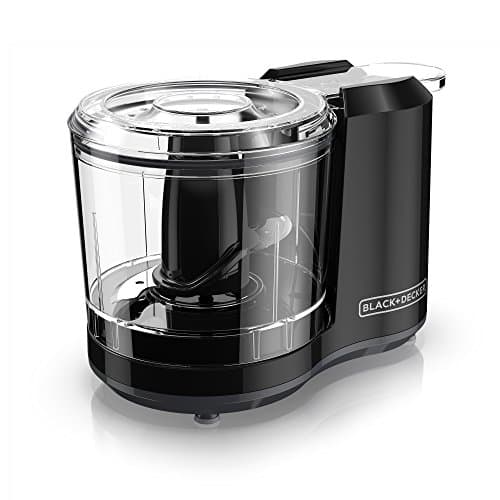
The last two picks answer different problems and it is worth knowing which one you have. If the problem is counter space, the BLACK+DECKER 1.5-Cup Electric Food Chopper is the smallest electric chopper worth buying: a 1.5-cup bowl, 150 watts, dishwasher-safe removable parts, and small enough to leave out or drop in a drawer. Its limit is exactly that size — two onions means two batches, and hard nuts or parmesan are a stretch at 150 watts.
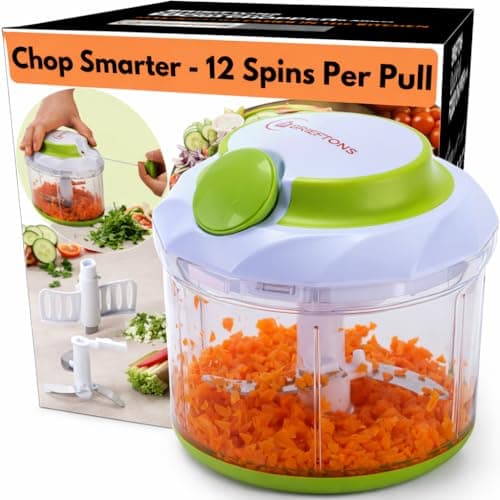
If the problem is outlets, the Brieftons QuickPull Manual Food Chopper (4-Cup) is the answer: a four-cup bowl driven by a pull cord, with no plug, no batteries and no noise. It is the larger bowl of the two and it works on a balcony, in a dorm or in a kitchen where the toaster and the kettle have already claimed both sockets. The trade is control — texture is set by how many times you pull, which takes a few goes to learn — and the cord is a wear part. Both are covered in full on our manual chopper roundup and electric chopper roundup.
How they compare
Every entry is the maker’s own published claim from the product’s Amazon listing. Where a maker publishes no footprint — which is most of them — the table says so rather than estimating one.| Tool | Published size | Storage claim | Needs an outlet | Second job |
|---|
| Cuisinart 5-Cup Chop & Shred Food Processor (FP-5) | 5-cup bowl; footprint not published | Parts nest in the bowl; cord stores in the base | Yes | Shreds as well as chops |
|---|
| Epicurean Kitchen Series Cutting Board (11.5×9) | 11.5 × 9 in | Thin, reversible profile | No | Trivet to 350°F |
|---|
| Zyliss Easy Spin 2 Salad Spinner (Large) | Large; footprint not published | Flat lid, made to stack in a cupboard or fridge | No | Rinses produce in the basket |
|---|
| OXO Good Grips Hand-Held Mandoline Slicer | Not published | Slim; stores in a drawer | No | Adjustable thickness in one tool |
|---|
| BLACK+DECKER 1.5-Cup Electric Food Chopper | 1.5-cup bowl | Small enough for a drawer | Yes | Oil holes for dressings |
|---|
| Brieftons QuickPull Manual Food Chopper (4-Cup) | 4-cup bowl | No cord to store | No | Silent, works anywhere |
|---|
Which to buy
Buy the Cuisinart 5-Cup Chop & Shred Food Processor (FP-5) if you want one machine and you shred cheese or carrots often enough to miss a disc. Buy the BLACK+DECKER 1.5-Cup Electric Food Chopper instead if you only ever chop, and you would rather spend a third as much and keep the cupboard. Buy the Brieftons QuickPull Manual Food Chopper (4-Cup) if the sockets, not the shelves, are the constraint.
Then add the Epicurean Kitchen Series Cutting Board (11.5×9) and, if you eat a lot of salad, the Zyliss Easy Spin 2 Salad Spinner (Large). Leave the OXO Good Grips Hand-Held Mandoline Slicer until last: it is the cheapest pick here and the one most likely to sit unused if you are not already someone who slices things thinly.
The rules that make a small kitchen work
Count slots, not tools. A cupboard has a fixed number of usable spaces and a tool that stacks or nests takes half a slot while a tool that does not takes a whole one. Two nesting items beat one awkward one, which is why published storage design is worth paying for and why we ranked on it.
Dual use beats single use, but only when both uses are real. A board that is also a trivet earns it. A gadget that claims eleven functions and does two well does not — and small kitchens are precisely where multi-function gadgets are marketed hardest. Our prep gadgets worth owning guide applies the same test.
Outlets are a real constraint. Two sockets behind a counter, one of them holding a kettle, is a normal apartment kitchen. Every hand-powered tool you own is one fewer thing competing for the other one, which is the case for manual choppers, pull-cord spinners, hand mandolines and hand peelers that the rest of the internet tends to skip.
Buy for what you cook now. The most expensive mistake in a small kitchen is the machine bought for the cooking you intend to start doing. If you have not made bread in a year, a dough blade is not the reason to choose a processor.
What to leave out
Single-purpose gadgets are the obvious answer, but the more useful one is subtler: leave out the second machine that does the same job as the first. A food processor and a food chopper overlap heavily; so do a food processor and an immersion blender, in several jobs. Our essential prep appliances guide maps those overlaps, and in a small kitchen the map is the point — you are choosing one of each, not all of each.
The tabletop spiralizer is the clearest example of a tool a small kitchen should think twice about. It is genuinely better than the handheld version, and it is a suction-mounted frame with three loose blades to store. Our spiralizer roundup covers the handheld alternative for exactly this reason.
Where the counter space actually goes
If you have room for one thing on the counter permanently, it should be a board — not an appliance. A board that is out is a board you use; an appliance that is out is an appliance you have to move to use the board. Everything else earns its place by coming out, working and going away again, which is the argument for the tools on this page that pack down.
The second thing, if you have room, is a knife block or a magnetic strip, because sharp knives make every tool on this page optional and dull ones make all of them necessary. That is not something we sell, and it is still the best advice on the page.