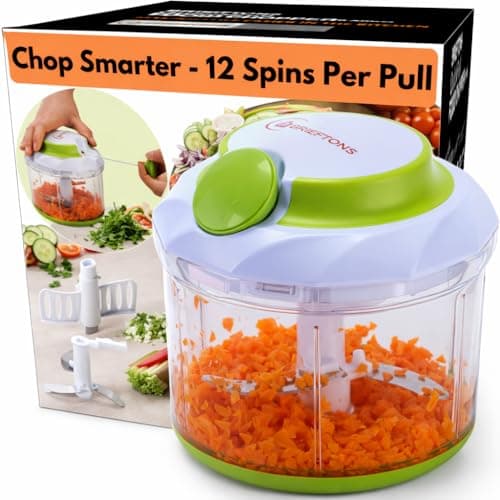
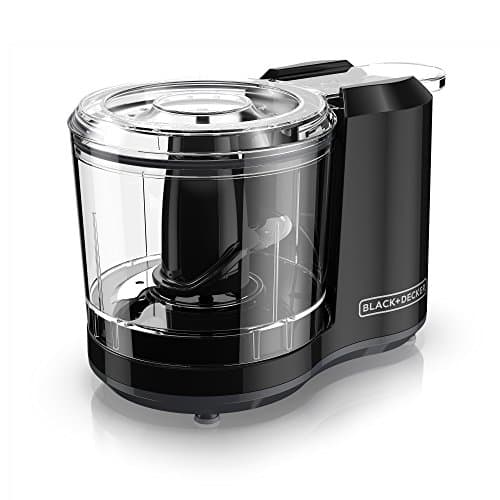
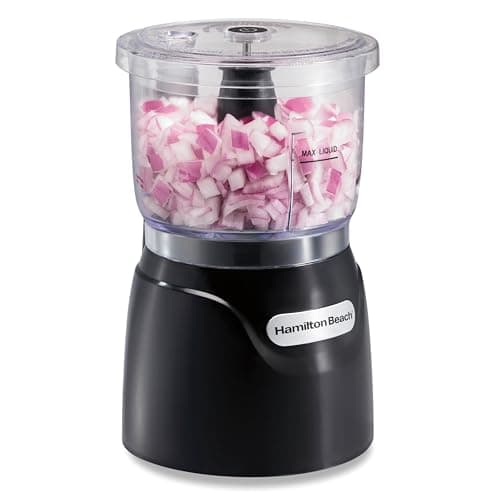
The Hamilton Beach 3-Cup Electric Vegetable Chopperis the chopper to buy under $25, and it is for the cook who wants a motor to do the work on everyday onions, garlic and herbs: three cups is the biggest bowl in this band and it is the only pick here with a plug. The budget pick — the cheapest tool on this page that still does the job properly — is the BLACK+DECKER 1.5-Cup Electric Food Chopper, a 1.5-cup mini that is the right answer when the job is one shallot and a clove of garlic rather than a bowl of salsa. In between, the Brieftons QuickPull Manual Food Chopper (4-Cup) is the one to buy if you want no cord, no noise and countable control over how fine the mince goes.
Every price in the table above is read live from Amazon and stamped with the date it was last checked. The $25 line is our editorial band, not a promise about today’s price — check the live figure before you buy.
What you can and cannot get for $25
This is the most honest thing on the page, so it goes near the top. Under $25 you can get a tool that minces— a spinning or spun blade that reduces food to small irregular pieces, fast, with almost no setup. What you cannot get is a tool that makes an even cube. Dicing needs a grid of blades and a press, and the push-dicers that do it well sit above this band; they are ranked on the best vegetable dicers. If uniform cubes for a mirepoix or a salsa are the actual requirement, spend the extra rather than buying one of these and being disappointed.
You also cannot get capacity. Three cups is the ceiling in this band, which is roughly one large onion plus a handful of herbs. Batch prep for a week of meals means a bigger bowl — see choppers for meal prep or step up to a mini food processor.
The one spec that decides this band.Not watts — bowl volume. All three of these have enough power for an onion. What you will notice daily is how many times you have to stop, empty the bowl and reload, and that is bowl size alone.
Which of the three, and why
The Hamilton Beach 3-Cup Electric Vegetable Chopperleads because it removes the most effort for the least money: press a button, get a chopped onion, rinse the bowl. Three cups is enough for a family-sized portion of most things, and the stack of published figures behind it — bowl volume, motor rating, dishwasher-safe parts — is in the spec rows below with its source. It is a plastic-bodied, cord-tethered tool and we are not going to pretend it is more than that.
The Brieftons QuickPull Manual Food Chopper (4-Cup) is the pick if a cord is the problem. It is pull-cord driven, so it works on a camping table or a crowded worktop with no outlet, and it is the only tool in this band that gives you texture control you can count: Brieftons publishes roughly five pulls for a coarse chop and ten for a fine mince. A pull is a discrete event in a way a motor pulse is not. Our full Brieftons QuickPull review goes through that figure and the pull cord’s status as a wear part in detail, and the whole manual class is ranked on manual choppers.
The BLACK+DECKER 1.5-Cup Electric Food Chopperis the budget pick and the smallest tool here. A 1.5-cup bowl is genuinely small — half an onion — but that also makes it the one that lives in a drawer rather than on the counter, and it is the cheapest route to not mincing garlic by hand. If your chopping is small and frequent rather than large and occasional, the smallest bowl is the right bowl.
Three things worth knowing before you buy cheap
- Nothing in this band is user-sharpenable.Blades on sub-$25 choppers are not sold as replacement parts, so the tool’s life is the blade’s life. Our note on sharpening chopper blades is honest about which ones can be touched up at all.
- Wash it immediately. Onion and garlic residue in a blade housing is the number one reason a cheap chopper gets thrown out while it still works. Check the spec rows for which parts each maker states are dishwasher safe.
- A bladed chopper stratifies.Food at the bottom gets minced to paste while the top stays in chunks. Pulse in short bursts and shake the bowl between them — this is technique, not a defect, and our method guide covers it properly.
Doubling the budget changes the answer in one specific way rather than generally: it buys a feed chute and a disc, which is the only capability a chopper cannot be taught. The best food processors under $50 is the next band up, and it is honest that exactly one machine in it actually slices.
How we picked
Tools we claim to have lab-tested: 0
Every site in this category tells you they ran twenty machines through a lab. We have not, and we say so. Here is what we do instead: read the manufacturer's manual and spec sheet, record the published bowl capacity, motor rating, blade and disc counts and materials, cross-check the warranty against the manufacturer's own warranty document, and cite all of it so you can check the work. Prices come live from Amazon's API and disappear rather than go stale.
The scores above are judgments from that documented research — not test results. The full rubric, including what disqualifies a product, is published in full.