For julienne, buy the Benriner Super Slicer (Japanese Mandoline). It is the only tool in this catalog whose listing states a count of dedicated julienne blades — a flat blade plus three interchangeable julienne blades — on an extra-wide bed that takes a full carrot without hanging off the edge. If you want the same cut with far more published safety hardware, the OXO Good Grips Chef's Mandoline Slicer 2.0 states julienne and French-fry cuts alongside a food holder and a runway guard. And if the job is one carrot rather than a tray of them, a Zyliss Julienne Y Peeler finishes it before a mandoline is out of the cupboard.
The julienne does not come from the flat blade. A mandoline makes a matchstick by passing food first over a comb of standing teeth, which score it into parallel grooves, and then over the flat blade, which lifts the scored layer off as separate strips. That is why julienne on a mandoline is an insert question, not a sharpness question: how many combs the maker ships, how coarse they are, and how securely they seat. A mandoline with no comb cannot julienne at any setting.
The honest centrepiece: nobody publishes a strip width
We checked all four listings. Not one of them states, in millimetres or inches, how wide the strip its julienne teeth produce actually is. Benriner says three julienne blades without sizing them; OXO names julienne and French-fry cuts without widths; Mueller states five blades covering slice, julienne and grate. So we print no width on this page, and we are not going to borrow one from a blog. This is the same finding our julienne peeler roundup reached about hand peelers — an entire category that declines to describe its own output — and it is the most useful thing to know before you buy: you will discover the width of your julienne by cutting a carrot, not by reading a box.
A classic julienne, for reference, is conventionally described in knife work as roughly one-eighth of an inch square and about two inches long; the batonnet is the thicker cut at roughly a quarter inch. Those are standard culinary definitions, not measurements of any tool on this page. Our julienne versus batonnet explainer sets out where each is used.
The four, ranked on julienne hardware
1. Three julienne blades, stated
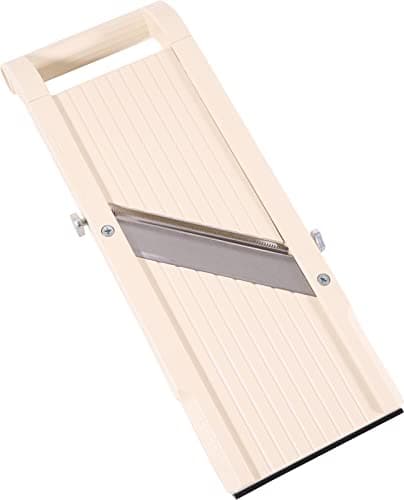
The Benriner publishes exactly what a julienne buyer wants to know: a flat blade plus three interchangeable julienne blades, an extra-wide slicing surface, and a screw-set thickness dial. Three combs means three coarsenesses of matchstick from one tool, which is the only way to get a fine julienne for a salad and a thicker baton for a stir-fry without owning two mandolines. It is also the sharpest cut on this site, which matters more on julienne than on plain slicing — a dull comb tears rather than scores, and a torn strip falls apart. The honest costs: the included guard is minimal, the frame does not fold, and this is the wrong tool for anyone nervous around sharp edges. Wear a glove.
2. Julienne plus the most published protection
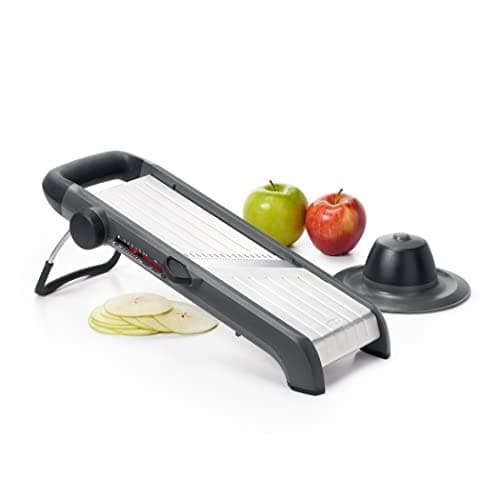
The OXO Good Grips Chef's Mandoline Slicer 2.0 states straight and crinkle slices plus julienne and French-fry cuts, 21 thickness settings on a dial, an included food holder and a runway guard, in a body that folds. For most home kitchens this is the better buy than the Benriner even though it loses on julienne specificity, because the thing most likely to stop you julienning regularly is being wary of the tool. The trade is honest: it is one of the pricier mandolines here, it is bulkier to store than a handheld, and its listing does not tell you how many julienne combs are in the box.
3. Five blades, lowest price
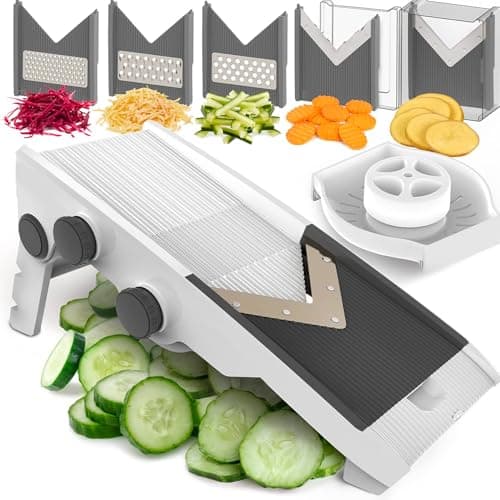
The Mueller Austria Multi-Blade Adjustable Mandoline publishes five interchangeable stainless blades covering slice, julienne and grate, an adjustable dial and an included hand-guard food holder, and it folds reasonably flat — for roughly a third of the OXO. If julienne is something you want to try rather than something you do weekly, start here. The limits are real and we state them on its card too: the blades dull faster than the premium tools, and the plastic frame flexes under hard pressure, which on a comb cut shows up as strips of uneven thickness.
4. One carrot, no mandoline
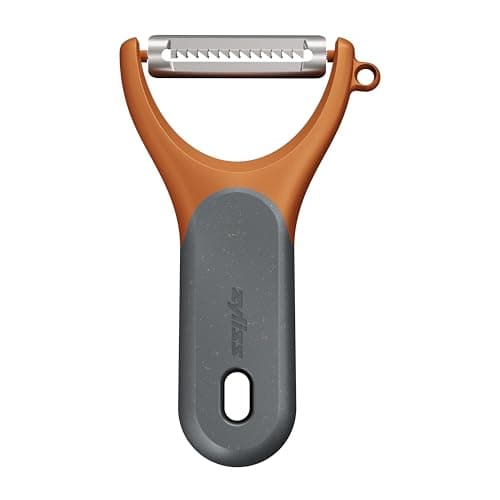
The Zyliss Julienne Y Peeler is the honest alternative for small jobs, and it is the cheapest thing on the page by a wide margin. It is a Y-shaped peeler with a julienne head: you draw it down a carrot and it lifts matchsticks directly. It is the only pick here that ships with a blade cover and states an extra-hardened blade, which is why it tops our peeler roundup. Its limit is geometry rather than quality — a peeler cuts a strip only as long as one stroke, so it makes short matchsticks, and it cannot do volume. For a garnish, a slaw for two, or a single courgette, it wins on total time including the wash.
What each listing publishes
| Pick | Julienne mechanism | Julienne blades published | Strip width published | Guard published |
|---|
| Benriner Super Slicer (Japanese Mandoline) | Interchangeable comb inserts | 3, plus the flat blade | Not published | Included, stated as minimal |
|---|
| OXO Good Grips Chef's Mandoline Slicer 2.0 | Julienne and French-fry cut settings | Count not published | Not published | Food holder and runway guard |
|---|
| Mueller Austria Multi-Blade Adjustable Mandoline | Interchangeable blade inserts | 5 blades covering slice, julienne, grate | Not published | Hand-guard food holder |
|---|
| Zyliss Julienne Y Peeler | Toothed peeler head, one stroke per strip | One fixed julienne head | Not published | Blade cover included |
|---|
Carrots, courgettes and the vegetables that julienne badly
Carrot is the benchmark and the reason this search exists: dense, straight and uniform, it scores cleanly and the strips hold together. Cut the carrot to the width of the bed first and work from the thick end. Courgette, cucumber and daikon julienne well but hold water, so salt the strips for ten minutes and pat them dry if they are going into a salad. Potato and celeriac julienne beautifully and are the point of the French-fry setting. Cabbage does not julienne — it shreds, which is a flat-blade job, and has its own page. Anything soft, ripe or round — tomato, avocado, mozzarella — will not survive a comb, and no setting changes that.
Why this page is not the peeler roundup
The best julienne peelers ranks hand tools against each other, and peeler vs mandoline vs spiralizer decides which class of tool you need at all. This page answers the narrower question — which mandoline to buy if julienne is the cut you care about — and the answer turns on comb inserts rather than on blade sharpness or price. All three pages link to each other and the boundary is stated on each.
Four things that decide julienne quality
A comb that seats without play. If the insert can rock, the grooves it scores wander and the strips come off in sheets. This is the single biggest difference between a cheap mandoline and an expensive one on this cut.
One continuous stroke. Start the pass before the food touches the comb and finish past the blade. A stroke that hesitates leaves a ridge, and the next pass catches on it.
Thickness set to match the comb. The comb decides the width of the strip; the dial decides its thickness. Set them to roughly the same number and you get a square matchstick; set the dial thin with a coarse comb and you get ribbons.
Firm, cold food. Twenty minutes in the fridge stiffens a courgette or a cucumber enough to change the result. A limp vegetable tears on a comb whatever the tool costs.
What we are not claiming
We have not tested these four tools and we have not measured a strip from any of them. Blade counts, cut types, thickness settings, bed widths, guards and blade covers are each maker’s own published wording, cited below — and where no maker publishes a julienne width, this page prints none rather than supplying one. The classic julienne and batonnet dimensions quoted above are standard culinary definitions, not measurements of these tools. Prices come live from Amazon with the date attached.