HUB 06 · Guides
Food Processor Blades and Discs, Explained
Most machines arrive with more attachments than anyone uses, and the naming is no help. Here is what each one is mechanically for, which jobs need which, and which you can leave in the box.
We earn a commission if you buy through our links. It does not change the price you pay, and it does not decide our picks — our selection criteria are published in full. How this works.
There is one distinction that makes sense of every attachment in the box: blades sit at the bottom of the bowl and cut what falls onto them; discs sit at the top and cut what you push past them.A blade produces random-sized pieces because food circulates unpredictably. A disc produces uniform pieces because every piece meets the edge once, in the same way. That is why you chop with a blade and slice with a disc, and why neither can do the other’s job.
The S-blade (the chopping blade)
The one that comes with every machine and does most of the work. Two curved blades on a central column, spinning fast, cutting whatever the vortex throws at them. It chops onions, mixes doughs and batters, purees soups and dips, makes pastry, grinds nuts and breadcrumbs, and emulsifies dressings.
Its defining characteristic is that it produces unevenpieces — that is inherent, not a fault. Food nearest the blade gets cut more often than food up the sides. The fix is pulsing rather than running: short bursts let everything redistribute between cuts, which is the difference between a clean chop and a bowl of onion juice.
Some machines, like the Cuisinart Mini-Prep Plus (DLC-2ABC), use a reversible blade with a sharp edge and a blunt edge. The blunt side fractures hard, dry things — spices, coffee, hard cheese — rather than slicing and smearing them.
The dough blade
A short, blunt plastic or nylon paddle. It looks like a downgrade and it is a different tool for a different job: it pushes and folds dough rather than cutting it, developing gluten without shredding the strands the way a sharp steel blade would. It is also gentler on the bowl, which a stiff dough would otherwise scour.
You do not need one. An S-blade makes perfectly good pizza and pie dough, and our dough roundup covers the technique. The dough blade is a refinement for people making bread dough regularly, and it is the attachment most often missing from cheaper machines.
The slicing disc
A flat disc with one blade and an opening. Food is pushed down the feed tube, meets the blade, and the slice falls through the opening into the bowl. Thickness is fixed by the height of the blade above the disc — which is why an adjustable disc, like the dial on the Breville Sous Chef 16 (BFP810)spanning 0.3–8.0 mm, is a genuinely different piece of engineering rather than a marketing feature.
The full account of what decides a slicing job is in best food processor for slicing. The short version: the disc sets the thickness and the feed tube sets the shape.
The reversible shredding disc
One disc, two faces: coarse shred on one side, fine on the other. Flip it over to change. It is the attachment that most justifies owning a processor at all, because shredding a block of cheese or a bag of carrots by hand is genuinely tedious and this takes seconds. Even the compact Cuisinart 5-Cup Chop & Shred Food Processor (FP-5) carries one, which is unusual at that size.
Two things worth knowing. Cheese shreds far better cold — twenty minutes in the freezer and mozzarella stops gumming the disc. And shred length is decided by how you load the tube: food loaded upright gives short shreds, food loaded on its side gives long ones. There is more in the shredding roundup.
Julienne, French-fry and dicing attachments
A julienne disc has a comb of teeth ahead of the blade: the teeth cut vertical channels, the blade cuts across them, and you get matchsticks. A French-fry disc is the same idea with wider spacing. A dicing kit adds a grid underthe slicing disc, so a slice is cut and then pushed through the grid into cubes. If you only ever want matchsticks from a carrot or two, the same comb of teeth comes on a handheld tool for a fraction of the price — see the julienne peeler roundup.
Dicing kits are the attachment people most often go looking for and are only available on specific models. If cubes are what you want, the cheaper route by a wide margin is a manual push-dicer, not a different processor.
The emulsifying or whisking disc
A flat plastic disc that sits on the drive shaft and beats rather than cuts. It whips cream and beats egg whites in a processor bowl. It is the least useful item in most boxes, because a processor bowl is the wrong shape for incorporating air and a hand whisk does it better with less to wash. If yours came with one, try it once and then be honest about it.
Order of use saves washing up. Do disc work before blade work when you can. Slice and shred into the bowl, tip that out, then fit the S-blade for the chopping and mixing. Doing it the other way round means washing the bowl twice, which is the actual reason people stop using the discs.
Which attachments matter when you are buying
| Attachment | What it does | Worth having? |
|---|---|---|
| S-blade | Chops, purees, mixes, grinds | Essential; comes with everything |
| Reversible shredding disc | Coarse and fine shred | The main reason to own a processor |
| Slicing disc | Even slices; adjustable on better machines | Yes — adjustable if you can |
| Dough blade | Kneads without shredding gluten | Only if you make bread dough |
| Julienne / French-fry | Matchsticks and batons | Nice; a mandoline also does it |
| Dicing kit | Cubes, via a grid under the slicer | Model-specific; a push-dicer is cheaper |
| Emulsifying disc | Whips cream, beats whites | Rarely used; a whisk is better |
The honest conclusion is that a machine with three well-chosen attachments beats one with eight. Every extra disc is a thing to store, a thing to lose and a thing you paid for — and the Cuisinart 14-Cup Food Processor (DFP-14BCNY) has been the default full-size processor for years partly because it ships with almost nothing beyond what you use. Wash them the way the cleaning guide describes and store them where nothing can land on an edge.
Two of the attachments above have a use most owners never discover. The dough blade is the correct tool for shredding cooked chicken, because blunt plastic tears meat into strands where the S-blade minces it to paste. And the julienne disc is one of four ways to get a matchstick cut — our julienne guide compares it against a knife, a julienne peeler and a mandoline blade, vegetable by vegetable.
The hardware
The hardware this guide is about
The products this guide refers to, with prices pulled live from Amazon and dated on every card. Full rankings live in the roundups linked above.
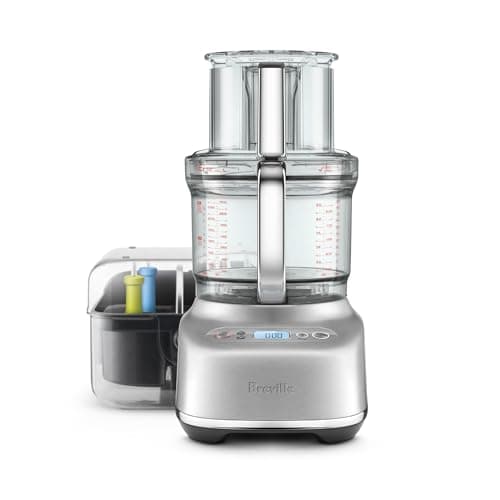
Serious, frequent cooks
Breville Sous Chef 16 (BFP810)
The one to buy if you actually use a processor daily: an adjustable slicing dial and a 1,450-watt motor that never flinches.
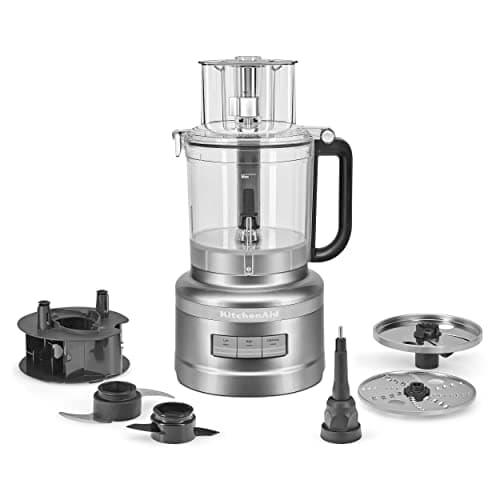
Dicing and prep variety
KitchenAid 13-Cup Food Processor (KFP1318)
A 13-cup KitchenAid with a 3-in-1 feed tube and an included dicing kit — the widest job range in the roundup.
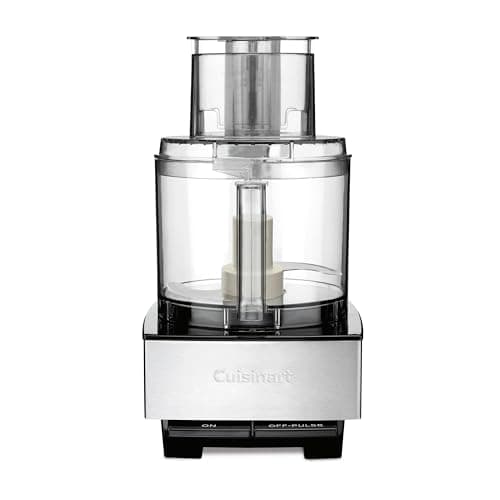
Most full-size kitchens
Cuisinart 14-Cup Food Processor (DFP-14BCNY)
The default full-size processor for a reason: a big, simple, 720-watt workhorse with the shortest parts list to go wrong.
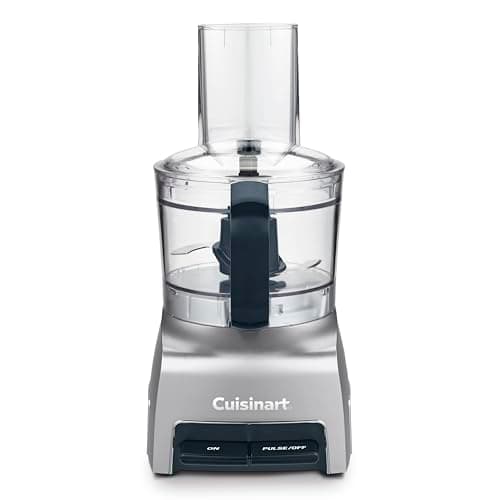
Small kitchens that still shred
Cuisinart 5-Cup Chop & Shred Food Processor (FP-5)
The smallest machine here that still shreds: a 5-cup bowl with a real reversible disc, so it slots between a chopper and a full-size processor.
#ad · As an Amazon Associate we earn from qualifying purchases.
Questions
Frequently asked
What is the S-blade in a food processor for?
Do I need a dough blade?
What is the difference between a slicing disc and a shredding disc?
Can a food processor dice?
Keep reading
Related
- How to shred chicken in a food processorWhat the dough blade is really for.
- What can you make in one?Twelve jobs, matched to attachments.
- Best food processor for slicingWhere the disc decides everything.
- Best food processor for shreddingThe reversible disc in detail.
- How to clean a food processorIncluding where to store the discs.