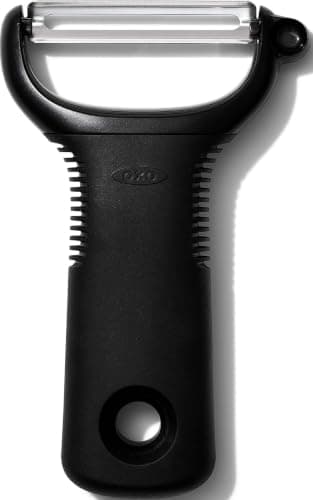
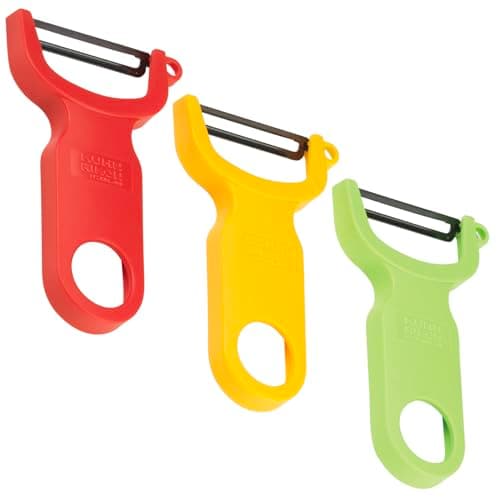
A peeler costs less than a bag of the potatoes it peels, which is exactly why most people own a bad one for a decade. The decision worth two minutes of thought is not the brand: it is the shape. A swivel peeler holds its blade in line with the handle and you push it away from you; a Y-peeler holds the blade crosswise and you pull it toward you. They suit different produce, and a kitchen that peels a lot benefits from owning both.
Swivel or Y — the only question that matters
Reach for a swivel peeler when the food is small, round and held in your hand: potatoes, apples, carrots, a knob of ginger. The blade tracks the curve, your thumb steadies the far end, and the stroke is short and controlled. The OXO Good Grips Swivel Peeleris the one to buy for that, and the reason is the handle rather than the blade — an oversized cushioned grip is what separates peeling two potatoes from peeling twenty without your hand cramping.
Reach for a Y-peeler when the food is large, hard and sitting on a board: butternut squash, celeriac, a mountain of carrots for stock. You brace the vegetable and pull the blade down its length in a single sweep. The OXO Good Grips Y-Peeler does that with a hardened stainless blade and, usefully, ships with a removable cover so it can live loose in a drawer without going blunt against everything else in there.
The test that beats every spec.A peeler is sharp enough if it takes the skin off a ripe tomato without you pressing. If yours needs pressure, it is dull — and a dull peeler wastes far more of the vegetable than a sharp one, because you compensate by digging deeper. Replacing a two-year-old peeler is usually a bigger upgrade than buying a more expensive one.
Carbon steel, and why the three-pack wins on sharpness
The Kuhn Rikon Original Swiss Peeler (3-Pack)is the outlier here and the pick for anyone who cares mainly about the edge. Its blades are carbon steel rather than stainless, and carbon takes and holds a keener edge — you notice it immediately on skins that fight back, like tomato and bell pepper. Kuhn Rikon sells them in threes for less than most single peelers cost, so color-coding one per cook or one per task is realistic.
The trade is maintenance. Carbon steel spots and discolors if you leave it wet in the rack, so it wants drying. That is a small habit, but it is a habit — if you want a tool that survives total neglect in a dishwasher, buy stainless and accept a slightly duller edge.
How they compare
| Peeler | Shape | Blade | Best at |
|---|
| OXO Good Grips Swivel Peeler | Swivel (in-line) | Twin swivelling stainless | Potatoes, apples, carrots held in the hand |
| OXO Good Grips Y-Peeler | Y (crosswise) | Hardened stainless | Squash, celeriac, long sweeping strokes |
| Kuhn Rikon Original Swiss Peeler (3-Pack) | Y (crosswise) | Carbon steel | Thin, delicate skins; sharpest edge per dollar |
What a peeler does that a machine cannot
Nothing in this catalog peels. A food processor slices and shreds but leaves the skin on; a mandolinemakes even slices of something already peeled. That is why a peeler survives in kitchens that own every appliance on this site — it is upstream of all of them. If you are outfitting a prep drawer from scratch, this is the first thing in it, alongside a decent board.
One thing a Y-peeler does that is worth knowing: run it down a peeled carrot or courgette and you get wide ribbons for salads. It is the cheapest route to a cut people usually buy a spiralizer for.
How we picked
Tools we claim to have lab-tested: 0
Every site in this category tells you they ran twenty machines through a lab. We have not, and we say so. Here is what we do instead: read the manufacturer's manual and spec sheet, record the published bowl capacity, motor rating, blade and disc counts and materials, cross-check the warranty against the manufacturer's own warranty document, and cite all of it so you can check the work. Prices come live from Amazon's API and disappear rather than go stale.
The scores above are judgments from that documented research — not test results. The full rubric, including what disqualifies a product, is published in full.