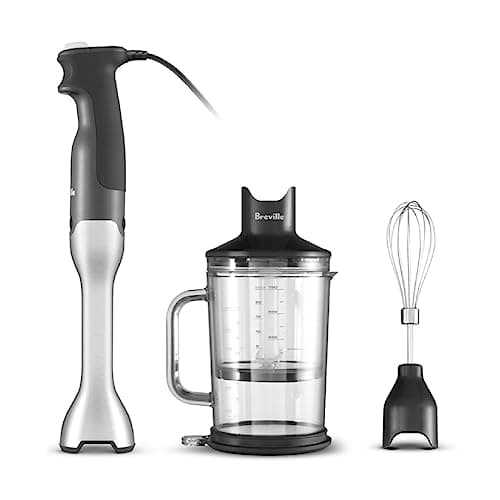
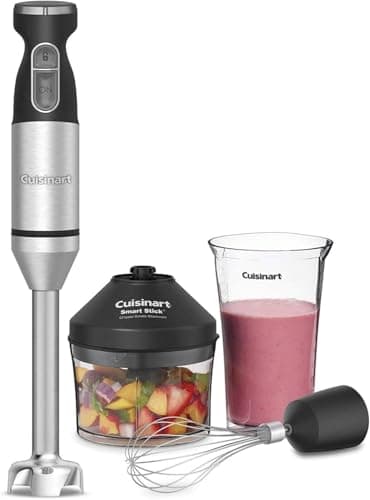
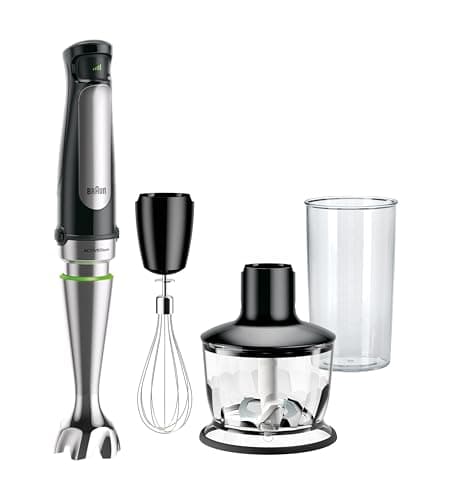
For most kitchens the Braun MultiQuick 7 (MQ7035X) is the one to buy: its bell is shaped to stop splatter, its speed is set by how hard you squeeze the trigger rather than by a dial you have to look at, and it arrives with a whisk and a processor bowl. The Breville Control Grip Immersion Blender (BSB510XL) wins in one specific kitchen — one where the soup gets blended in a non-stick pot — because its bell is designed to stop the blender suctioning to the pot and scratching the coating. And the Cuisinart Smart Stick Variable-Speed (CSB-179) is the honest third answer: neither bell, both attachments, noticeably less money.
The comparison you cannot run: watts
Every stick blender on our main immersion blender ranking is ordered partly on published motor wattage, because on a corded blender that figure predicts what it will push through. That comparison does not work here. Breville publishes 280 watts for the Control Grip. Braun publishes no wattage at all for the MQ7035X — its listing states the speed system, the attachments and the guard design, and never a motor figure.
We are not going to supply one. A converted figure, a number from a spec-aggregator site or an estimate from a review would be exactly the kind of claim this site exists not to make. So the honest position is: on power, this comparison is a draw by default, and anyone who tells you the Braun is more or less powerful than the Breville is reading a number neither maker published.
It is also worth saying that 280 watts is not a lot on paper, and the Control Grip is still one of the most liked stick blenders in the category. Wattage on an immersion blender is less decisive than it is on a food processor, because the load is thin and the blade is small. Where it does start to matter is stiff purees, and neither of these is the tool for that — the 600-watt All-Clad is.
Two bells, two different problems
Both blenders have the bell-shaped guard that distinguishes a considered stick blender from a basic one, and it is easy to assume they are the same feature. They are not, and the makers describe them differently.
Braun states a splash-control bell: the shape is there to reduce spatter. That is the problem you have when you blend a pot of tomato soup and end up wearing some of it. It is the single most-noticed thing about using the MQ7, and it is why it is the pick on our hub ranking.
Breville states a bell-shaped, anti-suction guard with a non-scratch base. That is a different pair of problems. Anti-suction is about the blender gripping the bottom of the pan and sticking there, which is annoying in stainless and alarming in a thin pot. Non-scratch is about what a metal guard does to a non-stick coating, which is the reason our catalog entry for the Breville says its honest skip line is that you can save money if you only blend in stainless or enameled pots.
So: if the thing that annoys you is the mess, buy the Braun. If the thing that worries you is the pan, buy the Breville. That is a cleaner answer than any spec table, and it is entirely based on what the two companies chose to publish about their own designs.
How you set the speed
The second real difference is control, and it is a matter of taste rather than a matter of better. The Braun sets speed by trigger pressure: squeeze gently and it runs slowly, squeeze harder and it speeds up. You never look at the blender. People who like it describe it as the most intuitive control in the category; people who do not, find it hard to hold one speed steadily through a long job.
The Breville uses a 15-speed control, which is the opposite philosophy: set it, then blend. It is more repeatable and less tiring for a long puree, and it takes a hand off the pot to change. The Cuisinart’s variable-speed dial works the same way with fewer steps.
Neither approach fails. If you have used a trigger-speed power tool and liked it, you will like the Braun; if you have ever wanted to set a blender and leave it, the Breville is the one. Our full Braun review and full Breville review go further into how each feels over a long job.
What comes in the box
Both include a whisk and a chopper. Braun calls its second attachment a food processor bowl and Breville calls its a chopper jug, and the practical effect is the same: the blender doubles as a mini processor for herbs, nuts, breadcrumbs and small batches of pesto. That attachment is the reason either of these is better value than its price gap over a basic stick suggests, and our guide to immersion blender attachments covers what each one is genuinely for and where it stops.
The Cuisinart Smart Stick Variable-Speed (CSB-179) also includes both, at a lower price, with a stainless shaft Cuisinart states is dishwasher safe. Its card carries the honest cost of choosing it: no anti-splash bell, so it spatters more than either blender above, and a chunkier grip. If you blend in a deep vessel and start slow, that cost is small. If you blend in a wide pan, it is not.
How they compare
Every entry is the maker’s own published claim from the product’s Amazon listing. Braun publishes no wattage for the MQ7035X, so the table says so rather than supplying one.| Blender | Published motor | Guard design | Speed control | In the box |
|---|
| Braun MultiQuick 7 (MQ7035X) | Not published | Splash-control bell | Trigger pressure | Whisk, food processor bowl |
|---|
| Breville Control Grip Immersion Blender (BSB510XL) | 280 watts | Anti-suction bell, non-scratch base | 15-speed control | Whisk, chopper jug |
|---|
| Cuisinart Smart Stick Variable-Speed (CSB-179) | 300 watts | No bell | Variable-speed dial | Whisk, chopper cup |
|---|
The verdict
Buy the Braun MultiQuick 7 (MQ7035X) unless you have a reason not to. It is the tidiest of the three to use, the trigger control is the most pleasant, and the attachment set is the most useful. Its honest costs are that it is the priciest of the three and that Braun tells you less about the motor than either rival does.
Buy the Breville Control Grip Immersion Blender (BSB510XL) if your soup pot is non-stick, if you have ever had a stick blender suction itself to the bottom of a pan, or if you would rather set a speed than hold one. Buy the Cuisinart Smart Stick Variable-Speed (CSB-179) if the price gap matters more than the bell, and blend in something deep.
And if none of these is quite it: the cord is the thing all three share, and it is the one complaint no bell fixes. Our cordless stick blender roundup covers the battery-powered alternative and is honest about what you give up — starting with the fact that no cordless maker publishes a wattage either.
Which jobs actually separate them
Soup in the pot it cooked in. This is the job both are built for and the one where the difference shows. Braun’s splash bell keeps more of it in the pan; Breville’s anti-suction bell stops the head grabbing the base. If your pot is stainless, the Braun is the better tool. If it is non-stick, the Breville is.
Mayonnaise and vinaigrette. Both do it well in the beaker or the chopper jug, and here the Braun’s trigger is a real advantage — an emulsion wants a slow start and a gradual increase, which is exactly what a pressure trigger gives you without looking away from the jar.
Whipping cream and egg whites. Both include a whisk and both are fine. Neither replaces a hand mixer for volume — our immersion blender versus hand mixer comparison is honest about where the whisk attachment stops.
Thick purees and nut butters. Neither. This is the job where published wattage genuinely decides things and where the heavier sticks earn their price. A 280-watt motor in a stiff load is working hard.
Smoothies with frozen fruit. Neither, really. A stick blender is not a countertop blender and our smoothie page says the no-ice limit up front rather than burying it.
The things that are the same
Both are corded, both have removable stainless shafts, both blend hot liquid safely if you follow the same rules, and both are washed the same way: run the shaft in warm soapy water for a few seconds before you touch it with a sponge. Neither motor body goes anywhere near a dishwasher, ever.
Both are also the same tool for the same job, and it is worth remembering how narrow the gap is. If the price difference between them is the deciding factor on the day you buy, buy the cheaper one — the bell you get is not the bell you wanted, but it is still a bell, and the difference between either of these and a basic stick blender is much larger than the difference between them.
Safety, which is identical for both
Take the pan off the heat. Let it stop bubbling. Submerge the head fully before you start and keep it submerged until you stop. Use the lowest speed that moves the food. Never put a hand or a spatula in the vessel while the blender is plugged in, and unplug it before you change an attachment.
The bell shape on either of these is a splash and suction feature, not a burn-safety feature. It reduces spatter; it does not make hot soup safe to blend carelessly. The full method is in our hot-liquid safety guide.