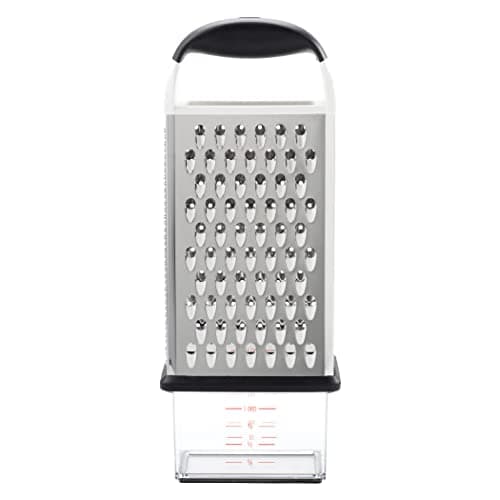
A box grater is the most versatile tool in this category and the one most likely to be bought on the wrong criterion. Every box grater grates. What separates them is whether the thing is pleasant enough to pull out for a handful of cheddar, and that comes down to three published details rather than to sharpness: what the fourth side does, whether there is a container under it, and how thick it is in a drawer. The OXO Good Grips Box Grater is the one we rank first because OXO publishes a good answer to all three.
Four sides, and only three of them grate
OXO lists generous coarse, medium and fine stainless steel grating surfaces and a slicing surface. That is the standard four-sided layout, and it is worth separating what each one is honestly for.
The coarse side is the one you will use most and the reason to own the tool: long shreds of cheddar, mozzarella or potato, fast, with the shreds staying separate rather than compacting. The medium side is for firmer cheeses and for carrot or zucchini going into a batter or a slaw. The fineside is for hard cheese, nutmeg and citrus zest, and it is the side a dedicated rasp does better — a box grater’s fine face is a compromise surface, and if zest is a regular job the tool for it is in the zester and rasp roundup.
The slicing sideis the one people misunderstand. It is a single fixed opening with one blade: it makes slices of one thickness, decided by OXO, and nothing you can adjust. For a few slices of cucumber onto a sandwich that is fine. For anything where thickness is the point — a gratin that has to cook evenly, potatoes for chips, cabbage for slaw — it is the wrong tool, and the adjustable answer is a mandoline. We set the two against each other directly in mandoline vs box grater.
The container is the feature that changes the workflow
OXO states a detachable container for catching, measuring, dispensing and storing freshly grated ingredients, and adds that you can grate onto a plate, onto a cutting board, or directly into the container.
That last option is the one that matters. Grating onto a board means a second step: scraping a loose pile into a bowl without losing a third of it down the side of the board. Grating into a sealed container means the shreds are already contained, already portionable, and already in something you can put in the fridge if you grated more than the recipe needed. It is a small mechanical difference that removes the most annoying part of the job.
The honest caveat is that the container is one more thing to wash, which is in the product’s cons above and is a fair complaint if you grate small amounts. If you grate two tablespoons of parmesan onto a plate, the container is overhead rather than help, and the tool for that job is a rasp.
Slim construction: the spec that decides whether you keep it
OXO calls out slim construction that conveniently fits into drawers, and publishes the dimensions to back it: 11.8 x 4.5 x 2.9 inches, 1.05 pounds.
This is the quietly decisive figure. A box grater that lives in a drawer gets used for a handful of cheese on a Tuesday; one that lives in the back of a cupboard behind the stand mixer gets used at Christmas. At 2.9 inches deep this is a flat-ish tool rather than a true box, which is why it fits a standard utensil drawer on its side. The trade is that a shallower body holds a shallower container, so very large batches mean emptying it partway through.
It is also still bulkier than a flat paddle grater, which is the first of its two published cons. If drawer space is the binding constraint in your kitchen, that comparison is made properly in prep tools for small kitchens.
The grip, and the protection no box grater ships
OXO states a soft, comfortable, non-slip handle. On a box grater the handle is load-bearing in a way it is not on most hand tools: you are pushing down and forward against a block of cheese with one hand while the other holds the grater steady, and a handle that twists in a wet grip is how the tool ends up skidding. A padded, non-slip grip is the right answer and it is the Good Grips premise doing real work.
What OXO does not publish — and what no maker in this category publishes — is any form of hand protection. There is no guard, no food holder and no stated finger shield in the declared features. That matters because the injury a box grater actually causes is not a dramatic one: it is knuckles, at the end of a block, when the piece of cheese becomes too small to hold and you keep going anyway.
Stop at the last inch, or wear a glove.The honest rule for every box grater, this one included: when the block gets down to roughly the size of the pad of your thumb, stop grating and either eat it or put it back. If you would rather keep going, a cut-resistant glove costs a fraction of the grater and is the only actual protection in this category — our glove roundup explains what the EN 388 and ANSI ratings on the packet mean, and the mandoline safety guide covers the same habit on the sharper tool.
What a box grater beats, and what beats it
It beats a rotary grater on versatility and on volume: a rotary is a finger-safe, one-job tool for hard cheese at the table, and it will not shred a pound of mozzarella or slice a cucumber. It beats a rasp on anything where you want shreds rather than powder.
It loses to a food processor with a shredding discon pure volume — if you are shredding several pounds of cheese or a bag of carrots, the machine is faster and your arm is not involved. It loses to a rasp on zest and hard cheese fineness. And it loses to a mandoline on any slice where the thickness has to be chosen rather than accepted.
The useful way to hold all of that: the box grater is the tool you own first, and the others are what you add when one of its four sides stops being good enough for a job you do often. The cheese grater roundup sorts the whole category by which of those jobs you actually have.
Who should buy something else
Anyone who only grates a little hard cheese over a finished plate.That is this product’s own skip line. A handheld rasp or a rotary grater is neater, smaller and goes to the table, and a four-sided box is more tool than that job needs.
Anyone whose real need is even slices. The fixed slicing side is not an adjustable slicer. Buy a mandoline and read the safety guide before you use it.
Anyone grating in bulk every week. Use the shredding disc on a processor. A box grater is a hand tool and the limiting factor is your shoulder.
What we are not claiming
We have not tested this grater, we do not own it, and there is no sentence on this page that reports a measurement we made. Every figure above — the three grating surfaces and the slicing surface, the detachable container and the four things OXO says it is for, the slim construction, the soft non-slip handle, the dimensions, the weight and the model number — is OXO’s own declared specification on the listing the buy button points at, read on the date stamped at the top of this page. Where the listing is silent, as it is on hand protection and on the care instructions, this page says so instead of filling the gap. The full method is on how we pick.