HUB 06 · Guides
Do Cut-Resistant Gloves Actually Work?
They work against the injury they are made for - a blade sliding across your hand - and they do essentially nothing against a knife tip or a moving powered blade. The gap between those two facts is where people get hurt wearing one.
We earn a commission if you buy through our links. It does not change the price you pay, and it does not decide our picks — our selection criteria are published in full. How this works.
Yes, for the one injury they are designed for. A cut-resistant glove is built to defeat a slicing load — an edge dragging across the fabric — which is exactly what a mandoline, a box grater and a dicing grid do to a hand. In that situation the blade skates over the knit instead of opening it, and the glove earns its very small price many times over. No, for a point. A knife tip, a fork, a skewer or a boning knife goes through cut-resistant knit without much argument, because puncture resistance is a different property tested on a different scale. Every glove in our catalog carries that distinction on its own listing, and one of them prints an outright warning.
The word in the name is “resistant”. Mercer Culinary states it plainly on its own listing: the glove is not cut proof, not puncture resistant, and must not be used with moving or serrated blades. That is the manufacturer of a professional A5 glove telling you the limits of its own product, and it is more honest than most of what is written about this category. Treat a glove as something that converts a bad accident into a near miss, not as permission to be careless.
What the knit is actually doing
Cut-resistant fabric works on two principles at once. The fibres are extremely strong in tension — high-density polyethylene, sometimes with glass or steel filament blended in — so an edge cannot easily part them. And the knit is loose enough that the fabric slides and bunches under a blade instead of presenting a fixed surface to cut. A slicing blade needs the material to stay still; the glove refuses.
A point defeats both mechanisms. It does not need to part a fibre along its length, only to push between two of them, and the knit’s give actively helps it. That is why cut and puncture are rated separately in every standard, and why “Level 5” on a glove box says nothing about a knife tip.
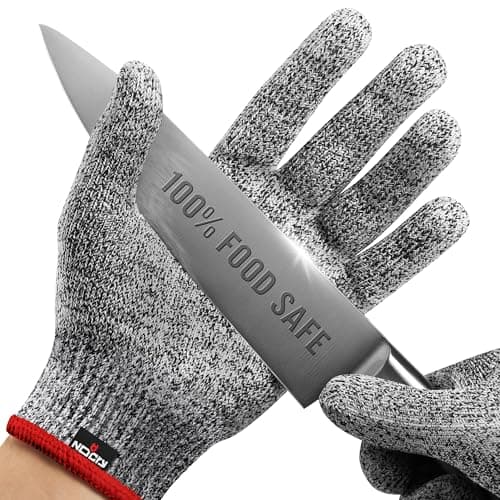
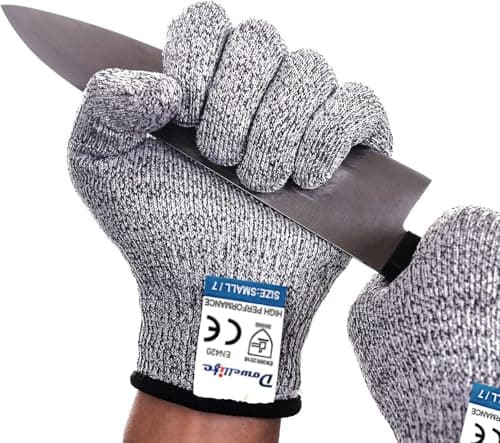
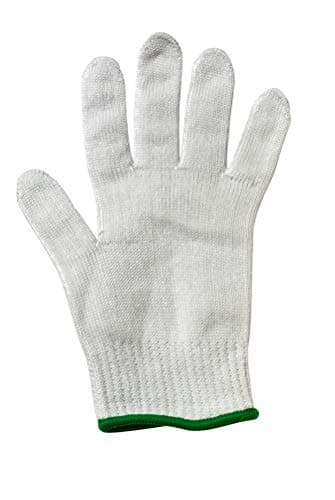
Our three picks publish three different constructions: NoCry states EN388:2016 Level 5 and ANSI 105-2016 and is food grade and machine washable; Dowellife states HDPE blended with elastic nylon for a closer fit, citing the older EN388:2003 Level 5 alongside the current scale; and Mercer Culinarystates a stainless-steel-reinforced 10-gauge knit at ANSI Level A5, washable up to 180 °F. What those ratings mean, where the two standards disagree, and why there is no published conversion between them is laid out in cut-resistant glove levels explained.
Where a glove genuinely changes the outcome
- A mandoline. The classic case. The blade is fixed, your hand travels toward it, and the injury happens on the last few passes when the vegetable is too short to hold safely. This is the single strongest argument for owning one — see the mandoline safety guide.
- A box grater or a rasp. Hundreds of small edges and a shrinking piece of cheese. Same geometry, same failure.
- Washing a dicing grid. Soapy water, numb fingers, dozens of exposed edges. Most chopper injuries happen here, not at the counter — which is why our chopper cleaning guide puts the glove at step three.
- Shucking, peeling or scraping with a fixed blade. Any job where the edge slides along your palm.
Where a glove will not save you
- Knife work with the tip. Boning, jointing, piercing. The tool is a point and the glove is rated for a slide.
- Any powered, moving blade. Mercer Culinary excludes this specifically, and the reason is worse than ineffectiveness: a knit glove can be caught and drawn in. Never wear one near a running meat grinder, deli slicer or food processor blade.
- Serrated edges. Also excluded on the same listing. A saw tooth engages the knit rather than skating off it.
- Heat. A cut glove is not an oven mitt. None of these publishes a heat rating; Mercer’s 180 °F figure is a washing temperature, not a handling one.
- A badly fitting glove. Loose fabric rotates on your hand and puts the protection somewhere other than where the blade is. Fit is a safety feature, which is why the closer-fitting nylon-blended pair exists.
The questions people actually ask
Are they food safe?
The ones sold for kitchen use are, and they say so: NoCry states food grade and 100% food safe on its listing. An industrial glove sold for carpentry or sheet metal is not necessarily, and should not go near food. Buy a glove labelled for the kitchen.
Can you wash them?
Yes, and you should. NoCry states machine washable; Dowellife states hand and machine washable and puts a hanging ring on each cuff so it dries next to the tool rather than balled in a drawer; Mercer Culinarystates machine washable up to 180 °F, which is a commercial sanitising temperature. Air-dry rather than tumbling — heat is the one thing likely to degrade a synthetic knit over time.
Do they have metal in them?
Some do. Mercer Culinary states a stainless-steel-reinforced knit. The other two are polyethylene-based with no steel claimed. A steel-blended glove is more substantial and less dexterous; neither is a chainmail glove, which is a different product entirely.
Are they waterproof?
No. These are knitted fabric and water passes straight through. That is fine — they are washable — but a wet glove is colder and less pleasant, and no listing here claims otherwise.
Do you need one on each hand?
You need one on the hand holding the food, which for most people is one glove. Both NoCry and Mercer are ambidextrous or either-hand, which makes a single glove flexible; Mercer is sold singly, so protecting both hands costs twice.
What level do you need in a kitchen?
A4 to A5 on the ANSI scale is the home-kitchen band, and above that the dexterity loss starts to make you less safe, because a glove you cannot feel the food through causes its own accidents. The reasoning and the full rating tables are in cut-resistant glove levels explained; which three to buy is in the glove roundup.
What we are not claiming
We have not cut-tested any glove, and nobody should trust a kitchen site that says it has. Every rating, material, care instruction and exclusion above is the manufacturer’s own published wording on the listing the buy button points at, cited below — including Mercer’s warning about moving and serrated blades, which is theirs and not ours. The mechanical explanation of why knit resists a slide and not a point is standard materials reasoning, not a measurement we made.
What each of our three publishes
| Glove | Published rating | Material / construction | Care, as stated |
|---|---|---|---|
| NoCry Cut Resistant Gloves (Food Grade) | EN388:2016 Level 5 and ANSI 105-2016 | Food grade knit, ambidextrous | Machine washable |
| Dowellife Cut Resistant Gloves (Level 5) | EN388:2003 Level 5 (EN388:2016 Level C) | HDPE fibre blended with elastic nylon | Hand and machine washable; hanging ring per cuff |
| Mercer Culinary Millennia Level A5 Cut Glove | ANSI Level A5 | Stainless-steel reinforced knit, 10 gauge | Machine washable up to 180 °F |
The honest observation about that table: all three describe a similar level of protection in three different vocabularies, and two different standards are in play with no published conversion between them. A buyer comparing “Level 5” against “Level A5” is not comparing like with like, and nobody in the industry publishes the mapping that would let you.
Five rules for wearing one
Wear it on the food hand. The hand that holds the vegetable, not the hand that holds the tool.
Wear it at the sink too. This is the step everyone skips and it is where a large share of the injuries happen.
Get the size right. A loose glove rotates and the protection ends up on the back of your hand.
Take it off near anything powered. Moving blades can draw knit in. This is the one case where the glove is worse than no glove.
Keep using the hand guard as well. A mandoline’s food holder and a glove are not alternatives; they protect against different parts of the same accident.
The hardware
The hardware this guide is about
The products this guide refers to, with prices pulled live from Amazon and dated on every card. Full rankings live in the roundups linked above.
Mandoline and grater work
NoCry Cut Resistant Gloves (Food Grade)
The mandoline glove to buy: EN388 Level 5 fabric, food safe, ambidextrous, and cheap enough that there is no excuse.
Fit and dexterity
Dowellife Cut Resistant Gloves (Level 5)
The stretchier alternative: HDPE knit blended with elastic nylon, so it fits closer and feels less like a mitten.
Professional kitchens
Mercer Culinary Millennia Level A5 Cut Glove
The commercial-kitchen glove: stainless-steel-reinforced knit, ANSI A5, color-coded by size, sold singly.
#ad · As an Amazon Associate we earn from qualifying purchases.
Questions
Frequently asked
Do cut-resistant gloves really work?
Are cut-resistant gloves puncture resistant?
Can you wash cut-resistant gloves?
Are cut-resistant gloves food safe?
Do cut-resistant gloves have metal in them?
When should you wear cut-resistant gloves?
Keep reading
Related
Receipts
Sources
- Amazon listing - NoCry Cut Resistant Gloves, food grade (EN388:2016 Level 5 and ANSI 105-2016 rated, stated 100% food safe, ambidextrous, machine washable)
- Amazon listing - Dowellife Cut Resistant Gloves, Level 5 (EN388:2003 Level 5 / EN388:2016 Level C, HDPE cut-resistant fibre blended with elastic nylon, hand and machine washable, hanging ring on each cuff)
- Amazon listing - Mercer Culinary Millennia Level A5 Cut Glove (ANSI Level A5, stainless-steel reinforced 10-gauge knit, machine washable to 180 F, maker states it is not cut proof or puncture resistant and must not be used with moving or serrated blades)
We do not run a testing lab and we do not pretend to. Specifications come from the manufacturer's own published documents and from published standards; prices come from the live Amazon API. Where a figure is not published, the page says “not published” rather than guessing. Read the full method.