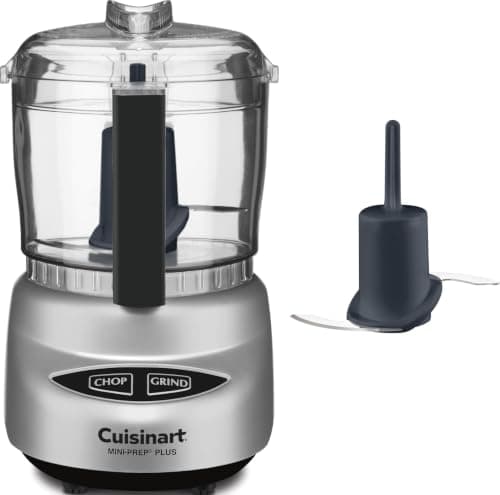
The Cuisinart Mini-Prep Plus (DLC-2ABC) is not a small food processor. It is a very good chopper that Cuisinart sells under the processor name, and getting that distinction right is the difference between loving it and returning it. It chops herbs, dices a shallot, grinds hard cheese, emulsifies a jar of dressing and makes a small bowl of pesto, all in a bowl you can wash in fifteen seconds. It does not slice, it does not shred, it does not do dough, and it will not stand in for a full-size machine. If those four jobs are the ones you actually do, it is one of the best-value tools in this entire category.
What the listing publishes, and what that adds up to
Everything in this section comes from Cuisinart’s own listing for this ASIN, read on the date stamped at the top of this page. We own no appliances and we run no lab — our how we pick page says so in those words — so what you get here is the manufacturer’s declared specification, read carefully.
A 250-watt motor. A 24-ounce work bowl with a handle, which the listing’s own size field calls 3 cups. A patented reversible stainless steel blade with a sharp edge and a blunt edge, driven by what Cuisinart calls an auto-reversing SmartPower blade, giving two processing options: chop and grind. A push-button control panel rather than a dial. A dishwasher-safe bowl and lid, with a motor base that is wiped clean. A body described as durable, lightweight plastic and BPA-free. In the box: the work bowl, the blade, a spatula and an instruction and recipe book. The listing records the model as DLC-2ABC in brushed chrome, 9.25 inches tall and 2.2 pounds, and a limited 18-month warranty.
Two of those numbers do most of the work in this review, and neither is the wattage.
The reversible blade, and the one job Cuisinart tells you not to give it
The blade is the design idea here and it is a genuinely clever one. One side is sharpened for cutting; the other is deliberately blunt for grinding, and the motor spins the blade in whichever direction the button you pressed calls for. Press chop and the sharp edge leads, which is what you want for herbs, onion, nuts and garlic. Press grind and the blunt edge leads, which crushes and pulverizes rather than slicing — the right action for hard cheese and for anything you want powdered rather than cut.
Here is the part worth paying for the review for, because it is in Cuisinart’s own listing copy and almost nobody repeats it: the grind function is “not recommended to grind beans as it chops.” In plain terms, the blunt edge is not a burr and this is not a coffee grinder. Pour coffee beans in and you will get an uneven mixture of dust and gravel, which is exactly the wrong grind for every brewing method. The same logic applies to peppercorns and to anything you need a consistent particle size from. If grinding coffee is the reason you were looking at this machine, it is the wrong purchase and Cuisinart says so first.
What the grind side is excellent at: parmesan and pecorino off a block, stale bread into crumbs, nuts to a coarse meal, and dried herbs or spices you want broken down rather than ground fine. Our breadcrumbs guide covers the first of those in detail.
Twenty-four ounces is smaller than it sounds
This is where returns come from. Twenty-four ounces is three cups of volume, and a spinning blade needs the food to sit in the path of the blade to cut it. Practically, that means you are working with roughly one to one and a half cups of ingredients at a time, not three, because the bowl has to have room for the food to move. One large onion. A generous handful of parsley. A small block of cheese. A single batch of dressing. Try to do two onions and the top one never reaches the blade.
The name does not help. “Mini-Prep Plus” has been used across more than one capacity over the years, so if you have seen this machine described as a 4-cup, that is not this listing: this one states 24 ounces and its size field reads 3 Cup. Buy by the ounces, not by the name.
The honest consequence is on the product card above: three cups is far too small for batch prep. If you are chopping for a family dinner rather than a single dish, you want the next size up — our mini food processor roundup ranks the 3-to-8-cup field, and what size food processor you need works the decision through in cups against the number of people you cook for.
What it cannot do, listed plainly
No slicing. No shredding. There are no discs for this machine, and that is not an omission to be fixed with an accessory — the design has no disc stem. Everything people buy a processor for in the vegetable-prep sense happens on a disc, which means it does not happen here. For slicing and shredding you want a full-size machine (see best food processor for shredding) or a mandoline or box grater instead.
No dough. A 250-watt motor and a 24-ounce bowl is not a dough environment, and there is no dough blade. See best food processor for dough.
No nut butter. People try. Nut butter is a long, hot, high-load job that needs a big motor and a bowl wide enough for the paste to climb the sides and fall back in. Our nut butter page explains why bowl shape matters more than watts for this one.
No cubes. This matters more than people expect, and it is the single most common disappointment with every bladed chopper. A spinning blade minces — it hits food repeatedly until the pieces are small and irregular, releasing liquid as it goes. It cannot produce an even dice, because nothing that spins can. If you want onion that looks like the photograph in the recipe, you need a push-down dicer, which presses food through a stationary grid. That is a different tool at a lower price, and we compare the two leading ones in Fullstar vs Mueller.
Eighteen months, and why we are flagging it
Cuisinart publishes a limited 18-month warranty on this listing — both in a feature bullet and in the listing’s own warranty field. We flag it for one reason: eighteen months is shorter than most buyers assume when they see the brand, and it is the kind of figure nobody checks until something has already stopped working. Note the purchase date somewhere you will find it again.
In fairness, it is also a figure that is published at all, which is more than a great many products in this category manage. Across the catalog we maintain for this site, the number of cheap kitchen tools whose listing states a warranty length is small, and we would rather have a short stated term than a long implied one.
Cleaning, storage and the part people actually like
Three washable items: the bowl, the lid and the blade, all dishwasher-safe. The base wipes with a damp cloth. In practice this is the single biggest reason a tool like this gets used instead of admired — it is fast enough to wash that you will reach for it for one shallot on a Tuesday, which is a sentence nobody has ever said about a 14-cup processor.
At 9.25 inches tall and 2.2 pounds it lives under a cabinet without being moved, and the brushed-chrome base is the version that does not look like a lab appliance. The spatula in the box is genuinely useful: a small bowl gets packed at the edges, and you will be scraping the sides between pulses.
One usability note we would not call a flaw but you should know: push buttons, not a dial. There is no variable speed and no true pulse control beyond tapping the chop button, so texture is managed by how long you hold it. For herbs that is fine. For anything you want coarse, tap and check rather than holding.
How it sits against the obvious alternatives
Against the Ninja Express Chop (NJ110GR), the pick on our chopper hub: the Ninja is the better pure chopper for texture control and is easier still to wash; the Cuisinart has the reversible grind side, a bigger bowl and a published warranty. If your jobs are herbs and garlic, the Ninja. If hard cheese and a dressing jar are in the mix, this.
Against the KitchenAid 3.5-Cup Food Chopper (KFC3516): very close call at a similar size, and we would buy on which is cheaper the day you look. Our KitchenAid 3.5-cup review has the detail.
Against a full-size machine such as the Cuisinart 14-Cup Food Processor (DFP-14BCNY): these are not competitors, they are complements, and the honest advice is that most kitchens that own a 14-cup processor still want something like this, because nobody assembles and washes a 14-cup bowl for half an onion. If you own neither and have to choose one, choose by job size using do I need a food processor, and then food processor vs chopper for the fork between a machine and a chopper.
Who should buy it
Cooks who chop small amounts often: herbs, garlic, a shallot, nuts, a block of parmesan, a jar of vinaigrette. People who want the thing out of the cupboard and washed inside two minutes. Anyone who has a full-size processor and never uses it because of exactly that friction. It is also one of the easiest things on this site to recommend as a gift, which is why it appears on kitchen gifts under $50.
Skip it if you need slicing or shredding discs, if you want an even dice, if you are grinding coffee, if you prep for more than about two people at a time, or if you were hoping one machine would replace a full-size processor. In every one of those cases there is a better answer on this site, and none of them is this.