The best first mandoline is the OXO Good Grips Chef's Mandoline Slicer 2.0, and the reason is not that it cuts better than the others — on a mandoline, thin is thin. It is that the OXO asks you to touch a bare blade fewer times than anything else here: the cuts are selected without swapping a blade out, the food holder is in the box, and the body folds for storage. The Mueller Austria Multi-Blade Adjustable Mandoline is the value alternative and the honest trade is exactly this — five loose blade inserts is five more chances to mishandle an edge. The NoCry Cut Resistant Gloves (Food Grade) is on this list as a pick, not an afterthought, because a first mandoline is two purchases and this is the second one.
The criterion nobody else ranks on: how often you touch the blade
Read a dozen “best mandoline for beginners” pages and they will rank on sharpness, thickness range and price. Those are real, and they are not what hurts a beginner. Our mandoline safety guide makes the point that nearly every serious cut happens the same way — the food gets small, the guard feels like a nuisance, and someone does “just the last few” freehand. That is a habit problem, and no product fixes it.
The product problem is different, and it is the one a first-time buyer can actually choose their way out of: how many times does this tool require you to handle a bare, loose, razor-sharp blade outside of slicing? Every blade change is one. Every wash is one. Every time you fish it out of a drawer is one. Those moments are unhurried, unglamorous and nobody writes about them, and they are where a beginner gets caught out — usually while washing up, with wet hands, thinking about something else.
That number is published, or near enough. Makers state how many blades come with a tool and whether the cuts are selected by dial or by insert. So this page ranks on it.
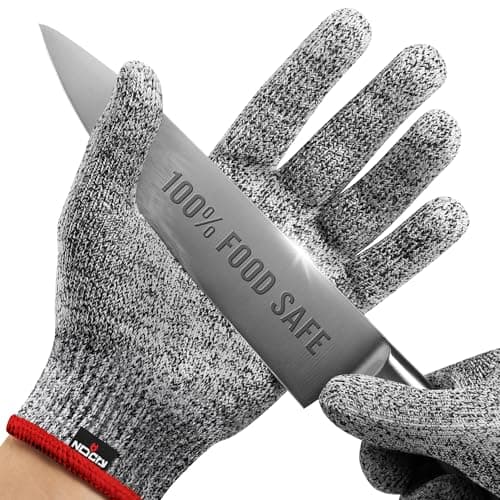
Buy the glove with the mandoline, not after the first cut. Every experienced mandoline user we would trust owns one, and most of them bought it the same way — afterward. A cut-resistant glove costs a fraction of any slicer on this page, and it is the only thing here that protects you during the two jobs the hand guard cannot: washing the blade and changing it.
Dial versus inserts, which is the whole decision
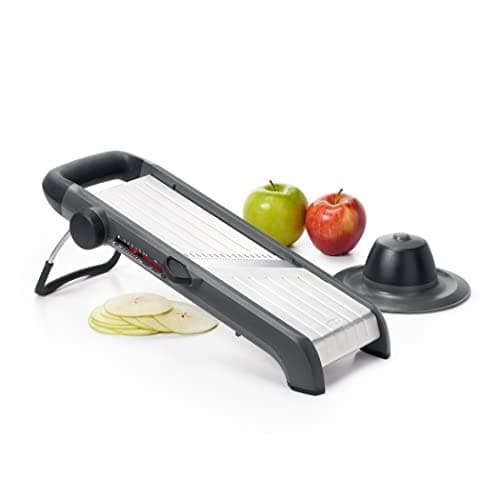
The OXO Good Grips Chef's Mandoline Slicer 2.0 sets thickness on a dial with 21 settings, and it produces straight slices, crinkle slices, julienne and French-fry cuts. You change what it does by turning something, not by removing something. It comes with a food holder and a runway guard, it is heavy enough not to skate across the counter, and it folds down for storage with the working face closed.
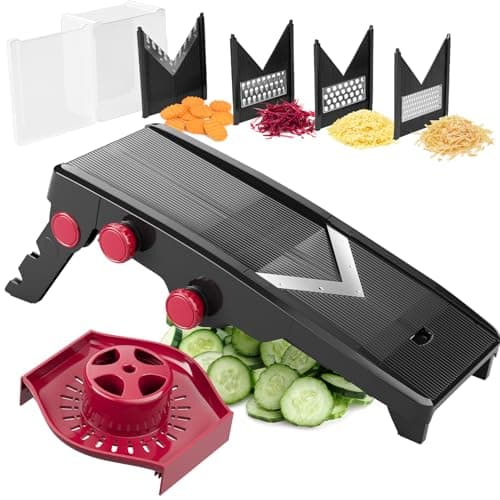
The Mueller Austria Multi-Blade Adjustable Mandoline is the opposite design and about a third of the price: five interchangeable stainless blades that you lift in and out by hand, plus an adjustable dial and the hand guard in the box. It is a lot of capability for the money and our full Mueller review covers it in detail. For a beginner the honest note is the one on its card: the blades are sharp but they dull faster than the premium mandolines, and a dulling blade is a blade you press harder on. Pressing harder is how a hand slips.
Neither approach is wrong. If you will genuinely use julienne and grate cuts, the Mueller gives you them cheaply and you handle five blades to get there. If you want to slice and occasionally julienne without ever lifting an edge out of a housing, the OXO is worth the difference, and it is the pick on our main mandoline ranking for overlapping reasons.
The one we would not start you on
The Benriner Super Slicer is the sharpest tool in our catalog and the one professional kitchens quietly rely on, and it is not on this page. Its own entry says why: the included guard is minimal, and the tool demands a cut glove and full attention. It also changes cuts by swapping in one of three separate julienne blades, which is exactly the blade-contact problem above.
None of that is a criticism of the Benriner. It is the right second mandoline, and our Japanese mandoline comparison explains what its design does better than the Western ones. It is simply the wrong first one, and the difference between those two statements is the entire purpose of this page.
The handheld option, and its real trade
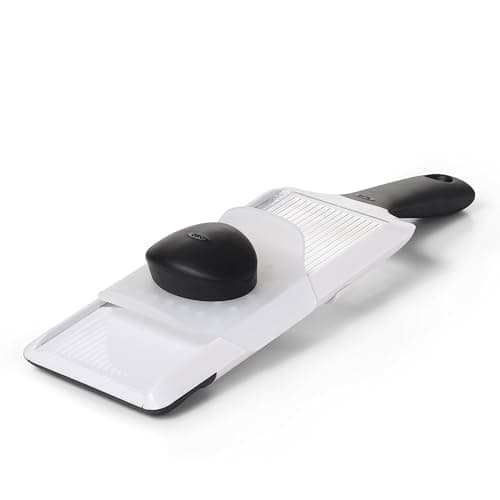
The OXO Good Grips Hand-Held Mandoline Slicer is the cheapest and most storable way into the category: a flat slicer with an adjustable dial, a non-slip grip and an included hand guard, that lives in a drawer. For a few cucumbers it is genuinely all you need, and it is the pick on our small-kitchen prep tool roundup for that reason.
We rank it below the two countertop slicers here because of stability, and stability is a safety feature. You hold a handheld mandoline over a bowl, which means the tool is moving as well as the food. A countertop mandoline plants itself and only the food moves. For a beginner that is a meaningful difference, and it is why the cheapest option is not the starting recommendation.
How they compare
Every entry is the maker’s own published claim from the product’s Amazon listing. “Loose blades” counts the separate cutting edges you handle to change what the tool does.| Tool | Cuts selected by | Loose blades to handle | Guard in the box | Rests on the counter |
|---|
| OXO Good Grips Chef's Mandoline Slicer 2.0 | 21-setting dial | None stated | Food holder and runway guard | Yes, folds for storage |
|---|
| Mueller Austria Multi-Blade Adjustable Mandoline | Dial plus 5 inserts | 5 | Hand-guard food holder | Yes, folds fairly flat |
|---|
| NoCry Cut Resistant Gloves (Food Grade) | — | — | EN388 Level 5, ambidextrous | — |
|---|
| OXO Good Grips Hand-Held Mandoline Slicer | Adjustable dial | None stated | Hand guard | No— held over a bowl |
|---|
What to buy
Buy the OXO Good Grips Chef's Mandoline Slicer 2.0 and the NoCry Cut Resistant Gloves (Food Grade) together. That is the recommendation, and the glove is not optional in it. Buy the Mueller Austria Multi-Blade Adjustable Mandoline and the same glove if the budget is the deciding factor or if you specifically want julienne and grate inserts for very little money.
Buy the OXO Good Grips Hand-Held Mandoline Slicer if you are not sure you will use a mandoline at all and you want the cheapest honest way to find out. If you use it enough to resent holding it, you will know, and the countertop model will still be there.
Your first five minutes with it
Before you slice anything, do three things. Put the glove on — not to slice, but to unpack. New blades arrive covered in packaging that has to come off, and that is the first bare-blade moment of the tool’s life. Set the thickness to something obvious and medium rather than to the thinnest setting; thin is where the tool feels fastest and where the food gets small quickest. And put the food holder somewhere you will not have to go looking for it, because the holder you cannot find is the holder you do not use.
Then slice something forgiving. A firm potato, a carrot or a cucumber holds its shape and gives you a feel for how much pressure the blade needs. A soft tomato, a small shallot and anything round and rolling are the awkward jobs, and they are not the ones to learn on.
What to look for in a first mandoline
A food holder that came in the box. Not sold separately, not an accessory — in the box, so it is with the tool from day one. All four picks on this page include one and we would not recommend a slicer that does not.
A dial rather than a drawer of inserts, unless you have a specific reason to want the inserts. Fewer loose edges is the whole argument of this page.
Weight and a non-slip foot. A mandoline that moves while you are pushing food across it is a mandoline fighting you. The premium countertop models are heavier for a reason.
Somewhere the blade is covered when stored. A model that folds closed, or one with a cover, means the drawer is not a hazard. This is the single most overlooked spec in the category.
A cut-resistant glove, bought at the same time. The NoCry pick here is EN388 Level 5 rated, food grade, ambidextrous and machine washable, and the honest limit is on its card: cut resistance is not puncture resistance. It stops a blade skating across your hand. It will not stop a knife tip. Our cut-resistant glove roundup compares the three we would buy.
The habits that matter more than the tool
Use the guard every single time, including the first slice and especially the last. Stop while the piece is still big enough to hold comfortably — the nub goes in the stock pot or gets finished with a knife, and that is not a failure, it is the correct end of the job. Slice with a long, even stroke rather than a short scrubbing one. Keep the board and the counter dry.
When you are done, wash the mandoline immediately, gloved, under running water, and never in a sink full of soapy water where the blade is invisible. Dry it and put it away closed. The full version of all of this is in our safety guide, which is the one page on this site we would ask you to read before you use the thing you bought.
What a mandoline is genuinely for
It is worth knowing what you are learning it for, because a mandoline used twice a year is a mandoline whose habits never become automatic. The jobs where it is unambiguously better than a knife: potatoes for a gratin or for chips, where even thickness is the whole recipe; cabbage for slaw, where a knife takes ten minutes and a mandoline takes one; cucumber and radish for anything that wants to look deliberate; and onions sliced thin enough to melt.
We have pages on the two biggest of those — mandolines for potatoes and mandolines for cabbage— and both make the same point from different directions: the thickness setting is the recipe. If the slicing you have in mind is none of those, a food processor with a slicing disc may be the better buy, and our mandoline versus food processor comparison sets out which one wins which job.