HUB 06 · Guides
Mandoline vs Food Processor
Both slice. One does it thinner and more precisely, the other does it faster and far more safely. Which you need depends on how much you are slicing and how thin.
We earn a commission if you buy through our links. It does not change the price you pay, and it does not decide our picks — our selection criteria are published in full. How this works.
Buy a mandoline if you want thin, precise, adjustable slices and are willing to work carefully by hand. Buy a food processor if you want volume, speed and safety, and can live with the thickness the disc gives you. The honest summary is that a mandoline slices better and a processor slices more, and the difference in risk between them is not small.
The comparison table
| Factor | Mandoline | Food processor |
|---|---|---|
| Thinnest achievable slice | Genuinely translucent | Limited by the disc |
| Thickness adjustment | Continuous on most models | Fixed, unless the machine has a dial |
| Speed on a large batch | Steady but manual | Much faster |
| Julienne and crinkle cuts | Yes, with blades | Rarely |
| Small quantities | Excellent | Wasteful — a whole bowl to wash |
| Injury risk | Significant — the blade is exposed | Low — the blade is enclosed |
| Cleaning | One surface, carefully | Bowl, lid, disc, spindle |
| Storage | Slim | A whole appliance |
Where the mandoline genuinely wins
Precision, and the range of it. A good mandoline — the OXO Good Grips Chef's Mandoline Slicer 2.0has twenty-one thickness settings — will give you a potato slice you can see through, which is what a proper gratin or a crisp needs and what almost no processor disc can produce. It also gives julienne, crinkle and French-fry cuts that a standard slicing disc does not, and it does all of that for a few small vegetables without dirtying a bowl.
The sharpest results come from Japanese-style slicers like the Benriner Super Slicer (Japanese Mandoline), which is the design professional kitchens use. It is also the one with the least protection, which brings us to the part of this comparison that matters most.
The safety difference is real, not theoretical
A food processor keeps the blade inside a closed bowl with a lid interlock; you feed food through a tube with a pusher, and your hands never approach the cutting edge. A mandoline puts a very sharp fixed blade in the open and asks you to push food across it with your hand. It is the single most common source of serious lacerations among home kitchen tools, and the injuries cluster at the same moment every time: the last third of the vegetable, when the piece is too small to hold and the guard has been set aside.
That is manageable — a cut-resistant glove, the supplied food holder, and a rule about discarding the end — but it has to be managed. Our mandoline safety guide is the piece to read before the first use, and it is the reason we weight safety heavily in the mandoline ranking.
The rule.Slicing a lot, at a thickness the disc gives you? Processor. Slicing thin, precisely, or in small amounts? Mandoline — with a glove. Doing both regularly? They cost roughly the same together as one premium processor, and they do genuinely different jobs.
The middle ground worth knowing about
A handful of food processors carry an adjustable slicing disc, which narrows this comparison considerably. The Breville Sous Chef 16 (BFP810)publishes a dial from 0.3 to 8.0 mm, which covers most of what people buy a mandoline for while keeping the blade safely inside the bowl. It costs a great deal more than a mandoline, so it is not a budget answer — but if you were going to buy a large processor anyway and slicing is why you were considering a mandoline, it is the one machine that resolves the question.
The cuts each one can and cannot make
A slicing disc makes one cut: a round, flat slice at the disc’s thickness. That is most of what home cooking asks for, and a processor does it faster than anything. What it does not do is julienne, crinkle-cut or French-fry cut — those need either a specific extra disc, which most machines do not include, or a mandoline with the right blade. The OXO Good Grips Chef's Mandoline Slicer 2.0 covers all four cuts from one body, and the Benriner Super Slicer (Japanese Mandoline) takes three interchangeable julienne blades on top of its flat one.
There is also a shape argument. A processor feed tube constrains what fits: a large potato may need trimming, and anything long has to be cut down to enter the tube, which means the slices come out in different diameters. A mandoline’s open bed takes the whole vegetable, so a courgette slices end to end at a constant width. For presentation work, that is the difference.
Price and storage, plainly
A good mandoline costs a small fraction of a good food processor and stores flat — most fold or stand slim enough for a deep drawer. A processor is an appliance: a permanent counter or cupboard resident with a bowl, a lid, a pusher and at least two discs to keep together.
That asymmetry is why the two are so often owned together rather than instead of each other. The mandoline is cheap enough that adding one to a kitchen with a processor is a minor decision, and it covers the thin-and-precise end the processor cannot reach. Going the other way — buying a processor because your mandoline is slow — is a much larger purchase for a narrower gain.
What each one is like to clean
A mandoline is one surface and one blade, and it is cleaned in about thirty seconds — carefully, under running water, with a brush rather than a cloth, blade facing away. The risk is real: mandoline cuts happen during cleaning almost as often as during use, because people reach into a sink of soapy water where the blade is invisible. Never put one in a sink of water; wash it immediately, on its own, in the open.
A food processor is a bowl, a lid, a pusher, a spindle and however many discs you used — more items, but almost all dishwasher safe and none of them dangerous to handle. If you dislike washing-up more than you dislike risk, that trade favors the mandoline; if the reverse, the processor.
The hardware
The hardware this guide is about
The products this guide refers to, with prices pulled live from Amazon and dated on every card. Full rankings live in the roundups linked above.
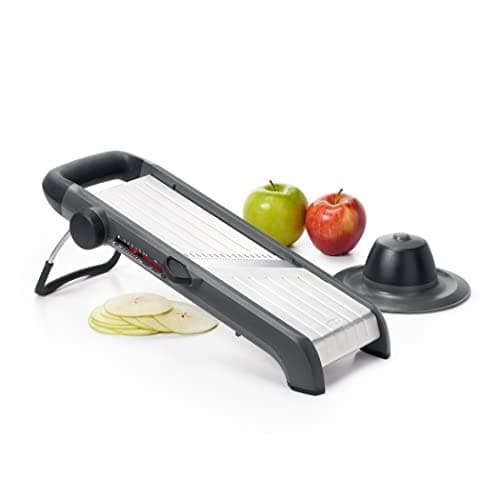
Most home cooks
OXO Good Grips Chef's Mandoline Slicer 2.0
The mandoline to buy: a solid, foldable slicer with a runway of thickness settings and a genuinely usable hand guard.
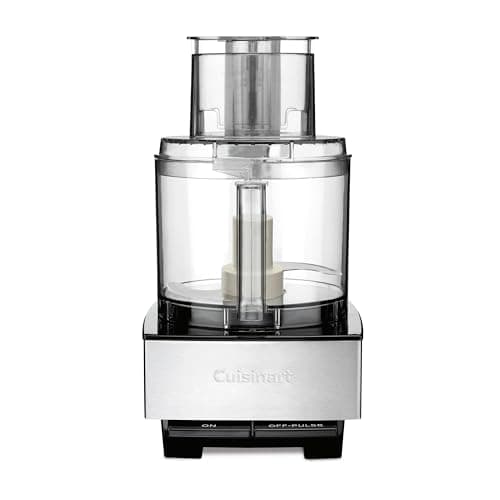
Most full-size kitchens
Cuisinart 14-Cup Food Processor (DFP-14BCNY)
The default full-size processor for a reason: a big, simple, 720-watt workhorse with the shortest parts list to go wrong.
#ad · As an Amazon Associate we earn from qualifying purchases.
Questions
Frequently asked
Does a food processor slice as thin as a mandoline?
Is a mandoline safer than a food processor?
Which is faster for slicing a lot of potatoes?
Do I need both?
Keep reading