Buy a julienne peeler — the Zyliss Julienne Y Peeler — if you want matchsticks occasionally, for a slaw or a garnish, and you want the tool to cost less than lunch and live in a drawer. Buy a mandoline — the OXO Good Grips Chef's Mandoline Slicer 2.0— if you need long, genuinely even sticks in volume and you also want slices. Buy a spiralizer — the OXO Good Grips 3-Blade Tabletop Spiralizer— only if what you actually want is noodles, because that is the one thing the other two cannot make.
Three tools, three different cuts
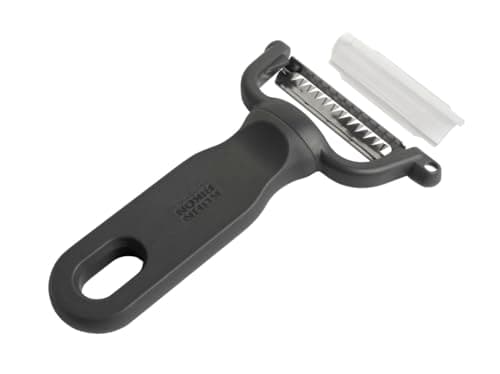
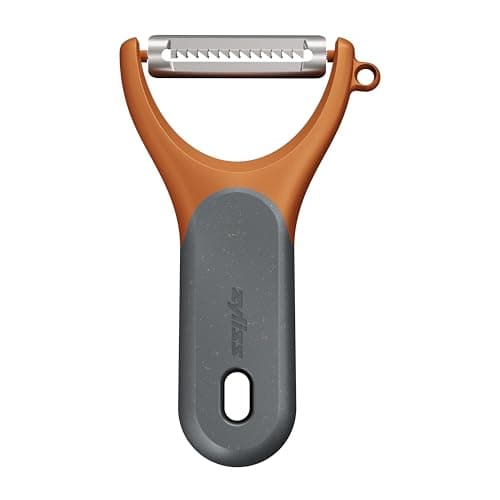
A julienne peeleris a Y-peeler with a toothed blade. You draw it down a vegetable and it takes off a shallow ribbon that the teeth split into strands as it goes. The strands are as long as your stroke and as thick as the teeth, which means they are short, slightly irregular, and come off a few at a time. You are also peeling, so the tool only ever takes the outer layer — there is always a core left over.
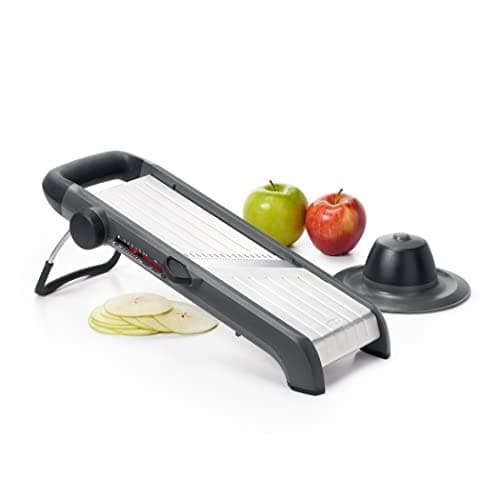
A mandoline is a fixed blade in a frame with a julienne insert. The whole vegetable passes across the blade, so the stick is the full width of the cut and the thickness is whatever the dial is set to. That is the only one of the three that gives truly uniform sticks at any volume, and it is why professional kitchens own them: the OXO Good Grips Chef's Mandoline Slicer 2.0 publishes 21 thickness settings plus julienne and French-fry cuts.
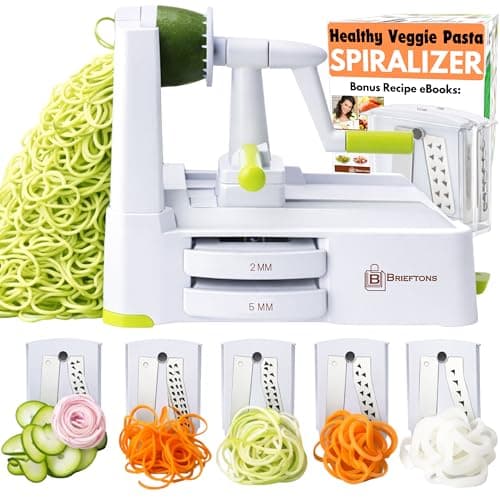
A spiralizer turns the vegetable against a blade so it comes off as one continuous spiral. The output is a noodle, not a stick, and no amount of fiddling will make it into a matchstick. The Brieftons 5-Blade Vegetable Spiralizerpublishes five blades by millimeter — 2 mm angel hair through to a flat ribbon — which is a different axis of choice entirely from thickness on a mandoline dial.
The comparison
| Factor | Julienne peeler | Mandoline | Spiralizer |
|---|
| What comes out | Short matchsticks, slightly uneven | Long uniform sticks, thickness you set | Continuous spiral noodles |
|---|
| Also slices? | Yes — it is still a peeler | Yes, and that is its main job | Ribbon blade only |
|---|
| Volume | A carrot or two before your arm notices | A tray of vegetables | Several, with a crank |
|---|
| Waste left over | A core you cannot peel further | A nub held by the food holder | A core stub on the prongs |
|---|
| Minimum produce size | Anything you can hold | Anything that fits the bed | Firm, at least 1.5 in across on the Brieftons |
|---|
| Storage | A drawer | A cupboard; the OXO folds | A cupboard; it mounts to the counter |
|---|
| How dangerous | Exposed teeth; a cover is the feature to buy for | The most dangerous tool in a home kitchen | Hands stay on a crank, away from the blade |
|---|
| Price class | Lowest | Middle to high | Middle |
|---|
Which one for which job
Carrot and daikon for a salad or a banh mi. Julienne peeler. The strands are short, which is what you want in a slaw, and you are doing one or two vegetables. The Zyliss Julienne Y Peelerships with a safety cover — the feature that matters most on a tool whose teeth are the most finger-hostile edge in the drawer — and states an extra-hardened blade. If you are left-handed, buy the Kuhn Rikon Family Y Julienne Peeler instead: it is the only one here whose listing states right- and left-handed use outright, and it includes both a blade guard and an eye remover.
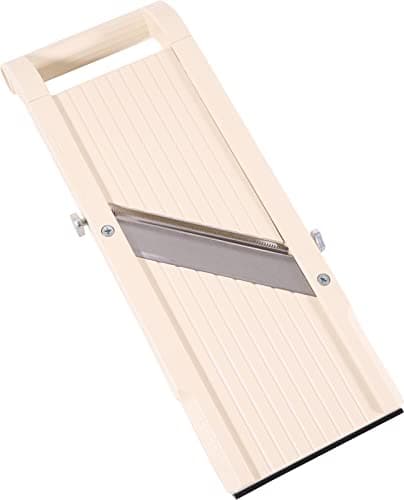
Potato for a gratin, cabbage for slaw, a tray of anything. Mandoline, and nothing else is close. This is a volume and uniformity job and the OXO Good Grips Chef's Mandoline Slicer 2.0 is the one to buy for most kitchens: a stable body, a 21-setting dial and a food holder that works. The Benriner Super Slicer (Japanese Mandoline)is the sharper, flatter professional alternative — a flat blade plus three interchangeable julienne blades — and its own trade-off is published plainly: the included guard is minimal and the blade is unforgiving. Read our mandoline safety guide before you use either, and buy a cut-resistant glove with it.
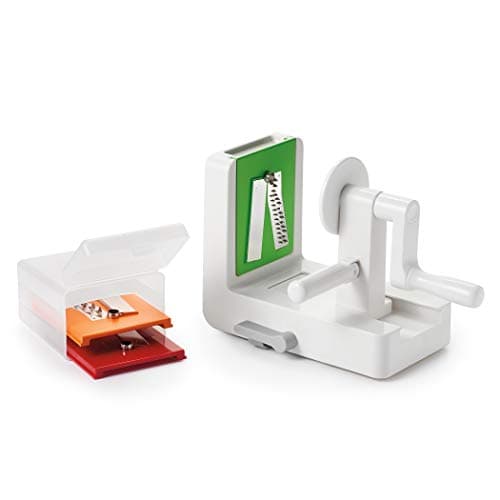
Zucchini noodles, curly sweet potato, anything presented as a nest. Spiralizer. The OXO Good Grips 3-Blade Tabletop Spiralizer is the pick: three blades, a suction-cup base so you can crank hard, and blade storage inside the body. Choose the Brieftons 5-Blade Vegetable Spiralizerif you want the widest cut range — five blades labeled by millimeter, in Japanese 420-grade stainless, with a locking suction lever. Its published limitation is the one to check first: firm produce at least 1.5 inches across, on a hard non-porous counter.
The honest ranking if you own none of them.Buy the julienne peeler first. It costs the least, stores in a drawer, needs no learning and does the job most people actually have. Buy the mandoline second, when you find yourself wanting even slices as much as sticks. Buy the spiralizer only if you specifically want noodles — it is a single-purpose tool and the least versatile of the three, however much counter space it asks for. Our julienne peeler roundup, mandoline hub and spiralizer roundup each rank their own field.
What about a knife, a grater or a food processor?
A knife makes the best julienne of all and it is free; it is simply slow, and the evenness depends entirely on your skill. If you want to learn it, our how to julienne vegetables guide covers the cut itself rather than the tools.
A box grateris not an alternative. Grating shreds and tears; julienning cuts. Grated carrot is wet and limp, matchstick carrot is crisp, and the difference shows in a salad within minutes — mandoline vs box grater is the page for that boundary.
A food processor with a julienne or French-fry disc will do this in volume and is the right answer if you already own one and the quantity is large. It is the wrong answer for one carrot, because you will spend longer washing the bowl than you saved. Our mandoline vs food processor comparison covers where that line sits.
What to look for in each of the three
On a julienne peeler, buy for the cover. The teeth on a julienne blade are the nastiest edge most kitchens contain, and they go in the same drawer as your hands and your sponge. Both of the peelers here publish one; the Zyliss Julienne Y Peeler is the cheapest julienne peeler we rank that ships with one. Second priority is an integrated eye remover, which both of these have, because it stops the tool needing a paring knife alongside it.
On a mandoline, buy for the guard and the dial. A food holder you will actually use is worth more than a sharper blade, because the sharpest mandoline in the world is only useful while your fingertips are intact. Then look at how the thickness is set: a dial with a published number of settings is repeatable, where a sprung plate is a guess. The OXO publishes 21 settings; the Benriner uses a screw-set dial.
On a spiralizer, buy for the mount.Everything about a tabletop spiralizer depends on it not moving, which is why both picks here publish suction bases and why the Brieftons’ own listing warns that a textured or porous counter defeats it. Check your counter before you check the blade count.
In all three, check the care instruction and believe the stricter one.The Zyliss says dishwasher safe and then recommends hand washing to keep it sharp — take the second instruction. The Kuhn Rikon makes no dishwasher claim at all, so plan on washing it by hand. The Brieftons publishes top-rack dishwasher safe. These are small things that decide whether a tool stays sharp for two years or six months.
What not to pay for: blade count on its own. Five spiralizer blades is genuinely useful if you cook from recipes that specify noodle width; three is plenty otherwise, and every extra insert is another small sharp object to store. The same applies to mandoline inserts.