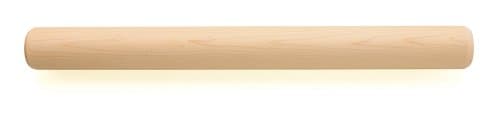
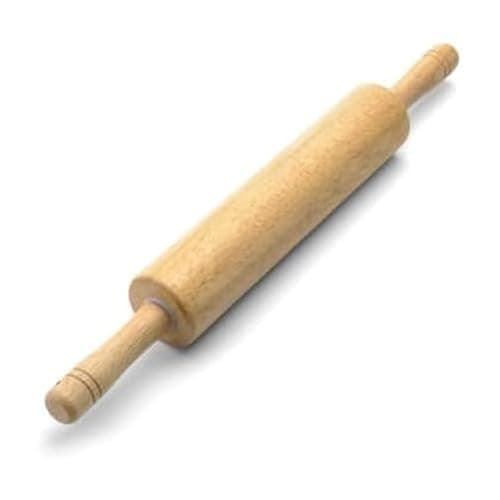
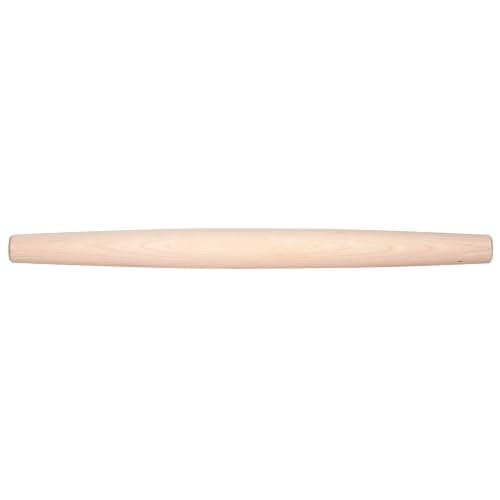
For pie and pastry, buy the J.K. Adams French Tapered Rolling Pin (FRP-1-AM): a tapered maple dowel that publishes both of the numbers that matter — 20.5 inches long and 1.75 inches across — and pivots on the counter, so you can turn a round of dough without ever lifting it. For bread and pasta, where you want full barrel width in every direction and no taper, the Fletchers' Mill Bakery Rolling Pin, Maple 18.5-Inch (BAKRP12) is the pick, and it is the only pin here that names its wood species rather than saying hardwood. The budget pick is the Farberware Classic Wood Rolling Pin, 18-Inch (5215807), the cheapest handled pin in this group that is straight with you about how much of its 18 inches actually rolls.
Prices above come live from Amazon with the date they were last checked. We print no number we cannot verify, so a blank price means check rather than a stale figure.
Read the barrel, not the box.An “18-inch rolling pin” usually means the whole tool with handles, and the handles do not roll dough. Farberware is unusually honest here: 18 inches overall with a stated 10-inch barrel. That is the width of dough you can cover in one pass, and it is the only figure worth comparing across pins — when a maker publishes it at all.
Why buy wood at all
There are three competing answers in a rolling pin and only one of them is wood. Steel is non-stick and can be chilled. Marble is heavy and stays cold on its own. Wood does neither of those things especially well, and it is still what most bakers reach for, for two reasons that are easy to state and hard to design around.
First, flour sticks to wood in a way it does not stick to a polished surface. A lightly floured wooden barrel carries a thin dry film that sits between the pin and the dough. On steel, the flour tends to slide off and collect at the edges, which is why a steel pin is usually sold with the instruction to chill it instead.
Second, wood tells you what it is doing. A wooden pin transmits the resistance of the dough to your hands: you can feel a cold lump of butter, a dry patch or a spot you have worked too thin. That feedback is the reason a French pin is a technique tool rather than a gimmick, and it is why professional pastry kitchens are full of plain wooden dowels.
The price is maintenance. Every pin on this page is hand wash, and two of the three ask for periodic food-grade mineral oil. Fletchers’ Mill is the strictest: damp cloth only, no submerging, no dishwasher. If that sounds like a chore you will not do, buy the steel or marble pin from our main rolling pin ranking instead and spend the difference on butter.
Three shapes, and they do not do the same job
A French (tapered) pin is one piece of wood, thickest in the middle and narrowing toward both ends, with no handles and no axle. You drive it with the flats of your palms. Because the ends are narrow it pivots in place, so you can swing it around a round of pie dough and roll outward in every direction without picking the dough up. That is why pastry cooks use them, and also why the first twenty minutes with one feels wrong if you grew up with handles.
A straight dowel— the bakery pin — is a plain cylinder: no taper, no handles. It gives you the full barrel width everywhere, which is exactly what a sheet of pasta or a slab of bread dough wants, and it gives you no mechanical help at all. Fletchers’ Mill makes the case for a thick barrel rather than a slim one: more dough covered per rotation and a straighter track.
A handled pinis a barrel on an axle between two grips. The dough sees a fixed-width cylinder and you get leverage — you can lean on it, and the motion is the one almost everybody already knows. The trade is that it cannot pivot, so a round crust has to be rotated by hand, and the barrel is always shorter than the tool.
Species, and why “hardwood” is not an answer
Two of these three pins name their wood. J.K. Adams states maple, crafted in Vermont. Fletchers’ Mill states solid rock maple, handcrafted in Maine from New England hardwoods. Rock maple — sugar maple — is dense and close-grained, which is what you want in a tool that gets wiped down wet and then dried a thousand times: fewer open pores to hold moisture, less movement across the grain, a surface that stays smooth.
Farberware says “moisture-resistant hardwood” and names no species, which means the density and the grain you are buying are unknown. That is not a disqualification at this price and we have not treated it as one, but it is the honest difference between the cheap pin and the two that cost three times as much, and it is more informative than any adjective in the listing.
None of the three publishes a warranty term. In a category where the failure mode is a barrel that cracks along the grain after years of damp wiping, that absence is worth noticing on all three equally.
Which one, for which baker
Buy the J.K. Adams French Tapered Rolling Pin (FRP-1-AM) if you make pie. The pivot is the whole argument: a 12-inch round of chilled butter pastry wants to be turned, not lifted, and a tapered pin turns it. At 20.5 inches it is the longest barrel here, so a full crust is one pass rather than three overlapping ones, and every overlap is a place the thickness can step. The costs are real: no handles means all the downward force comes from your palms, and it wants hand washing plus regular mineral oil.
Buy the Fletchers' Mill Bakery Rolling Pin, Maple 18.5-Inch (BAKRP12)if you roll bread, pasta or anything rectangular. A thick straight barrel tracks straight and covers more dough per rotation, and Fletchers’ Mill publishes the diameter as well as the length, which is the figure that actually decides how a pin behaves. The limits: the strictest care instruction on the page, and a shape that gives you neither the pivot of a French pin nor the leverage of handles.
Buy the Farberware Classic Wood Rolling Pin, 18-Inch (5215807)— the budget pick — if you want the familiar handled motion and you bake a few times a year. It is the cheapest honest version of that design, it separates the barrel figure from the overall length, and its care is ordinary: wipe it, oil it occasionally, do not soak it. The ten-inch barrel is the real constraint — a large pie round needs two passes — and the species is not named.
Care, in four lines
- Never put a wooden pin in the dishwasher. Heat and prolonged water open the grain, and on a glued handle assembly they attack the joint. Every maker on this page says so in its own words.
- Do not soak it. Scrape the dough off with a bench scraper, wipe with a barely damp cloth, dry it immediately.
- Oil it when it looks dry. Food-grade mineral oil, thin coat, wiped off after a few minutes. J.K. Adams and Farberware both ask for this; it takes a minute and it is the single thing that extends the life of the tool.
- Store it flat and dry. Not in a damp drawer against a metal tool. A pin that has been stored on a wet counter overnight is the one that cracks.
What a wooden pin will not do
It will not stay cold. If your kitchen is warm and your dough is butter-heavy, the pin warms up with everything else and the butter starts to smear rather than laminate — which is the case for marble or for the chillable steel pin on our main ranking. It will not guarantee an even thickness either; nothing on this page has rings or gauges, and if even thickness is your actual problem the adjustable pin on that same page is the honest answer. And it is not a pastry blender: cutting cold butter into flour is a different tool and a different motion, covered on our pastry blender ranking.