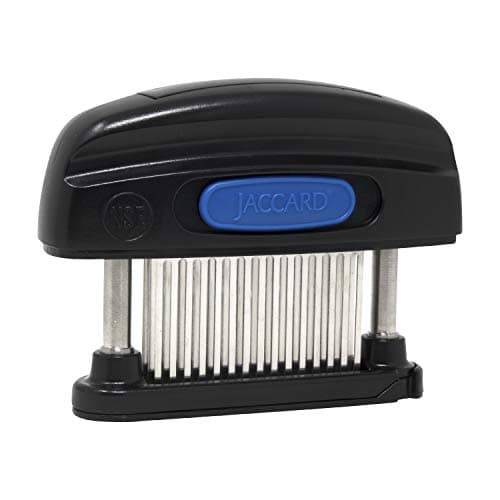
A mallet makes meat thinner. The Jaccard 45-Blade Meat Tenderizer (200345NS) does something different: 45 double-sided stainless blades drop through the muscle and sever the connective tissue that makes a cheap cut chew like a belt, and the steak keeps its shape and thickness while they do it. For chuck, round, flank, skirt and supermarket “value” packs, that is the single biggest improvement a ten-dollar-a-pound cut can get. It is also the reason this tool carries a rule no mallet does, and the rule is worth more of your attention than the marketing is.
Blade tenderizing moves the outside of the meat to the inside. Bacteria live on the surface of an intact cut, which is why a steak can be served rare. Forty-five blades carry some of that surface down into the center. USDA’s Food Safety and Inspection Service treats commercially needle- or blade-tenderized beef as its own labeled product class for exactly this reason: the label must say mechanically tenderized and must carry validated cooking instructions. At home there is no label — you are the label.
What it is, and what it actually does
Jaccard’s own description is unusually literal: a hand-held tenderizer with 45 double-sided razor-sharp stainless steel knives on stainless steel columns, mounted in a removable cartridge, NSF approved, and backed by a lifetime warranty against material and workmanship defects. Jaccard invented this category, and the tool in most restaurant kitchens is either this one or a direct copy of it.
Mechanically, tenderness in a cheap cut is mostly a collagen problem. Hard-working muscles — shoulder, leg, flank — are threaded with sheets of connective tissue that do not break down in the few minutes a steak spends in a pan. You have three ways out: cook it low and slow for hours so the collagen gelatinizes, slice it very thin across the grain, or cut the sheets into short segments before cooking so they cannot hold the meat together. A blade tenderizer is the third option, and it is the only one that lets you cook a cheap cut fast and hot like an expensive one.
The part that surprises people is what the meat looks like afterward: almost unchanged. A mallet flattens, spreads and tears a steak into something visibly pounded, and that is both its purpose and its cost. The Jaccard leaves the cut the same thickness, which means it still sears, still rests properly and still looks like a steak on the plate — and crucially, it stays thick enough to take a crust while the inside is where you want it.
How to use it without ruining the cut
The motion is straight down and straight up, with the meat flat on a board, and that is the entire technique. The three things that go wrong are all pressure and angle.
Do not rock it. Forty-five thin blades go in cleanly on a vertical stroke; tilt the head and you are levering them sideways, which both shreds the meat and is how a blade gets bent.
Do not over-pass it. One or two passes across the surface in a grid is enough for most steaks. Go back over the same square inch repeatedly and the muscle fibers stop being cut and start being minced — the meat goes mushy when it cooks and loses juice through the channels you made. Thin cuts need fewer passes than thick ones, not more.
Use a board you are willing to sacrifice slightly. The blades pass all the way through a thin cut and into whatever is underneath. A plastic or composite board is the right surface here, kept for raw meat, which is the standard advice anyway; stone, glass and ceramic will damage the blades.
Jaccard also states that the blades provide a pathway for marinade to penetrate deeper than it otherwise would, and that is mechanically obvious — you have made several hundred channels into the interior. Two caveats worth knowing: marinade entering the meat also means salt entering the meat, so a salty marinade will season the inside much more strongly than usual and a short marinade goes further than it used to. And anything you marinate after tenderizing has had its surface carried inward first, which is the food-safety point again rather than a separate one.
The marketing numbers, and why this page does not repeat them
Jaccard’s listing claims the tool “reduces cooking time by up to 40%” and increases marinade absorption “by up to 600%”. Both are presented with no method, no cut, no thickness and no reference behind them. The direction of both claims is plausible — severed connective tissue cooks through faster, and channels admit more liquid — but “up to 40%” against an unstated baseline is not a specification, and we are not going to print it as though it were. If you buy this tool expecting a stopwatch result, you are buying a number nobody has shown you the basis for.
What is verifiable on the listing is the hardware: 45 double-sided blades, stainless columns, a removable cartridge, NSF approval and a lifetime warranty. Those are the reasons to buy it.
What NSF approval actually certifies
NSF certification is a commercial-kitchen standard, and the food-equipment standard behind it — NSF/ANSI 2 — sets minimum requirements for the materials, design, fabrication, construction and performance of food handling equipment. Among the things it weighs are the smoothness of angles and corners in the food zone and the cleanability of the equipment’s components. On a tool whose entire working surface is forty-five narrow gaps that go into raw meat, that is the most relevant certification there could be, and it is the only certification any tool in our meat tenderizer roundup claims.
It is also the practical reason the removable cartridge matters more than it sounds. The part that goes into the meat comes out of the handle, so you are washing a comb of blades rather than trying to flush a sealed assembly.
Cleaning it — the question everyone asks second
Jaccard makes no dishwasher claim on this listing, and that absence is the honest headline. Our standing advice for this tool is therefore hand washing, immediately, with the cartridge out:
Wash it before the proteins dry. Meat residue in a 45-blade comb turns to glue within an hour and then needs soaking, which is exactly what you do not want to do with a bladed tool sitting invisible at the bottom of a sink full of water. Separate the cartridge from the handle first, run hot soapy water through the blade comb from the top so the water pushes residue out the way it went in, and use a brush — never a cloth or a sponge you are holding in your fingers, because these blades are described as razor-sharp and they are. Air dry it standing up so water drains out of the columns rather than sitting in them, and store it where a hand will not go into it. The listing describes no cover or blade lock, which is the one meaningful design gap against the OXO bladed tenderizer, whose toggle holds the blades retracted in a drawer.
The cooking rule that comes with it
This is the part a product page will not tell you. Whole, intact cuts of beef can be cooked rare because any contamination is on the outside, where the heat is most intense. Once you have driven blades through the cut, you no longer have an intact cut, and the interior has to be treated like the inside of ground beef or a marinade-injected roast.
USDA FSIS regulations require raw or partially cooked needle- or blade-tenderized beef sold at retail to carry the descriptive designation “mechanically tenderized” along with validated cooking instructions — the agency restated both requirements in a September 2026 Federal Register notice. The general USDA safe-minimum guidance for beef steaks, chops and roasts is 145°F with at least a 3-minute rest, measured with a thermometer in the thickest part. The practical home rule follows from both: if you Jaccard a steak, thermometer it, hit at least that temperature and give it the rest — and do not serve it blue. If someone eating it is pregnant, elderly, very young or immune-compromised, cook it further.
None of this is a reason not to own the tool. It is a reason to own it deliberately: the whole point is to make cheap, hard-working cuts worth cooking, and those cuts are rarely the ones you wanted rare anyway.
Who should not buy one
If you mostly cook tender cuts, this does nothing for you. Ribeye, strip, tenderloin and anything already marbled does not need its connective tissue cut, and piercing it just opens channels for juice to leave through.
If you want a dishwasher tool, buy something else — Jaccard claims no dishwasher safety here, and a bladed comb is the last thing to leave to chance.
If you need the meat thinner, not tenderer, this is the wrong tool entirely: a flat mallet or a scallopine pounder spreads a cutlet, and no blade tool does. The meat tenderizer roundup ranks both families side by side for exactly that reason.
If children or guests go into the drawer, weigh the missing blade cover seriously. Forty-five exposed razor-sharp columns in a kitchen drawer is a real hazard, and the cheaper OXO bladed tenderizer solves it with a lock.
Where this fits next to a grinder
There is a cheaper, older answer to a tough cut: stop serving it as a steak. Ground chuck is tender by definition because grinding does what the Jaccard does, only completely, and a home meat grinder turns the same cheap primal into burger, sausage and chili meat. If what you are processing is game rather than supermarket beef, the calculus changes again — grinding venison is the normal route for most of the animal, with the Jaccard earning its place on the few cuts you want to keep whole. And if you do not own a grinder, a food processor will grind meat within limits that the comparison sets out honestly.
The verdict
This is the blade tenderizer to buy, and the reasons are all documented rather than claimed: 45 double-sided blades, a cartridge that comes out so the part that touches raw meat can be cleaned properly, NSF approval — the only certification in the category — and a lifetime warranty on materials and workmanship. It does the job better than any mallet can and it does it without destroying the shape of the cut.
Buy it for chuck, round, flank, skirt and cheap steak packs, and buy it knowing two things: Jaccard’s 40% and 600% figures have no published basis, and the tool changes the cooking rule for the meat. Use a thermometer afterward and it is the best ten minutes of prep a cheap cut will ever get.
Is it worth it?
Yes, if you buy cheap cuts on purpose. Chuck, round, flank and skirt are where this earns its money, and it earns it on the first steak.
Yes, if you cook hot and fast. Cutting the connective tissue is what makes a hard-working cut survive a pan or a grill instead of needing three hours in an oven.
No, if your steak is already tender. On marbled cuts it opens juice channels and buys you nothing.
No, if you want it thinner. That is a mallet’s job and this tool deliberately does not do it.
What it costs, and what the money buys
It sits at the upper end of hand tenderizers — more than a plain mallet, less than a cheap kitchen gadget habit. What the premium buys over the budget blade tools is the removable cartridge, NSF approval and a lifetime warranty rather than a stated number of years. What it does not buy is a blade cover, which the cheaper OXO has.
What we are not claiming
We have not tenderized meat with this tool. The blade count, column material, removable cartridge, NSF approval and lifetime warranty above are Jaccard’s own published wording on the listing the buy button points at, cited below. Jaccard’s “up to 40%” cooking-time and “up to 600%” marinade-absorption claims are reported as marketing, not specification, because no basis is published for either. The food-safety guidance is USDA’s, cited to the Federal Register and to FSIS’s own temperature chart, not ours. The price comes live from Amazon with the date attached.